
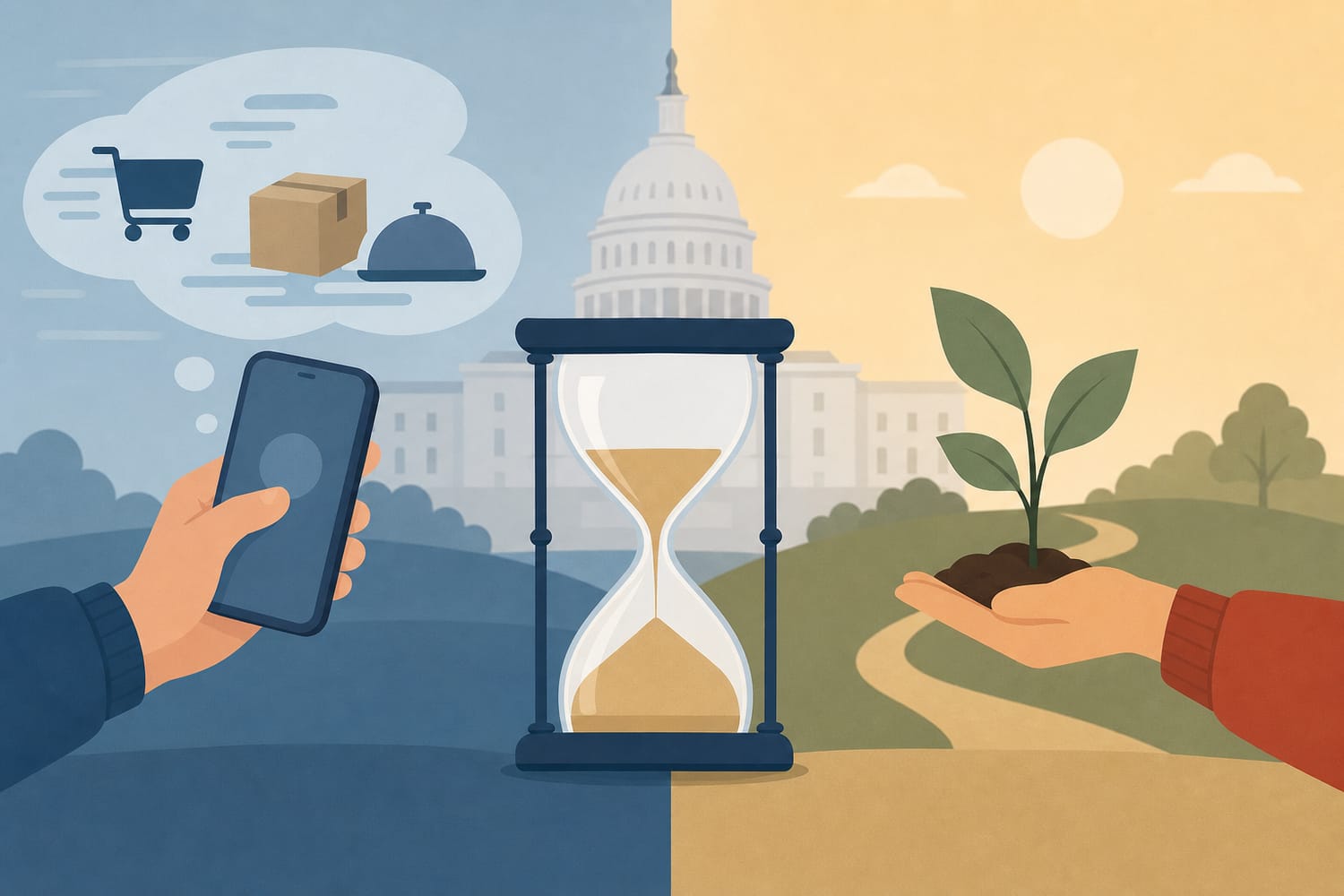
Instant gratification has become a defining feature of modern life. Food, entertainment, purchases, transportation, information, and communication can often be accessed within minutes. Supporters view this convenience as progress that saves time and expands opportunity. Critics argue that constant immediacy may weaken patience, self-control, and resilience. The debate is not simply about whether convenience is good or bad, but about how it shapes expectations, habits, and human behavior.
The Case for Modern Convenience
Advocates of convenience argue that reducing unnecessary delays allows people to use their time more productively. Online banking eliminates trips to a branch, delivery services assist people with limited mobility, and digital communication connects families across long distances. Search engines and educational platforms provide rapid access to information that once required hours in a library.
From this perspective, waiting is not automatically valuable. Standing in line, completing repetitive paperwork, or traveling to obtain a basic service does not necessarily build character. Removing these obstacles can make daily life more efficient and accessible, particularly for caregivers, people with disabilities, rural residents, and workers with demanding schedules.
Convenience can also create room for more meaningful forms of effort. A person who automates household payments may have more time to exercise, study, care for family members, or develop professional skills. Immediate access to tools and information can help entrepreneurs test ideas, students receive feedback, and patients connect with healthcare providers.
Supporters therefore reject the assumption that faster services inevitably make people lazy or impatient. They argue that technology does not eliminate effort; it changes where effort is directed.
Why Critics Are Concerned
Critics focus less on individual conveniences and more on their cumulative effect. When nearly everything is designed to arrive quickly, normal delays may begin to feel unreasonable. A slow webpage, unanswered message, difficult book, or long-term project can become unusually frustrating when compared with the speed of digital rewards.
Many online platforms offer immediate and repeated stimulation through notifications, short videos, likes, recommendations, and continuously refreshed content. The broader debate about social media’s impact on society reflects concerns that technologies designed for connection can also influence attention, expectations, and emotional habits.
Critics argue that this environment may encourage people to abandon activities that do not provide quick results. Learning an instrument, building a career, maintaining relationships, saving money, and improving physical health usually require repetition with little immediate reward. If discomfort or boredom always leads to an instant alternative, people may receive fewer opportunities to practice persistence.
This does not prove that technology directly destroys patience. A review of research on smartphones and cognition found that evidence concerning attention, memory, and delayed gratification was still developing rather than supporting simple, universal conclusions. Still, critics believe the available concerns justify greater caution.
Patience, Resilience, and Delayed Rewards
Patience involves tolerating delay without reacting impulsively, while resilience involves adapting to difficulty and recovering from setbacks. The two qualities often overlap because meaningful goals rarely proceed without frustration.
Psychological discussions of delayed gratification commonly describe a choice between a smaller reward now and a larger reward later. Research highlighted by the Association for Psychological Science suggests that people tend to discount future rewards and that emotional states such as gratitude may sometimes increase patience.
Critics of instant gratification see everyday waiting as a form of practice. Saving before making a purchase, finishing a difficult assignment, or continuing after an unsuccessful attempt can strengthen tolerance for discomfort. Without such experiences, they argue, setbacks may feel not only unpleasant but unacceptable.
Others caution against treating patience as an entirely personal virtue. Research suggests that abandoning a delayed reward can be a rational response when its timing or reliability is uncertain. Someone who has learned that promises are frequently broken may reasonably prefer a smaller, dependable benefit now. This view shifts part of the debate from individual discipline to trust, economic security, and social conditions.
Are Businesses Designing for Impatience?
Another side of the debate concerns commercial incentives. Many companies benefit when consumers act quickly. One-click purchasing, limited-time offers, personalized recommendations, and instant credit can reduce the pause during which a person might reconsider a decision.
Critics say these systems do more than satisfy existing demand. They may actively cultivate urgency by making reflection feel like a missed opportunity. The result can be impulsive spending, excessive consumption, or repeated engagement with content that offers quick emotional rewards.
Businesses respond that consumers genuinely value speed and simplicity. A streamlined checkout process is not necessarily manipulation, just as same-day delivery is not inherently harmful. Companies also compete in markets where customers may abandon services that are confusing or inefficient.
The central disagreement is therefore about responsibility. Should individuals be expected to control their own habits, or should platforms be responsible for designs that exploit predictable patterns of impulsive behavior? Most positions fall somewhere between complete personal responsibility and strict regulation.
Generational and Educational Perspectives
Concerns about instant gratification are often directed toward children and younger adults, who have grown up with on-demand media and rapid digital feedback. Some parents and educators worry that students may become less willing to struggle with complex material when summaries, solutions, and entertainment are instantly available.
Artificial intelligence has intensified this discussion. The debate over AI in everyday life includes both enthusiasm for greater efficiency and concern about relying on tools that can provide immediate answers without requiring the user to work through a problem.
Supporters of educational technology argue that quick feedback can improve motivation. A student who immediately sees why an answer is wrong can adjust before repeating the mistake. Digital tools can also support learners who need translation, accessibility features, personalized explanations, or flexible schedules.
Critics distinguish between tools that assist learning and tools that replace it. Receiving an answer instantly is not equivalent to understanding the reasoning behind it. However, blaming younger generations alone may be unfair. Adults created, marketed, purchased, and normalized the same systems, while earlier generations also adopted technologies that reduced effort and waiting.
Finding a Balance
The debate does not require a choice between rejecting convenience and accepting every form of immediacy. A balanced approach distinguishes between delays that serve no purpose and challenges that help develop valuable capabilities.
Useful habits may include:
- Creating a waiting period before nonessential purchases
- Turning off unnecessary notifications
- Completing difficult tasks before opening entertainment apps
- Practicing hobbies in which improvement is gradual
- Allowing children to experience manageable boredom and frustration
- Using AI and digital tools to support reasoning rather than replace it
These practices are not arguments for making life deliberately inefficient. Instead, they preserve opportunities to exercise judgment, persistence, and self-control while retaining the benefits of technology.
Convenience Without Dependence
Instant gratification can be both a modern convenience and a potential threat to patience. Its value depends on what is made faster, what is lost in the process, and whether people still retain the ability to tolerate delay when delay is necessary.
Convenience can remove barriers, increase accessibility, and free time for worthwhile pursuits. At the same time, environments built around constant stimulation and immediate rewards may make slower activities feel less tolerable. Patience should not be romanticized when waiting is pointless or unfair, but neither should every moment of discomfort be engineered away.
The most productive question may not be whether society should embrace or reject instant gratification. It may be whether individuals, families, businesses, and institutions can use convenience intentionally—saving time where speed improves life while protecting the patience and resilience needed for goals that cannot be rushed.