
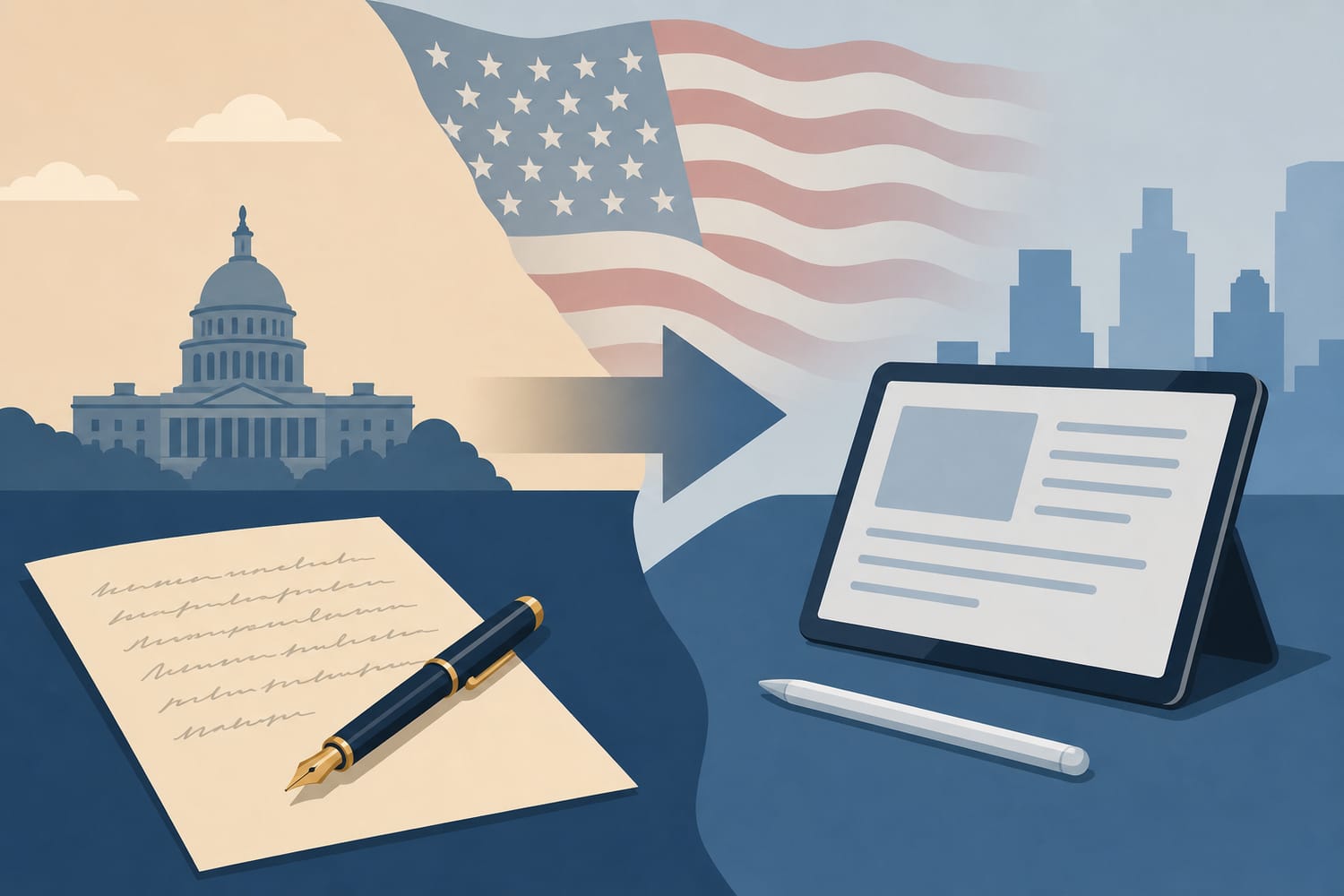
Handwriting is undeniably becoming less central to everyday communication, but whether that decline is harmful remains contested. Supporters of handwriting see it as a cognitive, practical, and cultural skill that technology cannot fully replace. Others view typing, touchscreens, and voice tools as natural improvements that make writing faster, more accessible, and better suited to modern life.
Why Handwriting Is Declining
For most people, digital writing is now more convenient. Emails have replaced many letters, online forms have replaced paper applications, and smartphones handle everything from shopping lists to personal messages. Schools and workplaces increasingly expect documents to be typed, searchable, shareable, and easily edited.
This transition is part of the broader debate over technology’s role in education. Students need digital literacy to participate in higher education and the workplace, so time spent teaching handwriting must compete with keyboarding, coding, media literacy, and other priorities.
Some critics describe this change as a decline because handwriting quality and fluency may deteriorate without regular practice. Others consider it a shift in communication methods, comparable to the movement from handwritten manuscripts to printing presses and typewriters.
The Case for Handwriting as an Essential Skill
Supporters argue that handwriting is more than a slower way to produce text. Forming letters requires coordination among visual attention, memory, language, and fine motor movement. This combination may help young children develop stronger mental representations of letters and connect written symbols with their sounds.
In an experimental study of handwriting and literacy learning, adults learning Arabic characters by hand became proficient more quickly than participants who learned through typing or visual observation. However, individual studies do not prove that handwriting is always superior in every subject, age group, or learning situation.
Handwriting advocates also emphasize note-taking. Because writing by hand is relatively slow, students must often summarize, select important points, and reorganize information rather than record every word. That extra processing may support understanding. Yet the benefit could come from the note-taking strategy rather than the pen itself: a disciplined typist can also summarize instead of transcribing.
Practical independence is another concern. People may still need to complete forms, label objects, leave emergency notes, write cards, or sign documents when devices are unavailable. From this perspective, basic legible handwriting remains a foundational life skill even if elegant penmanship does not.
The Case for Harmless Evolution
The opposing view begins with a simple observation: communication tools have always changed. Few people consider the loss of typewriter maintenance skills a social crisis, because computers perform the same basic task more effectively. If typing allows people to communicate faster and more clearly, declining handwriting may represent adaptation rather than deterioration.
Typed text offers several advantages:
- It can be edited, copied, searched, translated, and shared quickly.
- It remains legible regardless of the writer’s penmanship.
- Cloud storage makes documents available across different locations and devices.
- Digital collaboration allows several people to work on the same text.
- Spellcheck, dictionaries, and formatting tools can support clearer communication.
Typing may also reduce the mental effort required to form letters. For an experienced keyboard user, ideas can flow rapidly without the writer concentrating on pencil grip, spacing, or letter shape. Supporters therefore argue that digital writing can free attention for reasoning, organization, and revision.
Modern schools must also prepare students for environments in which assignments, applications, tests, and professional documents are frequently digital. The wider question of whether technology could transform traditional teaching reflects the same tension: education must preserve valuable established practices without ignoring the tools students will actually use.
What Should Schools Teach?
Much of the debate focuses not on whether handwriting has value, but on how much classroom time it deserves. Strong supporters favor explicit instruction and regular practice, sometimes including cursive. They worry that occasional handwriting assignments are insufficient for children to develop automatic, comfortable letter formation.
Critics respond that instructional time is limited. They may support teaching basic printing while questioning whether students need extensive penmanship lessons or mastery of traditional cursive. In their view, keyboard fluency deserves equal or greater attention because it is essential for academic research, workplace communication, and participation in digital society.
Age may matter. Handwriting could be especially important when children are first learning letters, while typing becomes increasingly useful as they begin producing longer and more complex work. This suggests that the choice need not be permanent: educational priorities can change as students develop.
Assessment also complicates the issue. A handwritten exam may measure knowledge alongside writing speed and physical endurance. A typed exam may introduce distractions, unequal keyboarding ability, or access to digital assistance. Neither format is automatically neutral.
Accessibility and Individual Differences
Arguments that treat one writing method as universally superior can overlook disability and learning differences. Some people experience dysgraphia, pain, impaired coordination, or other difficulties that make handwriting unusually slow and exhausting. For them, typing, word prediction, or speech-to-text may provide access to communication rather than an easy shortcut.
Expert-reviewed guidance on classroom accommodations for dysgraphia includes laptops, audio recording, scribes, alternative response formats, and speech-to-text. It also recommends supports such as specialized paper, adapted writing tools, and extra time, demonstrating that handwriting instruction and assistive technology can coexist.
At the same time, not everyone finds typing easier. Young students, people without regular device access, and individuals unfamiliar with keyboards may express themselves more comfortably on paper. A fair approach therefore considers the writer, purpose, and context rather than enforcing one method in every situation.
The Cultural and Personal Dimension
Handwriting also carries meanings that cannot be measured only through speed or test performance. A handwritten letter, family recipe, journal, or signature can feel personal because it contains visible traces of the writer. Historical documents allow readers to encounter not only someone’s words but also their physical marks.
Skeptics caution against confusing emotional attachment with necessity. People can communicate affection through a carefully composed email, preserve memories digitally, or create individuality through visual design. Cultural practices regularly evolve, and losing their everyday dominance does not mean they disappear entirely.
The disagreement is partly about values. One side emphasizes efficiency and accessibility; the other emphasizes physical experience, individuality, and continuity with the past.
A Balanced Future for Writing
A practical compromise is to treat handwriting and digital composition as complementary skills. Students can learn to write legibly and comfortably without being required to achieve decorative perfection. They can also receive structured keyboarding instruction rather than being expected to acquire digital fluency on their own.
Different tools may suit different purposes. Handwriting can be useful for early letter learning, diagrams, brainstorming, personal reflection, and quick notes. Typing is generally better for long documents, collaborative projects, extensive revision, and searchable records. Speech-to-text can help with accessibility or rapid drafting.
The decline of handwriting is therefore neither entirely harmless nor necessarily catastrophic. Losing all functional ability could create practical and educational limitations, but preserving handwriting does not require resisting digital progress. The central challenge is deciding what level of competence people need—and ensuring that efficiency does not eliminate a valuable option before its benefits are fully understood.