
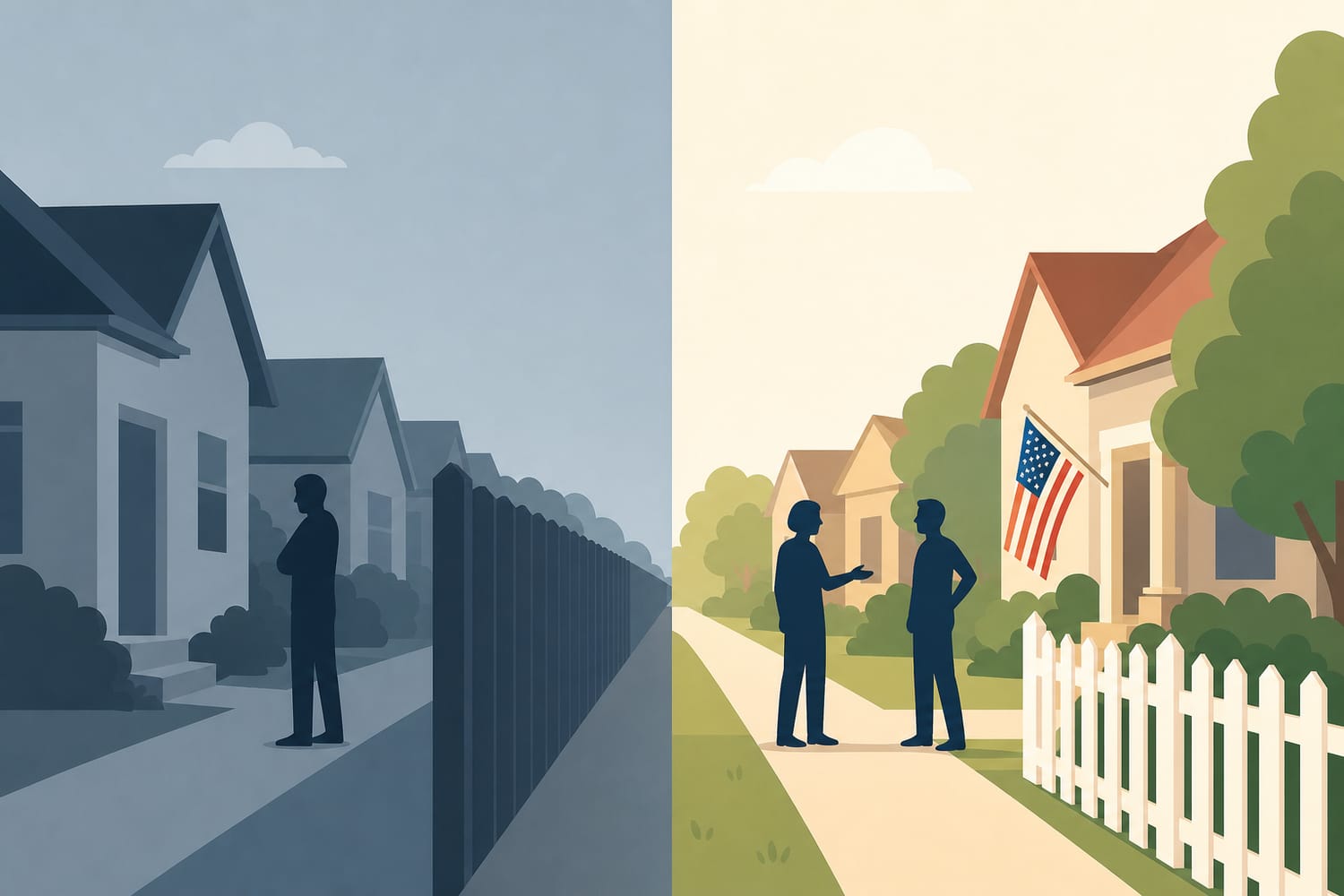
A Question That Feels Personal
For many Americans, the idea of being a “good neighbor” brings to mind a familiar set of images: borrowing a cup of sugar, helping shovel a driveway, watching someone’s child for a few minutes, or checking in on an elderly resident down the street. These gestures are often associated with a sense of community that feels warmer, slower, and more personal than daily life today.
At the same time, the question of whether Americans are losing the art of neighborliness is not simple. Some people believe neighborly bonds have clearly declined, weakened by technology, busier schedules, political division, and a culture of privacy. Others argue that neighborliness has not disappeared but changed form, moving into digital spaces, mutual aid networks, and more selective communities. Still others question whether the past was ever as neighborly as people remember, pointing out that traditional neighborhoods could also be exclusionary, judgmental, or unsafe for many residents.
The debate is less about whether people care about others and more about how Americans define community, responsibility, and connection in modern life.
The View That Neighborliness Is Declining
One common argument is that Americans are less connected to the people physically closest to them than they once were. Supporters of this view often point to declining participation in local organizations, fewer casual conversations with neighbors, and the growing tendency to treat home as a private retreat rather than part of a shared community.
In this view, neighborhood life has become more isolated. People may live next door to one another for years without knowing each other’s names. Garage doors open and close automatically, online shopping replaces trips to local stores, and entertainment happens through personal screens rather than shared public spaces. Even in densely populated areas, residents may feel surrounded by strangers rather than members of a community.
Those who worry about this decline often connect it to broader social trends. Longer work hours, commuting, economic stress, and family obligations leave many people with little time or energy for casual neighborhood relationships. In households where both adults work, evenings and weekends may be consumed by errands, children’s activities, or recovery from the workweek. Neighborliness can begin to feel like another obligation rather than a natural part of daily life.
This side of the debate often argues that the loss matters because neighborhoods are one of the basic building blocks of civic trust. If people do not know or trust those who live near them, they may be less likely to help during emergencies, cooperate on local problems, or feel invested in the well-being of their community.
The Role of Technology and Digital Life
Technology is often blamed for weakening face-to-face neighborliness. Critics argue that smartphones, social media, streaming platforms, and remote work have changed how people spend their attention. Instead of chatting on front porches or meeting at local events, people may be communicating with friends, coworkers, or interest groups who live far away.
From this perspective, technology creates connection at a distance while reducing connection nearby. A person may know intimate details about someone across the country but not recognize the family living across the street. Online convenience can also reduce the everyday interactions that once helped build familiarity. Grocery delivery, online banking, remote meetings, and digital entertainment can make it possible to live efficiently without much contact with the surrounding community.
However, others argue that technology is not necessarily the enemy of neighborliness. Many neighborhoods use group chats, Facebook groups, Nextdoor, text chains, and community apps to share information, organize events, warn about safety concerns, locate lost pets, or coordinate help after storms. In some places, digital tools have made it easier for people to connect with neighbors they might not otherwise meet.
The disagreement, then, is not just about technology itself but about how it is used. Some see it as replacing real community; others see it as a new tool for building one.
Privacy, Boundaries, and Changing Expectations
Another important side of the debate focuses on privacy. Some Americans may not want the kind of neighborly involvement that previous generations considered normal. For them, being a good neighbor means being respectful, quiet, and nonintrusive rather than socially involved.
This view suggests that modern neighborliness may look less like dropping by unannounced and more like respecting boundaries. Many people value privacy in their homes and may feel uncomfortable with neighbors who expect frequent interaction. Apartment dwellers, renters, young professionals, and families with demanding schedules may prefer friendly distance over close involvement.
Supporters of this perspective might argue that not everyone wants a tight-knit neighborhood, and that this does not automatically indicate moral decline. A person can be considerate, helpful in emergencies, and respectful of shared spaces without wanting deep personal relationships with nearby residents.
On the other hand, critics worry that too much emphasis on privacy can lead to indifference. If everyone keeps to themselves, vulnerable people may go unnoticed. Elderly neighbors, single parents, people with disabilities, or families facing hardship may lack informal support. The challenge is finding a balance between respecting boundaries and maintaining enough connection to care for one another.
Nostalgia and the Question of the “Good Old Days”
Much of the discussion about declining neighborliness depends on comparisons with the past. Some people remember earlier decades as more communal, when neighbors knew one another, children played outside together, and people helped without being asked. These memories often shape the belief that something valuable has been lost.
But others caution against idealizing the past. Not everyone experienced traditional neighborhood life as warm or welcoming. In many communities, neighborliness was limited by race, class, religion, gender, or conformity to local norms. Some neighborhoods excluded certain people through segregation, discrimination, or social pressure. People who were different, whether because of their background, politics, sexuality, or lifestyle, might have found close-knit communities restrictive rather than supportive.
From this perspective, the old model of neighborliness was not always universally kind. It could provide belonging for some while enforcing exclusion for others. Modern privacy and mobility may offer people more freedom to choose their communities instead of being dependent on the acceptance of those who happen to live nearby.
Still, even those skeptical of nostalgia may acknowledge that something can be learned from older patterns of local care. The question is whether Americans can preserve the benefits of neighborly connection without recreating the exclusions or pressures that sometimes accompanied it.
Political Division and Social Trust
Political polarization is another factor often mentioned in the debate. Some Americans feel less comfortable engaging with neighbors because they fear political conflict or cultural disagreement. Yard signs, bumper stickers, social media posts, and national news debates can turn local relationships into extensions of national divisions.
For some, this means avoiding conversation altogether. They may worry that a casual interaction could become tense or that discovering a neighbor’s political views could damage a fragile relationship. In communities where politics is highly visible, people may sort themselves socially, interacting mostly with those who share similar beliefs.
One side argues that this political tension is a major reason neighborliness has declined. If people view those with different opinions as threats rather than fellow residents, local trust becomes harder to maintain. Simple cooperation, such as discussing school issues, public safety, or community improvements, may become entangled in ideological suspicion.
Another view is that neighborliness can actually be an antidote to polarization. Knowing someone personally may soften stereotypes and make disagreement more manageable. A neighbor may hold different political beliefs but still help jump-start a car, bring food during an illness, or watch a home while someone is away. In this sense, local relationships may remind people that civic life depends not only on agreement but also on mutual respect.
Economic Pressures and Mobility
Economic change also shapes how people relate to their neighbors. Rising housing costs, frequent moves, job instability, and the decline of long-term homeownership in some areas can make neighborhood bonds harder to form. If people expect to move within a year or two, they may invest less effort in getting to know those around them.
Renters, in particular, are sometimes described as less connected to neighborhoods, though this can be an unfair generalization. Many renters are deeply involved in their communities, while some homeowners remain isolated. Still, housing instability can make it difficult to build lasting relationships. When residents are constantly coming and going, trust and familiarity take time to develop and are easily disrupted.
Economic inequality can also affect neighborliness. In mixed-income areas, residents may have different schedules, concerns, and levels of security. In wealthier communities, privacy and professionalized services may replace informal mutual help. In lower-income communities, neighbors may rely more heavily on one another, but stress and limited resources can also strain relationships.
Some argue that Americans are not less neighborly by choice; they are simply more exhausted and economically pressured. From this angle, rebuilding neighborliness requires addressing the conditions that leave people too busy, anxious, or transient to connect.
New Forms of Neighborliness
While many worry about decline, others see signs of adaptation. Mutual aid groups, community fridges, local online forums, neighborhood cleanups, parent networks, and disaster response efforts show that many Americans still care about nearby people. During crises such as hurricanes, wildfires, power outages, or public health emergencies, neighbors often step in before formal institutions arrive.
This side of the debate argues that neighborliness may be less visible because it no longer always follows traditional patterns. Instead of porch conversations, it may happen through text threads. Instead of lifelong relationships on one block, it may involve temporary but meaningful cooperation among residents. Instead of assuming everyone shares the same values, modern neighborliness may be more intentional and inclusive.
There is also a growing interest in designing communities that encourage interaction, such as walkable neighborhoods, shared green spaces, community gardens, and local events. Advocates say physical design matters: people are more likely to know one another when streets, parks, and public spaces make casual contact easy.
What Americans May Be Debating Beneath the Surface
The debate over neighborliness is really a debate about what people owe one another. Some believe Americans have become too individualistic and need to restore habits of local responsibility. Others believe the meaning of being a good neighbor has changed, with greater emphasis on consent, boundaries, and chosen forms of connection. Still others argue that the past was mixed, offering both community and exclusion.
There may be truth in several perspectives at once. Americans may be more isolated in some ways and more connected in others. They may have lost certain casual neighborhood habits while gaining new tools for organizing and support. They may value privacy more than previous generations while still wanting to live in places where help is available when needed.
Whether neighborliness is declining depends partly on how it is measured. If it means knowing every family on the block, it may be less common than before. If it means respecting others, offering help in moments of need, and participating in local problem-solving, it may still exist, though unevenly and in changing forms.
The central question is not only whether Americans are losing the art of being good neighbors, but what kind of neighborliness fits a diverse, mobile, busy, and digitally connected society. The answer may not be a return to the past, but a rethinking of how everyday care can survive in modern life.