
Why Third Places Matter
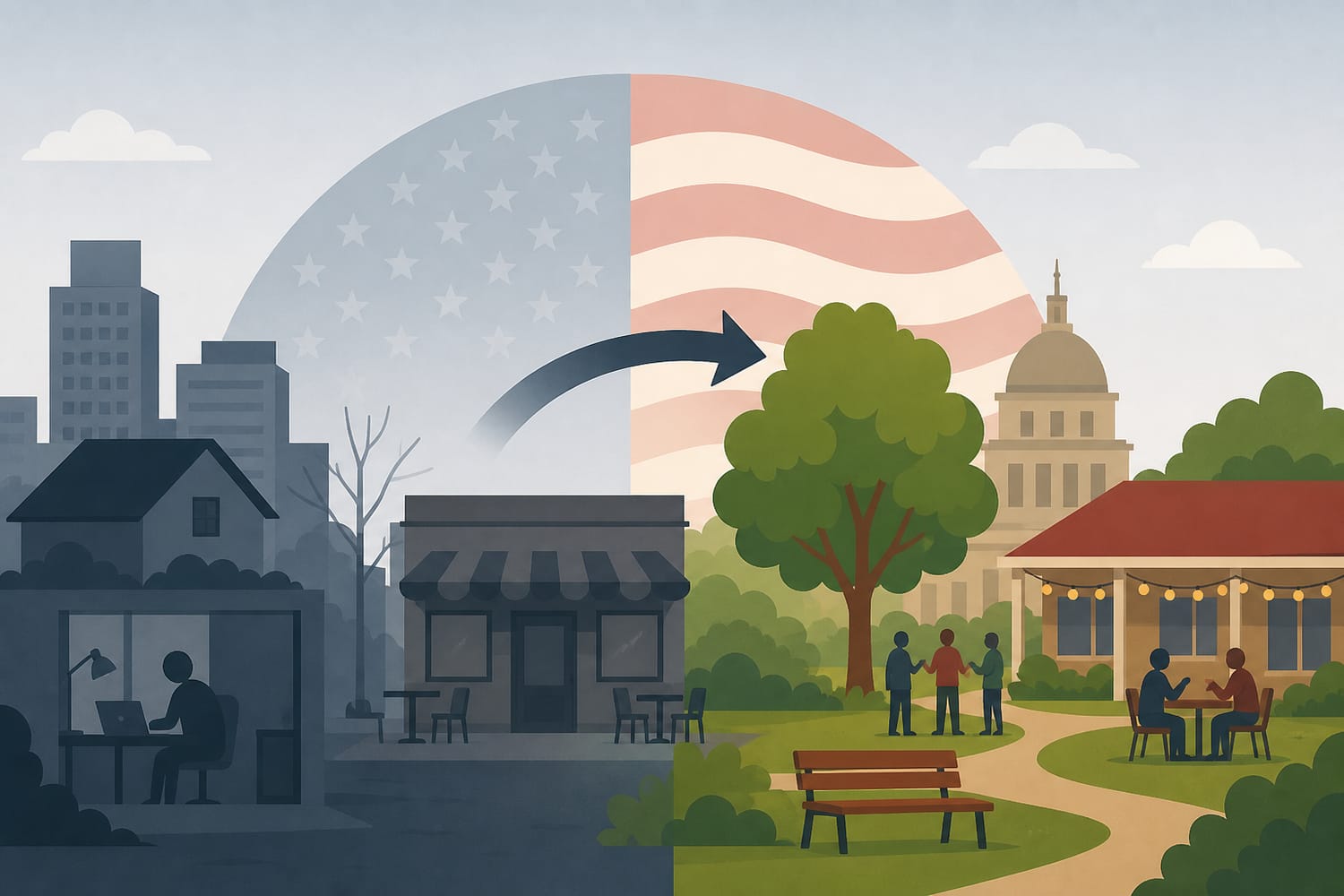
For much of American history, community life has depended on spaces that were neither home nor work. Sociologists often call these “third places”: cafés, diners, libraries, barber shops, churches, parks, union halls, bookstores, recreation centers, corner stores, and neighborhood bars. These places offer something different from private family life and professional obligation. They are settings where people can linger, talk, argue, relax, and form weak social ties that may later become friendships, networks, or sources of support.
The concern today is that many of these spaces are disappearing, weakening, or becoming less accessible. Critics point to loneliness, political polarization, declining civic participation, and the commercialization of public life as signs that Americans have lost important social infrastructure. Others argue that the story is more complicated: third places have not vanished so much as changed form, moving online, becoming more specialized, or adapting to new economic realities.
The debate over third places is therefore not simply about coffee shops or town squares. It is about how Americans connect, who gets included, who pays for shared space, and whether community can be rebuilt in a society shaped by technology, mobility, inequality, and changing work patterns.
The Argument That Third Places Are in Decline
One common view is that America has experienced a significant decline in accessible, informal gathering places. Supporters of this argument often cite the shrinking role of local institutions that once anchored community life. Churches and other religious institutions, for example, have historically served as major third places, providing not only worship services but also potlucks, volunteer groups, youth programs, and social networks. As religious attendance has declined in many parts of the country, so has one important source of regular face-to-face connection.
Other institutions have also weakened. Local newspapers, civic clubs, bowling leagues, labor unions, parent-teacher associations, and neighborhood associations have declined in membership or influence in many communities. Small businesses that once functioned as informal meeting spots have struggled against rising rents, online shopping, and big-box retail. Public spaces such as parks, plazas, and libraries remain important, but they are often underfunded or unevenly distributed.
From this perspective, the decline of third places has contributed to a more isolated society. People may have many digital contacts but fewer casual, recurring encounters with neighbors, shop owners, librarians, or fellow residents. Without these everyday connections, communities may lose trust and resilience. A person who does not know their neighbors may be less likely to participate in local government, help during a crisis, or understand the concerns of people outside their own social circle.
The Economic Pressure on Shared Space
Another side of the debate focuses less on culture and more on economics. According to this view, third places are declining because land, time, and attention have become increasingly expensive. In many cities and suburbs, commercial rents are high, making it difficult for independent cafés, bookstores, music venues, and community-oriented businesses to survive. Places where people can sit for hours without spending much money are often financially fragile.
The same applies to public institutions. Libraries, parks, recreation centers, and community centers require funding, staffing, maintenance, and political support. When local budgets are tight, these spaces may be among the first to face cuts. In lower-income neighborhoods, the lack of well-maintained public gathering places can reinforce inequality. Wealthier communities may have attractive parks, walkable downtowns, and private clubs, while poorer areas may have fewer safe and comfortable places to gather.
There is also the issue of time. Many Americans work long hours, commute long distances, or juggle multiple jobs and caregiving responsibilities. Even when third places exist, people may not have the energy or schedule flexibility to use them. Supporters of this argument say rebuilding community requires more than opening coffee shops or parks; it also requires addressing housing costs, wages, transportation, work-life balance, and public investment.
The View That Third Places Have Evolved, Not Disappeared
Not everyone agrees that third places are in decline. Some argue that the concept is too nostalgic and may romanticize a past that was not equally welcoming to everyone. Traditional third places often excluded people based on race, gender, class, religion, sexuality, or age. A local diner or fraternal club might have created community for some residents while making others feel unwelcome or unsafe.
From this perspective, today’s community spaces may be more fragmented but also more diverse. People gather in gyms, gaming groups, coworking spaces, dog parks, farmers markets, breweries, mutual aid networks, hobby clubs, and online communities. The local town square may no longer be the main center of social life, but people still find belonging through shared interests and identities.
Digital spaces are especially important in this argument. Online forums, social media groups, group chats, gaming platforms, and virtual communities can provide real companionship and support, especially for people who are geographically isolated, disabled, socially anxious, or part of a minority group in their local area. Critics of the decline narrative say it is too easy to dismiss online community as inferior, even though many people experience it as meaningful and sustaining.
Concerns About Digital Replacements
Others respond that digital communities, while valuable, cannot fully replace physical third places. They argue that in-person interaction has unique benefits: body language, spontaneous conversation, shared presence, and the possibility of encountering people who are not selected by an algorithm. A neighborhood library or park can bring together people of different ages, backgrounds, and political beliefs in a way that online platforms often do not.
Digital spaces can also intensify division. Social media platforms are designed around engagement, not necessarily trust or civic health. Online communities may connect like-minded people while reducing exposure to different viewpoints. They can foster support, but they can also spread misinformation, harassment, and outrage. For those worried about polarization, the decline of physical third places means fewer opportunities for low-stakes interaction across social divides.
At the same time, defenders of digital community note that physical spaces are not automatically inclusive or civil. A town hall meeting can be hostile; a neighborhood bar can be exclusionary; a park can feel unsafe. The comparison between online and offline community is therefore not simple. Both can connect people, and both can fail them.
Suburbs, Cars, and the Design of Daily Life
Urban planning is another major part of the debate. Many critics argue that American communities were built in ways that make third places difficult to sustain. Car-dependent suburbs often separate homes, workplaces, stores, schools, and entertainment into different zones. When daily life requires driving from one private space to another, casual public interaction becomes less likely.
Walkable neighborhoods, by contrast, tend to support informal contact. A person walking to a grocery store, café, school, or park may run into neighbors and local business owners. These small interactions can build familiarity over time. Advocates of walkable design argue that America cannot rebuild community without changing zoning laws, investing in public transit, allowing mixed-use development, and creating safe pedestrian spaces.
Opponents or skeptics may agree that walkability has benefits but warn against oversimplifying the issue. Not everyone wants dense urban living. Many people value privacy, space, quiet, and the affordability that some suburbs or smaller towns provide. Others argue that urban redevelopment can lead to gentrification, pushing out the very communities it claims to help. In this view, the challenge is not simply to build more cafés and plazas, but to ensure that improvements do not become amenities only for wealthier residents.
The Role of Business in Community Life
Private businesses often serve as modern third places, but this raises questions about access and commercialization. Coffee shops, restaurants, gyms, and breweries can create lively social environments, yet they usually require customers to spend money. A person who cannot afford a five-dollar coffee or a monthly membership may be excluded from spaces that appear public but are actually commercial.
Some business owners see themselves as community builders and intentionally create welcoming environments with events, open seating, local art, or public discussions. Others must prioritize profitability to survive. From their perspective, it may be unrealistic to expect small businesses to provide community space without steady revenue.
This leads to a broader disagreement: should third places be primarily market-driven, or should government and civic institutions provide more free and low-cost spaces? Those favoring public investment argue that community is a public good and should not depend entirely on consumer spending. Those wary of government-led solutions may prefer local entrepreneurship, voluntary associations, religious groups, and nonprofits, arguing that community works best when it grows organically rather than through top-down planning.
Can America Rebuild Community?
There is broad agreement that many Americans want more connection, even if they disagree about what caused the problem or how to solve it. Possible solutions include stronger libraries, better parks, community centers, local events, public markets, walkable neighborhoods, affordable commercial space, expanded transit, and support for clubs, sports, arts, and volunteer groups. Workplaces could also play a role by allowing more flexible schedules, giving people time to participate in community life beyond their jobs.
But rebuilding third places may require acknowledging that no single model fits everyone. Rural towns, dense cities, suburbs, immigrant communities, retirees, young adults, parents, and remote workers may all need different kinds of gathering spaces. Some people will find community in churches or synagogues; others in libraries, online groups, sports leagues, maker spaces, or neighborhood gardens.
The debate ultimately turns on what kind of social life Americans want. If third places are seen as essential civic infrastructure, then their decline is a serious public problem requiring investment and planning. If they are seen as naturally evolving forms of association, then the task is less about restoring the past and more about supporting new ways people already gather. Either way, the question remains urgent: in a society organized around private homes, demanding work, and personalized technology, creating shared spaces may be one of the most important challenges of American community life.