
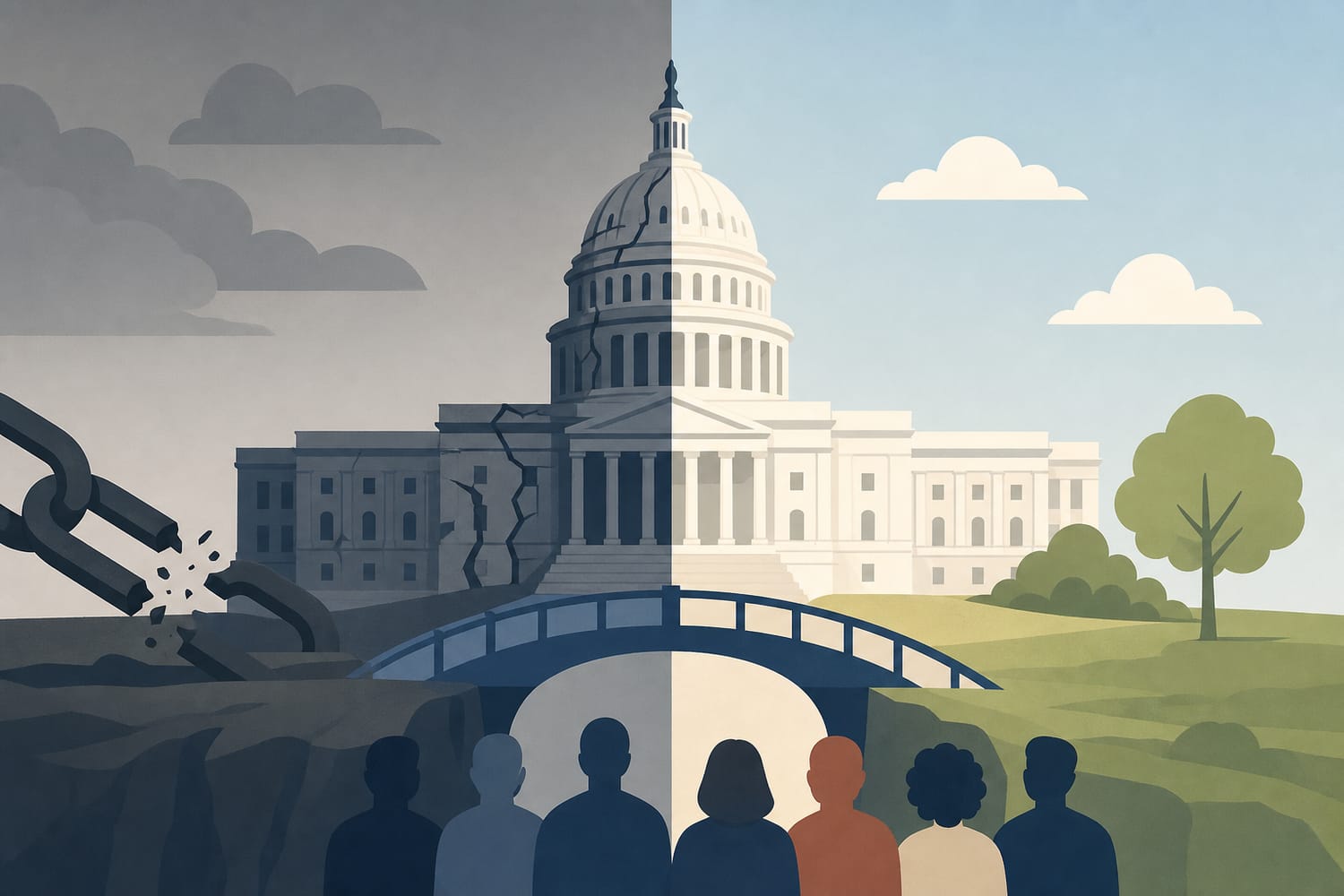
Trust has long been described as a kind of social glue: it helps people accept election results, follow public health guidance, pay taxes, use courts, support schools, and believe that disagreement can be handled peacefully. In the United States, however, confidence in many major institutions has declined over recent decades. Polling organizations have documented falling or historically low trust in Congress, the presidency, the Supreme Court, the news media, public schools, organized religion, big business, labor unions, police, and the medical system—though the level of trust varies by institution, political affiliation, race, age, education, and region.
The debate over why trust has fallen is broad and often sharply divided. Some argue that Americans have become more cynical because institutions have repeatedly failed them. Others believe that institutions are being unfairly undermined by partisan media, social platforms, and political leaders who benefit from public anger. Still others see the decline as a symptom of deeper social change: economic insecurity, cultural fragmentation, geographic sorting, loneliness, and a weakening sense of shared national purpose.
Whether trust can be rebuilt depends partly on what people think caused the decline in the first place. There is no single explanation, and there is no single solution.
The View That Institutions Have Earned Public Distrust
One common argument is that declining trust is a rational response to institutional failure. From this perspective, Americans are not simply misinformed or overly cynical; they are reacting to real mistakes, scandals, and broken promises.
Critics point to events such as the Vietnam War, Watergate, the Iraq War and flawed intelligence about weapons of mass destruction, the 2008 financial crisis, the opioid epidemic, corporate fraud, clerical abuse scandals, political corruption, and failures in disaster response. For many people, these events suggest that powerful institutions often protect themselves before they protect the public.
Those who hold this view argue that trust should not be demanded from citizens; it must be earned through competence, honesty, and accountability. When banks are rescued while homeowners lose savings, when elected officials appear more responsive to donors than voters, or when public agencies communicate poorly during crises, skepticism can seem justified.
This side of the debate often emphasizes transparency and consequences. If leaders make major mistakes and keep their positions, or if institutions investigate themselves without meaningful reform, public confidence is unlikely to return. From this perspective, rebuilding trust requires stronger ethics rules, clearer accountability, less secrecy, and evidence that institutions can admit failure and change.
The View That Distrust Is Being Manufactured
Another perspective argues that while institutions are imperfect, public distrust has been amplified by political incentives and media ecosystems that reward outrage. According to this view, many Americans are being encouraged to see institutions as corrupt, hostile, or illegitimate even when those institutions are functioning reasonably well.
Supporters of this argument point to partisan news, social media algorithms, conspiracy theories, and political campaigns that frame opponents not merely as wrong, but as dangerous. In this environment, trust can become tribal. People may trust an institution when their side controls it and reject it when the other side does. Courts, election offices, law enforcement agencies, universities, and news outlets may be judged less by their behavior than by whether they are perceived as aligned with a political identity.
This perspective often highlights the speed and scale of misinformation. False claims can spread quickly, while corrections often reach fewer people. Social media platforms can make rare examples of misconduct appear widespread, and emotionally charged content tends to attract more attention than careful explanations.
Those who focus on manufactured distrust argue that institutional reform alone will not solve the problem. They believe society also needs better media literacy, more responsible political leadership, stronger local journalism, and digital platforms that do less to reward sensational or misleading content.
The Partisan Divide Over Which Institutions Deserve Trust
Trust in American institutions is now strongly shaped by politics. Conservatives, liberals, and moderates often distrust different institutions for different reasons.
Many conservatives express skepticism toward national media organizations, universities, federal bureaucracies, public health agencies, and parts of the legal system. Some believe these institutions are dominated by progressive cultural values and are dismissive of conservative viewpoints. They may argue that experts and administrators make decisions without enough democratic accountability, and that institutions use neutral language while advancing ideological goals.
Many liberals, by contrast, tend to express greater concern about corporate power, certain police practices, religious influence in politics, conservative media, and political movements they believe undermine democratic norms. Some liberals argue that institutions have historically failed marginalized groups and that trust cannot be rebuilt without addressing inequality, discrimination, and unequal access to power.
There are also divisions within each political camp. Some conservatives strongly support police and the military but distrust federal agencies. Some progressives trust scientific institutions but are skeptical of corporations and law enforcement. Libertarians may distrust government power across the board, while populists on both the left and right may distrust economic elites.
This partisan divide complicates reform. A change that one group sees as restoring integrity may be viewed by another as institutional capture. For example, efforts to regulate misinformation may be seen by supporters as protecting democracy, while opponents may view them as censorship. Attempts to reform policing may be seen by some as necessary accountability and by others as undermining public safety.
The Role of Economic Insecurity
Another major explanation centers on economics. Trust is often easier to sustain when people feel stable, secure, and optimistic about the future. Many Americans have experienced decades of wage pressure, rising housing costs, medical debt, student loans, job instability, and the decline of manufacturing or local industries. Even when national economic indicators look strong, many households feel vulnerable.
From this viewpoint, institutional distrust grows when people believe the system is not working for them. If hard work does not lead to financial security, or if younger generations expect to be worse off than their parents, confidence in government, business, education, and the media can weaken.
Some argue that economic inequality is especially damaging because it creates the perception that rules are different for the wealthy and well-connected. When powerful individuals avoid consequences, use tax advantages, or influence policy through lobbying and campaign donations, citizens may conclude that institutions serve elites rather than the public.
Others caution that economic explanations are important but incomplete. Some affluent Americans also distrust institutions, and some communities with economic hardship maintain strong local trust. Still, many analysts believe economic stability is a major foundation for civic confidence.
The Cultural and Social Fragmentation Argument
Beyond economics and politics, some observers point to a broader decline in shared community life. They argue that Americans increasingly live in different information worlds, attend fewer civic organizations, move through more individualized social networks, and have fewer opportunities to build trust with people unlike themselves.
In this view, trust is not only built by national institutions. It begins in families, neighborhoods, schools, workplaces, religious communities, unions, clubs, and local associations. When these bonds weaken, people may become more suspicious of strangers and more vulnerable to narratives that portray other groups as threats.
Cultural conflict also plays a role. Debates over race, gender, immigration, religion, education, guns, speech, and national identity often become symbolic battles over who “owns” America’s future. Institutions caught in the middle may lose legitimacy with one side or another no matter what they do.
Some people believe the answer is to restore older forms of community and shared values. Others argue that trust must be rebuilt through a more inclusive national identity that recognizes America’s diversity. These approaches differ, but both suggest that institutional trust cannot be separated from social trust.
The Case for Reform and Accountability
Many people across the political spectrum agree that institutions must become more accountable, even if they disagree about what accountability means. Common proposals include stronger anti-corruption laws, limits on conflicts of interest, more transparency in government decision-making, improved access to public records, clearer standards for police conduct, campaign finance reform, and stricter consequences for misconduct.
Supporters of reform argue that institutions often ask for trust without offering enough proof of trustworthiness. They believe confidence will return only when citizens can see that rules are applied fairly and that leaders are not above them.
In journalism, reform might mean clearer separation between news and opinion, more corrections, greater transparency about sources, and less reliance on outrage-driven coverage. In science and medicine, it might mean acknowledging uncertainty more openly and communicating risks without overstating certainty. In education, it might mean more parental involvement, better performance measures, or more equitable funding, depending on one’s perspective.
The challenge is that reforms can be interpreted through partisan lenses. Even well-intentioned changes may be dismissed if people do not trust the reformers.
The Case for Civic Responsibility
Another side of the debate emphasizes not only institutional behavior but also citizen responsibility. Trust, according to this view, cannot be rebuilt if the public expects perfection, refuses compromise, or consumes information only from sources that confirm existing beliefs.
Supporters of this argument say democratic institutions are run by human beings and will always be flawed. If every mistake is treated as proof of corruption, then no institution can survive public scrutiny. They argue that citizens should practice patience, verify information before sharing it, participate locally, vote in less glamorous elections, and distinguish between criticism and blanket rejection.
This view does not necessarily deny institutional failures. Rather, it warns that total cynicism can become self-fulfilling. If qualified people avoid public service because institutions are constantly attacked, performance may decline further. If citizens assume elections are illegitimate whenever their side loses, democratic stability weakens.
Critics of this perspective respond that calls for civic responsibility can sound like blaming the public for elite failures. They argue that citizens cannot be expected to trust systems that do not demonstrate integrity.
Can Trust Be Rebuilt?
Rebuilding trust in America is possible, but it is unlikely to happen quickly or evenly. Trust may return first at the local level, where people can see results more directly: a school that improves, a city agency that responds, a local newspaper that reports fairly, a police department that builds relationships, or a court that treats people with dignity.
National trust is harder because national institutions are more distant and more politicized. Still, several principles may help: competence, honesty, accountability, fairness, and humility. Institutions that admit uncertainty, correct errors, punish misconduct, and communicate clearly are more likely to earn confidence over time.
At the same time, Americans may need to accept that trust does not mean blind loyalty. Healthy democracy requires skepticism, criticism, and oversight. The goal is not to eliminate distrust entirely, but to prevent distrust from becoming so absolute that shared facts, peaceful transitions, and collective problem-solving become impossible.
The debate continues because Americans disagree not only about which institutions have failed, but about what kind of country those institutions should serve. Any serious effort to rebuild confidence will have to address both performance and perception, both accountability and polarization, and both institutional reform and civic culture. Trust, once lost, is difficult to restore—but not beyond repair.