
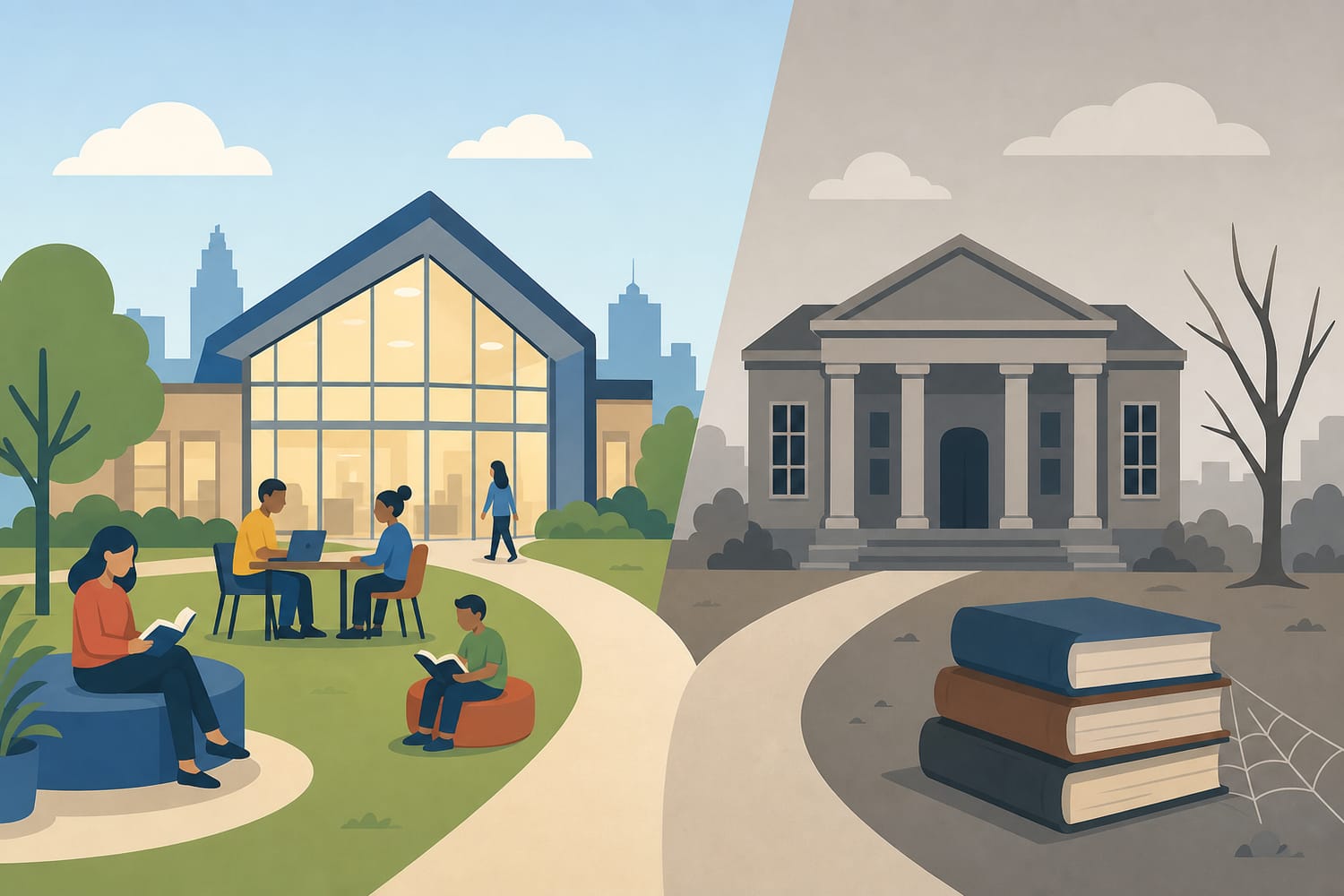
Public libraries have long occupied a distinctive place in civic life. They are associated with books, quiet reading rooms, research help, children’s story hours, and free access to knowledge. Yet in an era shaped by smartphones, search engines, e-books, streaming media, remote work, and changing public budgets, their future is widely debated. Some see public libraries as more essential than ever: trusted, inclusive community hubs that provide access not only to information but also to technology, social services, education, and public space. Others question whether libraries remain relevant in their traditional form, especially when so much information is instantly available online.
The debate is not simply about whether libraries should exist. It is also about what they should become, who they should serve, how they should be funded, and whether their expanding role strengthens or dilutes their core mission. Different communities answer these questions in different ways, depending on local needs, economic conditions, demographics, and political priorities.
The Case for Libraries as Essential Community Hubs
Supporters of public libraries often argue that libraries have successfully evolved beyond being book-lending institutions. In many places, they now function as multipurpose community centers. Patrons use them for internet access, job applications, résumé help, language learning, homework support, legal information, public meetings, and cultural programming. For people without reliable home internet, printers, computers, or quiet workspaces, the library can be a vital resource.
This view emphasizes equity. Even in a highly digital society, access to information is not evenly distributed. A person may own a phone but lack broadband internet, a laptop, a safe study environment, or the digital skills needed to navigate government forms, employment portals, or online education. Libraries help close these gaps by offering free access to technology and staff assistance.
Advocates also point to the library’s role as one of the few remaining indoor public spaces where people can spend time without being expected to buy anything. In cities and towns where commercial spaces dominate, libraries offer a rare alternative: a place open to children, seniors, students, job seekers, immigrants, low-income residents, and anyone else. For supporters, this makes libraries not outdated, but uniquely important.
The Argument That Libraries Are Losing Relevance
Critics of traditional public library models argue that libraries face an identity problem. If their original purpose was to provide access to books and information, the internet has changed that landscape dramatically. Search engines, online databases, e-books, audiobooks, and digital archives have made information more accessible than ever before. Many people now read, research, and learn from home without ever entering a library building.
From this perspective, maintaining large library buildings, collections, and staffing structures may seem inefficient, especially when local governments face competing demands such as housing, public safety, infrastructure, and schools. Critics may ask whether tax dollars should fund institutions that some residents rarely use.
There is also skepticism about whether libraries can realistically be everything to everyone. As libraries add services related to social work, mental health, workforce development, technology training, and community events, some critics worry that the mission becomes too broad. They argue that libraries may be asked to solve problems better handled by specialized agencies, while librarians are placed in difficult roles for which they may not have sufficient training or support.
Books, Reading, and the Traditional Mission
One major point of debate concerns whether libraries should prioritize books and reading or continue expanding into broader community services. Those who favor a traditional mission argue that reading, literacy, and access to curated knowledge remain deeply important. They worry that as libraries focus more on events, technology, and social services, books may become less central.
For these observers, the library’s value lies partly in its ability to support deep reading, research, and intellectual development. They may see the quiet, book-centered library as a necessary counterbalance to a fast-moving digital culture filled with distractions, misinformation, and algorithm-driven content. In this view, libraries should modernize, but not abandon their foundational role.
Others respond that the traditional mission has not disappeared; it has expanded. Literacy today includes digital literacy, media literacy, financial literacy, and civic literacy. A library that teaches someone how to identify misinformation online or apply for a job may still be fulfilling its educational purpose. Supporters of this broader view argue that libraries have always adapted to new formats, from newspapers and microfilm to DVDs, databases, and e-books.
Digital Access and the Changing Meaning of Information
The rise of digital media has created both opportunities and challenges for libraries. On one hand, digital collections allow patrons to borrow e-books, audiobooks, research materials, and streaming content without visiting a physical branch. This can make libraries more convenient and accessible, especially for people with mobility issues, busy schedules, or limited transportation.
On the other hand, digital resources are not free for libraries to provide. Licensing agreements for e-books and digital materials can be expensive and restrictive. Libraries may pay high fees for limited access, and they often do not own digital content in the same way they own physical books. This raises questions about long-term sustainability and fairness.
There is also a broader concern about the quality of information. While the internet offers enormous access, it also contains misinformation, scams, biased sources, and overwhelming amounts of unfiltered content. Librarians can help users evaluate sources and find reliable information. Supporters see this as a reason libraries are more relevant, not less. Skeptics, however, may wonder whether enough people use these services to justify continued investment at current levels.
Libraries as Social Service Front Lines
In many communities, libraries have become informal front lines for social challenges. People experiencing homelessness may use libraries for warmth, restrooms, internet access, or safety. Others may seek help with unemployment, immigration paperwork, disability benefits, or housing applications. Some library systems have responded by hiring social workers or partnering with local service organizations.
Supporters of this role argue that libraries are meeting real community needs. Because they are open, trusted, and free, they naturally become places where people seek help. Refusing to address these needs, advocates say, would ignore the realities of modern public life.
However, this development is also controversial. Some patrons and staff members worry about safety, stress, and the changing atmosphere of library spaces. Librarians may feel pressured to handle crises involving mental health, addiction, or poverty without adequate training. Critics argue that relying on libraries to absorb social problems can allow governments to underfund more appropriate services. In this view, libraries should be partners in community support, but not substitutes for social welfare systems.
Public Funding and Questions of Value
Funding is central to the debate. Public libraries are usually supported by taxes, grants, donations, or a combination of sources. Supporters argue that libraries provide a strong return on investment by offering educational resources, early literacy programs, workforce support, internet access, and community space at no direct cost to users. They may point out that a single library card can provide access to materials and services that would be expensive to purchase individually.
Opponents or skeptics may not necessarily oppose libraries altogether, but they may question whether current funding levels are justified. If library visits decline in a particular area, or if residents increasingly rely on digital alternatives, some taxpayers may prefer reduced spending or restructured services. Others may support fewer physical branches and more online resources.
The question of value often depends on who is being asked. A family with young children may value story time and children’s books. A student may need study space and databases. A job seeker may depend on computers and printing. A person who buys all their books and has reliable internet may see less personal benefit. This uneven visibility can shape public opinion.
Rural, Urban, and Suburban Differences
The future of public libraries may look different depending on location. In rural areas, a library may be one of the few available public institutions offering broadband internet, educational programming, or meeting space. Its importance may be heightened by limited transportation and fewer nearby services.
In urban areas, libraries may serve large and diverse populations with complex needs. They may function as cultural institutions, technology centers, safe spaces for youth, and support points for vulnerable residents. At the same time, they may face heavy demand, security concerns, and intense budget pressure.
Suburban libraries may experience different expectations. Some may be highly used for children’s programming, study rooms, community events, and digital borrowing. Others may struggle to attract patrons who have more private resources at home. These differences suggest that there may not be one single future for public libraries, but many local futures.
Possible Paths Forward
Several visions exist for what libraries should become. One model emphasizes the library as a civic hub: a place for public dialogue, education, cultural events, technology access, and community connection. Another model focuses on digital transformation, with fewer physical materials and stronger online services. A third prioritizes the traditional reading and research mission, preserving libraries as quiet spaces for books, study, and learning.
Some communities may blend these approaches. A future library might include books, digital media, meeting rooms, maker spaces, children’s areas, career support, local history archives, and partnerships with schools or nonprofits. The challenge is deciding which services fit the community’s needs and which stretch the institution too far.
The debate over public libraries reflects larger questions about public goods, technology, inequality, and civic life. Are libraries outdated because information is everywhere, or essential because trustworthy access is still uneven? Should they remain focused on books, or adapt to wider social needs? There is no universal answer. What seems clear is that libraries are not standing still. Whether they thrive, shrink, or transform will depend on how communities define their value in the years ahead.