
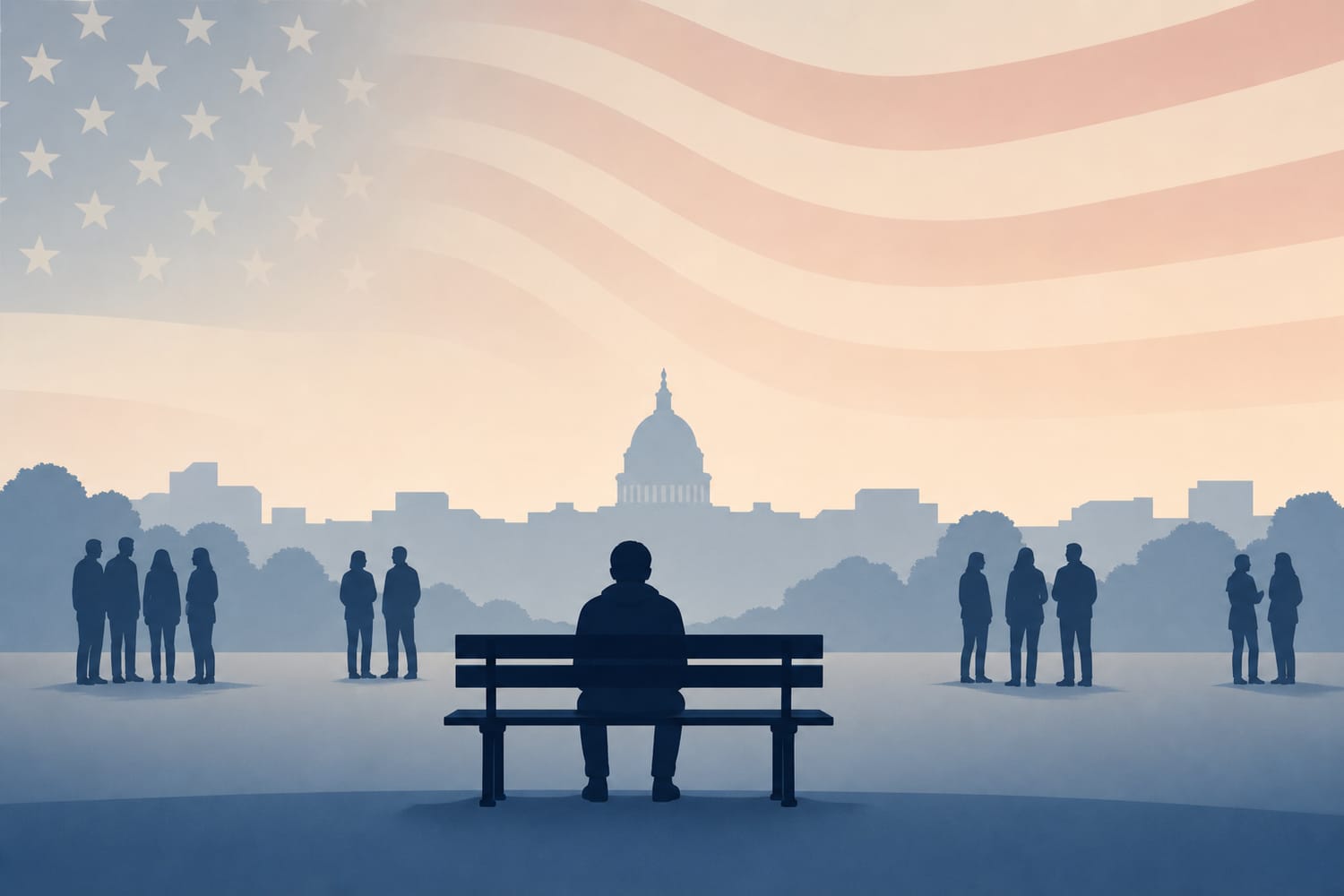
A Growing Concern in American Life
Across the United States, loneliness has become a major topic of public conversation. Health officials, researchers, journalists, religious leaders, employers, and community organizers have all raised concerns that Americans are becoming more socially disconnected. Some point to declining participation in civic groups, lower church attendance, fewer close friendships, and rising rates of people living alone. Others argue that the situation is more complicated: Americans may not be losing community so much as changing the ways they form it.
The debate over loneliness is not simply about whether people feel sad or isolated. It touches larger questions about modern life: technology, work, family, politics, religion, urban design, and the economy. Some see loneliness as a public health crisis requiring national action. Others believe the “epidemic” framing risks exaggerating the problem or overlooking new forms of connection. Understanding the issue requires looking at the different perspectives involved.
The Case That America Is Becoming More Lonely
One side of the debate argues that the United States is experiencing a serious decline in social connection. Supporters of this view often point to research showing that many Americans report having fewer close friends than in previous decades. Surveys have found that some people have no one they feel they can confide in during difficult times. Loneliness is not limited to older adults; young people also report high levels of isolation, despite being digitally connected.
This perspective often connects loneliness to broader social trends. Families are smaller and more geographically dispersed. People move for school, jobs, or housing, sometimes leaving behind extended family and longtime neighbors. More Americans live alone than in past generations. Traditional gathering places, such as churches, union halls, local clubs, and neighborhood associations, have seen participation decline in many areas.
Those who see loneliness as an epidemic also emphasize its health consequences. Studies have linked chronic loneliness and social isolation to increased risks of depression, anxiety, heart disease, dementia, and premature death. From this viewpoint, loneliness is not just a private emotional problem but a public health concern similar to smoking, obesity, or substance abuse. Advocates argue that if social disconnection harms both mental and physical health, society should treat it as seriously as other health risks.
Technology as a Cause—or a Tool
Technology is one of the most debated factors in discussions about loneliness. Critics argue that smartphones, social media, and digital entertainment have weakened face-to-face relationships. They say people now spend more time scrolling, streaming, or gaming and less time talking with neighbors, attending local events, or deepening friendships. Social media can also encourage comparison, making people feel excluded when they see others posting about parties, vacations, or achievements.
Some critics believe online interaction creates an illusion of connection without the depth of in-person relationships. A person may have hundreds of online contacts but few people they can call in a crisis. From this perspective, digital platforms can replace meaningful social bonds with quick reactions, likes, and short messages that do not fully satisfy the human need for belonging.
Others push back against this view. They argue that technology can help people maintain relationships across distance, especially in a country where families and friends often live far apart. Video calls, group chats, online communities, and social platforms can allow people to stay connected in ways that were impossible in earlier eras. For people with disabilities, social anxiety, niche interests, or marginalized identities, online spaces may provide community that is difficult to find locally.
This side does not necessarily deny that technology can contribute to isolation, but it sees the issue as depending on how technology is used. Passive scrolling may increase loneliness, while active communication with friends or participation in supportive communities may reduce it. The technology debate, then, is not only about devices themselves but about habits, platform design, and the balance between online and offline life.
The Changing Role of Work
Work is another major factor in the loneliness debate. For many Americans, the workplace has long been a key source of social interaction. People often make friends through jobs, share routines with coworkers, and feel part of a team. However, changes in the economy have disrupted this role.
Some argue that remote work has intensified loneliness by reducing daily casual contact. Without commutes, office conversations, lunches, or informal check-ins, workers may feel more isolated. Younger employees, in particular, may miss out on mentorship and friendship-building opportunities. Critics of remote work say that while it offers flexibility, it can weaken workplace culture and reduce a sense of shared purpose.
Others see remote work differently. They argue that traditional workplaces were not always reliable sources of community and could also be stressful, exclusionary, or draining. Remote work may allow people to spend more time with family, participate in local activities, avoid long commutes, and build community outside the office. For some, flexibility improves well-being and makes social life easier, not harder.
Beyond remote work, some point to job instability, long hours, and economic pressure as deeper causes of loneliness. If people are working multiple jobs, struggling with housing costs, or constantly stressed about money, they may have less time and energy for friendship and civic engagement. From this view, loneliness is partly a symptom of economic insecurity.
Decline of Traditional Institutions
Many commentators connect loneliness to the weakening of traditional institutions. Religious congregations, civic clubs, neighborhood groups, unions, and volunteer organizations once provided regular social contact and a shared sense of purpose. Even people who were not close friends might see each other weekly, cooperate on projects, and feel connected to a larger community.
Those concerned about institutional decline argue that these organizations gave Americans more than social events. They created habits of cooperation, trust, responsibility, and mutual aid. When participation falls, people may lose both companionship and a sense that they belong to something bigger than themselves.
However, others argue that traditional institutions were not equally welcoming to everyone. Some people felt excluded from churches, clubs, or civic groups because of race, gender, sexuality, class, religion, or political beliefs. For them, the decline of older institutions may represent freedom from restrictive social expectations rather than a simple loss.
This perspective suggests that the challenge is not necessarily to restore the past but to build new, more inclusive forms of community. Community can exist through cultural groups, mutual aid networks, hobby circles, online forums, activist organizations, recovery groups, or informal friend networks. The question is whether these newer forms can provide the same depth, consistency, and broad social trust that older institutions once offered.
Politics, Polarization, and Trust
Political polarization is often mentioned as another reason Americans may feel less connected. Some observers argue that intense political division has made it harder for people to maintain relationships across ideological lines. Families may avoid discussing politics, neighbors may distrust one another, and communities may split into opposing camps. In this environment, people may feel safer retreating into smaller groups of like-minded individuals.
A related concern is declining trust. If people believe that others are hostile, dishonest, or threatening, they may be less likely to engage in community life. Social trust can influence whether people talk to neighbors, join organizations, help strangers, or participate in local problem-solving. Lower trust may therefore deepen loneliness, even in crowded places.
At the same time, some argue that political engagement can create community. Campaigns, advocacy groups, protests, and local organizing can bring people together around shared values. For individuals who feel isolated, political or social movements may offer belonging and purpose. The downside, critics say, is that communities formed mainly around opposition to others may reinforce division rather than broad social connection.
Is Loneliness Really Worse Than Before?
Not everyone agrees that America is facing a uniquely modern loneliness epidemic. Skeptics question whether today’s loneliness is worse than in previous generations or simply more visible. They note that past eras had their own forms of isolation: rural loneliness, unhappy marriages, racial segregation, social stigma, and limited opportunities for people who did not fit community norms.
Some also caution that survey data can be difficult to interpret. People may define friendship, community, and loneliness differently across generations. Greater openness about mental health may lead more people to report loneliness now than in the past. In addition, nostalgia can distort memory, making earlier communities seem warmer and more united than they actually were.
This skeptical view does not deny that loneliness is real or painful. Instead, it questions whether the “epidemic” label captures the complexity of the issue. If loneliness is framed too dramatically, it may encourage panic or simplistic solutions. Skeptics argue for careful evidence, attention to differences among groups, and recognition that social change includes both losses and gains.
Possible Solutions and Different Priorities
The debate over loneliness also includes disagreement about solutions. Public health advocates often call for national strategies, including screening for loneliness in healthcare settings, funding community programs, supporting mental health services, and designing cities with more public spaces. They argue that social connection should be treated as part of infrastructure, not merely a personal responsibility.
Community-focused thinkers emphasize local action: neighborhood events, libraries, parks, volunteer groups, faith communities, recreational leagues, and intergenerational programs. They believe loneliness can be reduced when people have repeated, low-pressure opportunities to meet and cooperate.
Others focus on individual responsibility. From this view, people may need to make more deliberate efforts to maintain friendships, join groups, limit unhealthy technology use, or reach out to others. Critics of this approach warn that it can blame individuals for problems shaped by work schedules, housing patterns, disability, poverty, or discrimination.
Economic reformers argue that stronger wages, affordable housing, paid leave, and shorter work hours could indirectly reduce loneliness by giving people more stability and time. Urban planners point to walkable neighborhoods, public transit, and shared spaces. Technologists suggest redesigning platforms to encourage meaningful interaction rather than addictive engagement.
A Debate About What Community Should Mean
At the heart of the loneliness discussion is a larger question: what kind of community do Americans want? Some believe the country needs to recover older habits of belonging, duty, and local involvement. Others believe America must create new forms of connection that reflect diversity, mobility, and digital life. Still others think the problem has been overstated, though they agree that many individuals are struggling.
The debate does not have a single clear answer because loneliness is both personal and social. It can come from grief, mental illness, family breakdown, discrimination, overwork, technology, geography, or cultural change. It can affect people surrounded by others as well as those who are physically alone.
What most perspectives share is the recognition that human beings need meaningful connection. Whether America is losing its sense of community or transforming it, the concern remains significant. The challenge is to understand the many causes of disconnection without romanticizing the past, dismissing new forms of belonging, or ignoring the people who feel left out in the present.