
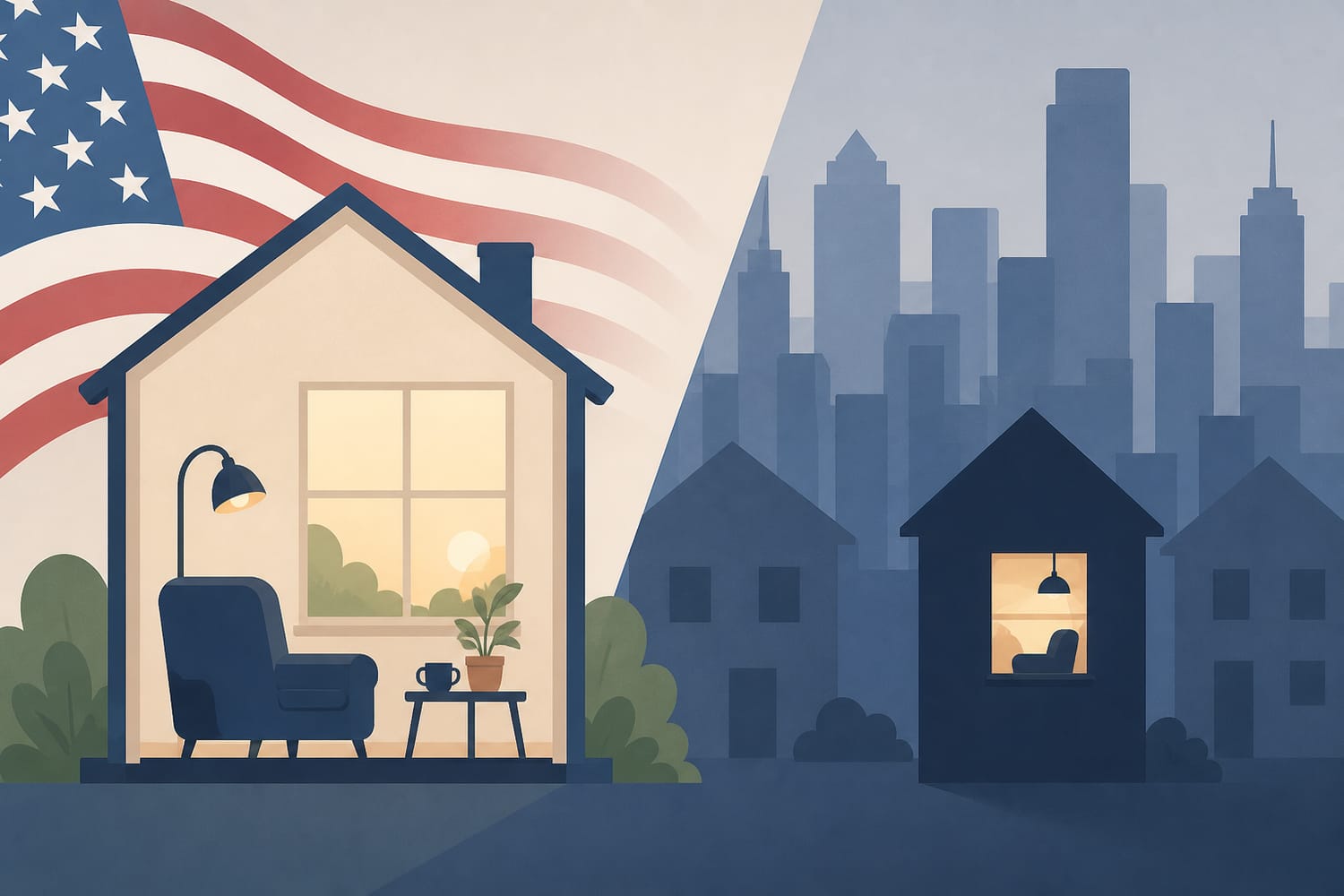
A Changing Household Landscape
More Americans are living alone than at any point in the country’s history. Once seen as unusual outside of widowhood or transitional life stages, solo living has become a common household arrangement across age groups, income levels, and regions. People live alone in downtown apartments, suburban homes, retirement communities, and rural areas. Some do so temporarily, while others build entire lives around having their own space.
This shift has sparked a broader debate about what solo living means for American society. To some, it reflects progress: more personal freedom, greater economic independence, and expanded choices for women, older adults, and people who do not follow traditional family paths. To others, it signals a troubling rise in loneliness, weakened social bonds, and a culture that increasingly prioritizes individual preference over community.
The reality is complicated. Living alone does not automatically mean being lonely, and living with others does not guarantee connection. Still, the growth of solo households raises important questions about modern life, housing, work, relationships, aging, and the meaning of independence.
The Case for Independence
Supporters of solo living often frame it as a sign of expanded freedom. In earlier generations, many people had fewer choices about household structure. Women, in particular, were often economically dependent on marriage or family arrangements. Today, higher educational attainment, workforce participation, and broader social acceptance of different lifestyles have made it more possible for people to live independently.
For younger adults, living alone can represent self-discovery and control. It allows people to set their own routines, manage their own finances, decorate their space as they wish, and make daily decisions without compromise. Some see this as an important step in personal development. A person who lives alone may learn practical skills, develop confidence, and gain clarity about what they want from relationships and work.
For divorced or widowed adults, solo living can also be empowering. Rather than moving in with family or quickly remarrying, some choose to preserve their autonomy. Older adults may value the dignity of remaining in their own homes, especially if they have spent decades building a familiar environment. In this view, solo living is not a failure of family or community but a legitimate expression of self-determination.
The Concern About Isolation
Critics argue that the rise in solo living may reflect and contribute to social isolation. They point to concerns about loneliness, declining civic participation, and weaker ties among neighbors, relatives, and local organizations. From this perspective, the growth of one-person households is part of a larger pattern in which Americans spend more time alone and less time in shared spaces.
Loneliness has become a major public health concern. Researchers have linked chronic loneliness to increased risks of depression, anxiety, heart disease, cognitive decline, and premature death. While not everyone who lives alone is lonely, people who live by themselves may face higher risks if they lack strong friendships, family support, or community involvement.
Some critics also worry that a society built around individual households can become less resilient. In multi-person households, people often share caregiving, transportation, meals, and emotional support. When more people live alone, these forms of informal support may become harder to access. This can be especially serious during illness, job loss, extreme weather, or emergencies.
The Difference Between Solitude and Loneliness
A key distinction in the debate is the difference between solitude and loneliness. Solitude can be chosen, peaceful, and restorative. Many people who live alone enjoy quiet, privacy, and freedom from constant social demands. For introverts, remote workers, artists, and people recovering from stressful relationships, living alone can provide necessary space.
Loneliness, by contrast, is usually defined as the painful gap between the social connection a person wants and the connection they actually have. A person can feel lonely in a crowded household, in a marriage, or among roommates. Another person may live alone and feel deeply connected through friendships, family, work, faith communities, hobbies, or neighborhood networks.
This distinction complicates simple claims about solo living. Advocates argue that the household structure itself is not the problem. The more important issue is whether people have meaningful relationships and access to community. Critics respond that while living alone is not the same as loneliness, it can make loneliness easier to hide and harder to address.
Economic Factors and Housing Realities
Solo living is also shaped by economics. For some Americans, living alone is a mark of financial security. Being able to afford rent, utilities, groceries, and household expenses without sharing costs can signal independence and stability. In expensive cities, however, solo living may be out of reach for many people, which makes it a privilege tied to income.
At the same time, some people live alone under financially difficult circumstances. Older adults on fixed incomes, widowed homeowners, or low-income renters may not be choosing solitude so much as navigating limited options. They may struggle with housing costs, maintenance, transportation, and medical expenses.
The rise of solo living also influences housing markets. One-person households increase demand for smaller units, apartments, and accessible housing. Some urban planners argue that cities need more studios, one-bedroom apartments, co-living arrangements, and age-friendly communities. Others worry that a growing number of separate households increases consumption of space, energy, and resources.
Relationships, Marriage, and Changing Expectations
Solo living is closely tied to changing attitudes toward marriage and partnership. Americans are marrying later, divorcing more often than in the mid-20th century, and increasingly accepting single adulthood as a valid life path. Some people live alone while dating. Others are single by choice. Still others are in committed relationships but choose not to share a home.
Supporters view this flexibility as healthy. They argue that people should not feel pressured to marry or cohabit for social approval, financial necessity, or fear of being alone. Living alone may allow people to enter relationships more intentionally rather than out of dependence.
More traditional critics see the trend differently. They worry that declining marriage and smaller households weaken family structures. In their view, families provide emotional stability, social responsibility, and intergenerational support. They may argue that a culture of solo living can encourage avoidance of commitment or reduce the importance placed on long-term partnership.
Between these positions is a more moderate view: household arrangements have diversified, but the need for commitment and care remains. People may find those commitments through marriage, friendship, extended family, chosen family, or community networks.
Technology’s Mixed Role
Technology has changed the experience of living alone. On one hand, smartphones, video calls, messaging apps, online communities, and social media can help people stay connected. Someone living alone can talk daily with relatives, participate in interest-based groups, work remotely, or maintain long-distance friendships.
On the other hand, technology may also create a substitute for in-person connection. Critics argue that digital interaction can be shallow, fragmented, or emotionally unsatisfying when it replaces face-to-face relationships. Food delivery, remote work, streaming entertainment, and online shopping can make it possible to meet many needs without leaving home.
The debate over technology mirrors the broader debate over solo living. It can support independence and connection, but it can also enable withdrawal. Much depends on how people use it and whether online contact complements or replaces deeper relationships.
Aging Alone
One of the most serious dimensions of solo living involves aging. Many older Americans live alone due to widowhood, divorce, having no children, or living far from family. Some strongly prefer aging in place and maintaining independence as long as possible. They may see living alone as central to their identity and dignity.
However, aging alone can bring risks. Health problems, mobility limitations, cognitive decline, and social isolation can become more difficult to manage without household support. Even routine tasks like grocery shopping, home repairs, or getting to medical appointments can become major challenges.
Some policymakers and advocates call for stronger community-based support systems, including home care services, senior centers, public transportation, and neighborhood volunteer programs. Others emphasize the importance of multigenerational housing or encouraging families to remain more closely connected. The disagreement is often not about whether older adults need support, but about who should provide it: families, communities, markets, or government programs.
Community Beyond the Household
A major question is whether society can adapt to more people living alone by strengthening community outside the home. Some argue that the problem is not solo living itself, but the lack of accessible public spaces and social institutions. If people had more welcoming parks, libraries, cafes, community centers, religious groups, clubs, and neighborhood events, living alone might not lead to isolation.
This view suggests that America needs to rethink community design. Walkable neighborhoods, mixed-use development, public transportation, and shared gathering places can make casual social interaction easier. In car-dependent areas, people who live alone may have fewer spontaneous opportunities to connect.
Others are skeptical that public spaces can replace the intimacy of household and family life. They argue that community ties are valuable but cannot fully substitute for the daily support of living with others. From this perspective, the household remains a uniquely important source of care and belonging.
A Debate Without a Simple Answer
The rise of solo living in America can be interpreted in more than one way. It may represent independence, equality, privacy, and freedom from outdated expectations. It may also reveal loneliness, economic strain, weakened family ties, and gaps in community support.
Both interpretations can be true at the same time. For some, living alone is deeply fulfilling. For others, it is painful or precarious. The same household arrangement can mean liberation in one context and isolation in another.
The most balanced view may be that solo living is neither inherently good nor inherently bad. What matters is whether people have real choices, stable housing, meaningful relationships, and support when they need it. As more Americans live alone, the challenge is not to judge the choice itself, but to build a society where independence does not have to come at the cost of connection.