
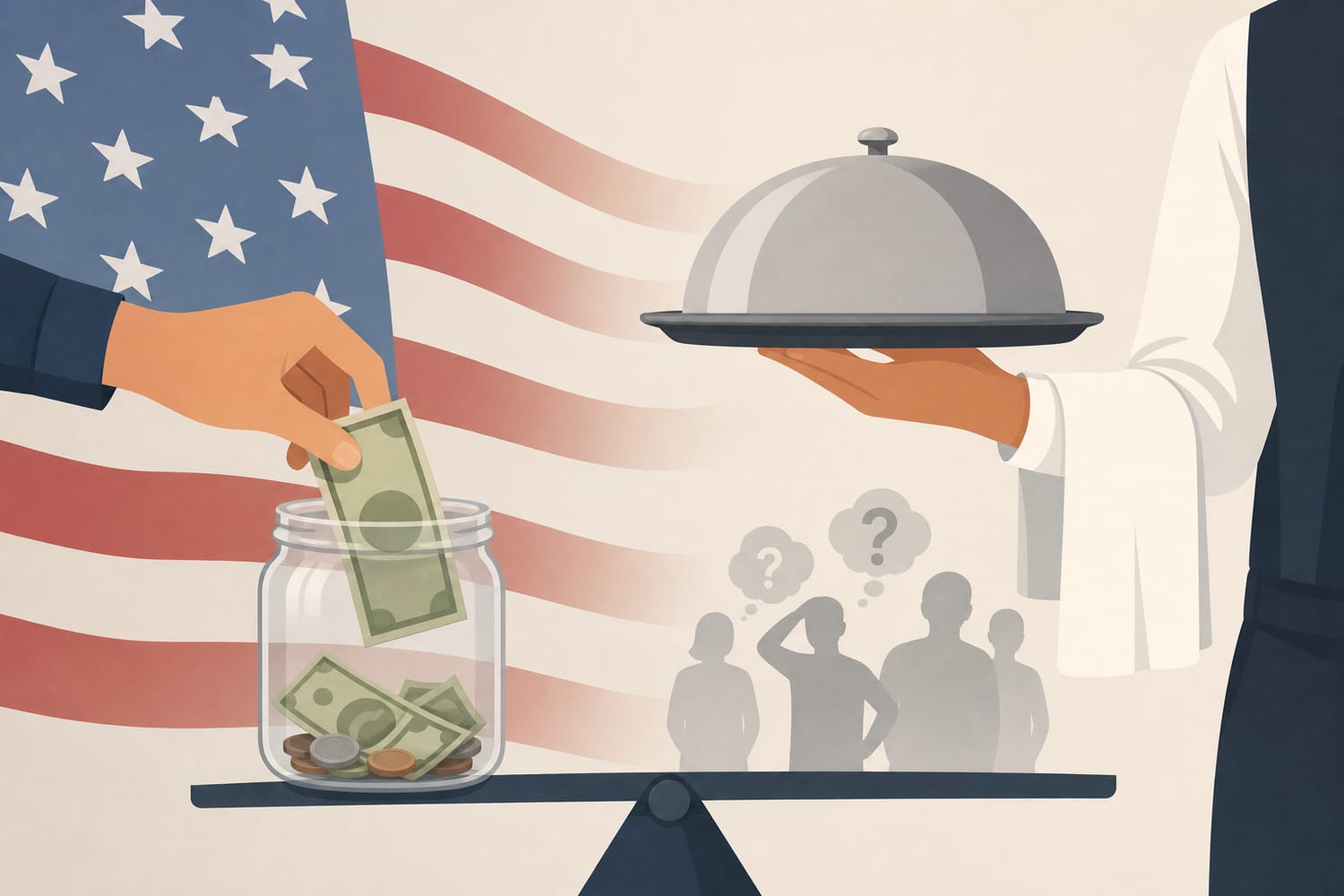
Tipping is one of the most recognizable features of American service culture. For visitors, it can be confusing; for workers, it can be essential income; for customers, it can feel like either a meaningful gesture or an unavoidable obligation. In restaurants, coffee shops, rideshares, salons, hotels, delivery apps, and even self-checkout screens, tipping has become a frequent part of everyday transactions.
The debate over tipping culture in America often centers on a basic question: is tipping a voluntary expression of gratitude, or has it become a form of social pressure that shifts responsibility for wages from employers to customers? Different people answer this question in very different ways, depending on their experiences as workers, customers, business owners, or observers of the broader economy.
There is no single viewpoint that captures the whole issue. Tipping can reward excellent service, help workers earn more, and give customers a sense of personal connection. At the same time, it can create uncertainty, inequality, awkwardness, and resentment. Understanding the debate requires looking at the arguments on multiple sides.
Tipping as a Reward for Good Service
One of the most common defenses of tipping is that it allows customers to reward workers for good service. In this view, tipping is a flexible and personal way to say thank you. A server who is attentive, friendly, knowledgeable, and efficient can receive a larger tip than someone who provides minimal effort. Supporters argue that this creates an incentive for better service and gives workers some control over their earnings.
Many customers also like the idea that tipping lets them express appreciation directly. A generous tip after a positive dining experience, a difficult delivery, or a thoughtful haircut can feel more immediate and personal than simply paying a fixed price. For some, tipping is not only about money but also about recognition.
Some service workers share this view. In certain restaurants, bars, salons, and hospitality jobs, tips can significantly increase income. Experienced servers or bartenders in busy locations may earn more through tips than they would under a flat hourly wage. For these workers, tipping is not necessarily a burden but a system that can reward skill, speed, emotional labor, and customer relationships.
From this perspective, eliminating tipping could remove a source of motivation and potentially reduce earning potential for some employees. Supporters of tipping often worry that replacing tips with higher menu prices or service charges might result in less take-home pay, especially for top-performing workers in high-traffic businesses.
Tipping as Social Pressure
Critics of tipping culture argue that tipping is no longer truly voluntary in many situations. While tipping is often described as optional, customers may feel judged, guilty, or embarrassed if they do not tip, even when service is average or minimal. Payment screens that suggest 20%, 25%, or 30% tips can create pressure, especially when the employee is standing nearby.
This pressure has become more noticeable with the spread of digital payment systems. Customers may now be asked to tip at coffee counters, bakeries, food trucks, retail shops, and other places where tipping was once uncommon. Some people refer to this as “tip creep” or “tipflation,” meaning that tipping expectations have expanded into more areas and higher percentages.
For critics, the issue is not generosity itself but the feeling of obligation. They argue that when customers are expected to supplement wages across more industries, tipping becomes less about gratitude and more about avoiding shame. A person may tip not because they received exceptional service, but because they fear appearing rude or cheap.
This can lead to frustration. Customers may feel that businesses are using tipping prompts to transfer labor costs onto them without being transparent about pricing. Instead of clearly charging enough to pay workers well, businesses may rely on customers to fill the gap at the end of the transaction.
The Worker’s Perspective
For workers, tipping can be both beneficial and stressful. In tipped industries, income often varies from shift to shift. A worker might earn a strong income on a busy weekend night but much less during slow hours, bad weather, or economic downturns. This unpredictability can make budgeting difficult.
Tipped workers also depend heavily on customer behavior, which may not always be fair. A server’s tip can be affected by things outside their control, such as kitchen delays, restaurant policies, menu prices, seating arrangements, or the customer’s mood. Some customers may tip poorly regardless of service quality, while others may tip generously out of habit.
There are also concerns about bias. Research and personal accounts suggest that tipping can reflect customers’ prejudices based on race, gender, age, appearance, accent, or perceived friendliness. Workers may feel pressure to perform emotional labor, tolerate disrespect, or present themselves in certain ways to earn higher tips.
At the same time, many tipped workers defend the system because it can offer higher earnings than standard hourly wages. In some states and cities, tipped workers earn a base wage plus tips, and in busy establishments this can be financially attractive. For these workers, the main problem may not be tipping itself but unfair management practices, inconsistent schedules, or lack of benefits.
The Customer’s Perspective
Customers often have mixed feelings about tipping. Many people want to support service workers and understand that tips can be an important part of their income. They may tip generously because they know wages in many service jobs are low and because they value the labor involved.
However, customers also face rising costs for food, housing, transportation, and other necessities. As prices increase, expected tip percentages can feel more burdensome. A meal that already costs more than it used to may become significantly more expensive once tax, tip, and fees are added.
Some customers also find tipping rules confusing. How much should one tip at a sit-down restaurant? What about takeout? Should a customer tip for a drip coffee, a fast-casual meal, or a retail purchase? Should tips be calculated before or after tax? Should poor service reduce the tip, or is that unfair to workers who rely on it?
The lack of consistent standards can create anxiety. People may want to do the right thing but feel unsure what the right thing is. This uncertainty contributes to the sense that tipping culture is less a simple act of appreciation and more a complicated social expectation.
The Business Owner’s Perspective
Business owners also have different views on tipping. Some restaurant and hospitality owners argue that tipping helps keep menu prices lower and allows employees to earn more than the business could otherwise afford to pay in fixed wages. They may say that customers are accustomed to the system and that removing tipping could make prices appear too high, even if the total cost is similar.
Others have experimented with no-tipping models, higher wages, or service charges. These businesses often aim to create more stable income for workers and a more transparent experience for customers. In theory, customers pay one clear price, and workers receive predictable compensation.
However, no-tipping models can be difficult to maintain. If prices rise to cover wages, customers may compare them unfavorably with competitors that still list lower menu prices before tips. Some workers may also leave if they believe they can earn more in tipped positions elsewhere. For small businesses operating on tight margins, changing the compensation model can be risky.
This creates a challenging environment. Even business owners who dislike tipping may feel trapped by industry norms, customer expectations, and competition.
Cultural Differences and American Expectations
Tipping in America stands out compared with many other countries. In some places, service charges are included, wages are higher, or tipping is modest and occasional. Visitors to the United States are often surprised by how common and expected tipping is.
Supporters of the American system may argue that it reflects a customer-service culture where attentiveness is valued and rewarded. Critics may respond that other countries provide good service without making workers dependent on customer discretion.
The cultural aspect matters because tipping is not just an economic practice; it is a social ritual. People learn tipping norms through family, friends, workplaces, travel, and public discussion. When those norms shift, conflict often follows. What one person sees as standard courtesy, another may see as excessive pressure.
Possible Alternatives
Several alternatives are often proposed. One is to raise wages for service workers and reduce reliance on tips. This could make income more stable and pricing more transparent. Another is to use automatic service charges, which can be distributed among staff. Some businesses prefer hybrid systems, where workers receive higher base pay but customers can still leave optional tips.
Each option has trade-offs. Higher wages may require higher prices. Service charges may still feel like mandatory tipping if customers do not understand where the money goes. Optional tipping with higher base pay may reduce pressure but may not fully solve income inequality among workers.
Policy changes are also part of the debate. Some advocates call for ending the lower tipped minimum wage, which allows employers in many states to pay tipped workers less than the standard minimum wage as long as tips make up the difference. Supporters of this change argue it would reduce worker dependence on tips. Opponents worry it could hurt small businesses or reduce job opportunities.
A Debate Without an Easy Answer
Tipping culture in America is difficult to judge because it serves different functions for different people. For some workers, it is an opportunity to earn more. For others, it creates instability and dependence on customer approval. For some customers, it is a meaningful way to show appreciation. For others, it feels like a growing obligation attached to more and more purchases.
The debate is not simply between generosity and selfishness, or between tradition and reform. It involves wages, prices, business models, customer psychology, worker dignity, and cultural expectations. Tipping can be both gratitude and social pressure at the same time, depending on the setting and the people involved.
As tipping prompts continue to appear in new places, the conversation is likely to continue. Whether America keeps its current system, reforms it gradually, or moves toward clearer pricing and higher wages, the central question will remain: who should be responsible for ensuring that service workers are fairly paid—the customer, the employer, or both?