
Why This Debate Matters
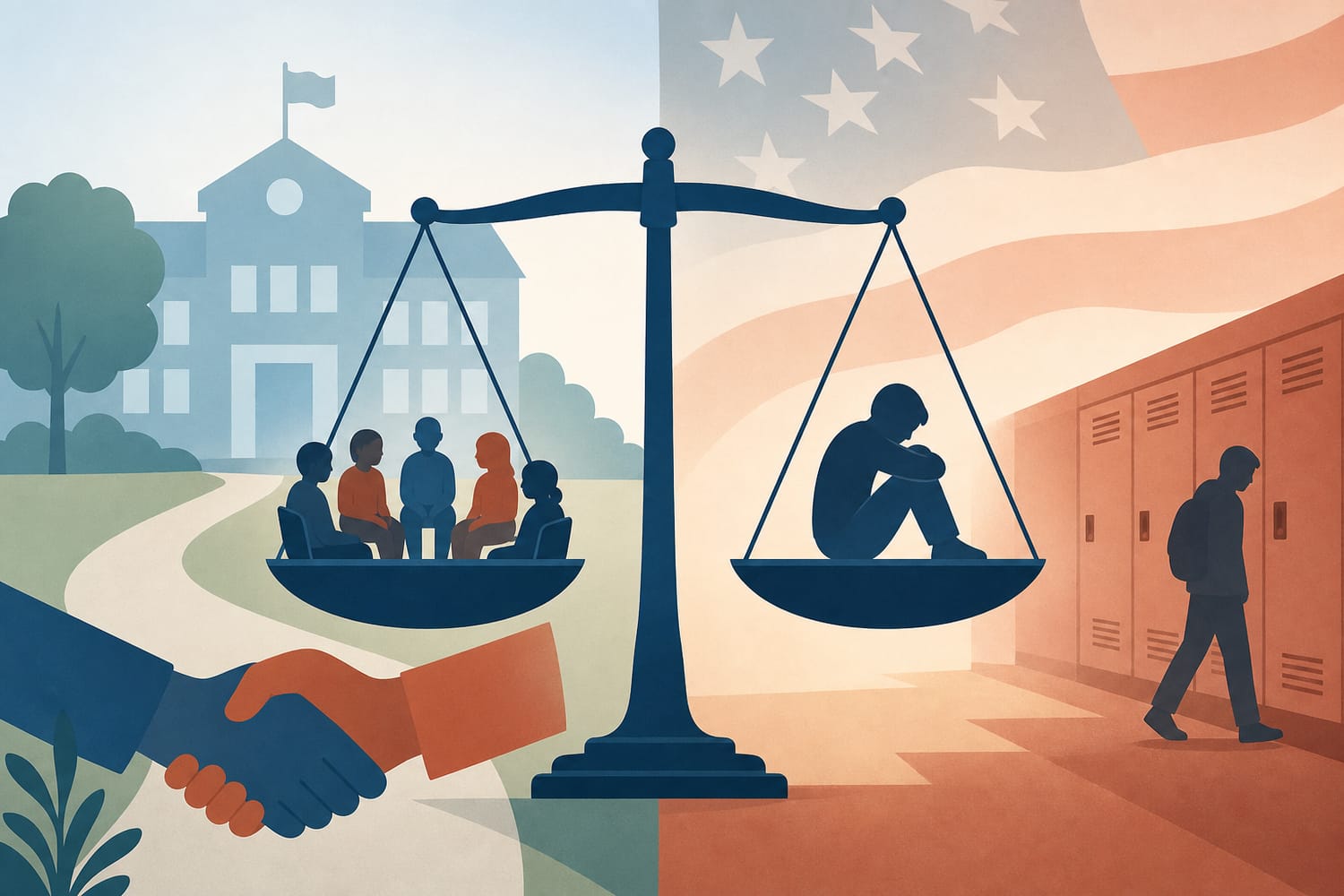
Restorative justice in schools has become one of the most debated approaches to student discipline. Supporters see it as a humane and effective alternative to suspensions, expulsions, and zero-tolerance policies. Critics worry that it can weaken consequences, place too much burden on teachers, and allow disruptive or harmful behavior to continue without enough accountability.
At the center of the debate is a basic question: when students break rules, harm others, or disrupt learning, what should schools do? Traditional discipline often focuses on punishment: detention, suspension, removal from class, or formal consequences. Restorative justice focuses more on repairing harm, rebuilding relationships, and helping students understand the impact of their behavior.
The disagreement is not always between people who care about discipline and people who do not. In many cases, both sides want safe schools, fair treatment, and better outcomes for students. The conflict is over which methods actually produce those outcomes.
What Restorative Justice Means in Schools
Restorative justice is an approach that asks students to take responsibility for their actions by understanding who was harmed, how they were harmed, and what can be done to make things right. In schools, this may involve restorative circles, mediation between students, conversations with teachers, written reflection, community service, apologies, or agreements about future behavior.
Instead of asking only, “What rule was broken and what punishment should follow?” restorative practices ask, “What happened, who was affected, and how can the harm be repaired?”
For minor conflicts, this might mean two students talking through an argument with a counselor. For more serious incidents, it may involve a structured meeting with the student who caused harm, the person harmed, families, staff, and administrators. The goal is not simply to avoid punishment, but to create accountability through dialogue and repair.
However, schools use the term “restorative justice” in different ways. Some have full programs with trained staff, clear procedures, and ongoing support. Others adopt the language without enough training or consistency. This difference is a major reason why people disagree about whether restorative justice works.
The Case for Restorative Justice
Supporters argue that traditional school discipline has often failed students. Suspensions and expulsions may remove a student from the classroom temporarily, but they do not always teach better behavior. A student who is suspended may fall behind academically, become more disconnected from school, and return without having resolved the underlying issue.
Advocates also point to research showing that exclusionary discipline has been used disproportionately against Black students, Indigenous students, students with disabilities, and students from low-income backgrounds. From this view, restorative justice is a way to reduce unfair discipline practices and keep students connected to education.
Supporters believe restorative practices can improve school climate by encouraging empathy, communication, and problem-solving. When students are required to face the people they harmed, explain their actions, and participate in repairing the damage, advocates say this can be more meaningful than simply sitting at home during a suspension.
Many also argue that restorative justice reflects how people often resolve conflicts in real life. In workplaces, families, and communities, repair and dialogue are often necessary after harm occurs. Schools, they argue, should teach students these skills rather than relying mainly on punishment.
Concerns About Accountability
Critics do not always reject restorative justice entirely, but they often worry about how it is implemented. One major concern is that restorative practices can become a substitute for consequences rather than a form of accountability. If students believe they can misbehave, attend a brief conversation, and return to class without meaningful consequences, critics argue the approach may encourage more disruption.
Teachers and parents who express concern often describe situations where students repeatedly interrupt class, bully peers, or defy staff, yet face few visible consequences. In these cases, restorative justice may be perceived as “letting bad behavior slide,” even if that is not the intention.
Critics argue that accountability must include clear boundaries. They believe students should understand that harmful behavior has predictable consequences, especially when it affects the safety or learning of others. From this perspective, restorative conversations may be useful, but they should not replace discipline in serious or repeated cases.
Some also worry that restorative justice can put pressure on victims to forgive or participate in conversations before they are ready. If a student has been bullied, threatened, or assaulted, requiring a meeting with the person who harmed them may feel unfair or even harmful. Critics say the needs and safety of victims must come first.
The Role of Teachers and School Staff
Another major part of the debate is the burden placed on teachers. Supporters of restorative justice often say that it works best when the whole school is trained and committed. Teachers, counselors, administrators, and students all need to understand the process. Restorative practices are not simply a quick conversation after misbehavior; they require time, skill, and follow-through.
Teachers who support restorative practices often say they help build stronger relationships with students. When students feel respected and understood, they may be more willing to cooperate and less likely to act out. Some educators find that restorative circles create a sense of community and reduce conflicts before they escalate.
However, other teachers argue that restorative justice can be difficult to manage in already crowded and stressful classrooms. If teachers are expected to handle serious behavior problems through dialogue without enough administrative support, they may feel abandoned. Critics say that asking teachers to facilitate restorative conversations, document incidents, maintain order, and continue instruction can be unrealistic.
This concern is especially strong in schools with staffing shortages, large class sizes, or high levels of student need. In such settings, even a well-intentioned restorative program may fail if staff do not have the time or resources to carry it out properly.
Safety, Disruption, and the Rights of Other Students
A central argument against poorly implemented restorative justice is that it may overlook the rights of students who want to learn in a safe and orderly environment. When one student repeatedly disrupts class, the rest of the class loses instructional time. When bullying or harassment is not addressed firmly, targeted students may feel unsafe.
Critics argue that schools have a responsibility not only to the student who misbehaved, but also to the students affected by that behavior. They worry that discipline reforms sometimes focus too heavily on reducing suspensions without equally focusing on whether classrooms become calmer, safer, or more productive.
Supporters respond that restorative justice, when done correctly, does take harm seriously. They argue that traditional discipline can also fail victims by removing the offender temporarily without repairing the damage or preventing future harm. A suspension may punish the student, but it does not necessarily help the victim feel heard or safe.
Both sides often agree that safety matters. The disagreement is whether restorative justice protects safety better than traditional discipline, or whether it risks weakening the boundaries that make safety possible.
Equity and Disproportionate Discipline
One of the strongest arguments for restorative justice comes from concerns about equity. Data from many school systems has shown that some groups of students are suspended or expelled at higher rates than others, even for similar behavior. Supporters of restorative justice argue that these patterns can contribute to long-term inequality by increasing absenteeism, lowering achievement, and raising the risk of involvement with the juvenile justice system.
From this perspective, reducing suspensions is not about ignoring misbehavior. It is about questioning whether exclusionary discipline has been used too often, too harshly, or too unevenly. Restorative justice is seen as a way to address behavior while keeping students in school.
Critics may agree that discipline should be fair but question whether lowering suspension numbers always means schools are safer or more just. They argue that if schools reduce suspensions by simply not responding to serious behavior, the result may be hidden disorder rather than true equity.
Some also argue that disadvantaged students are harmed when classrooms become chaotic. If disruptive behavior is not addressed effectively, students in under-resourced schools may lose even more learning time. For these critics, equity requires both fair discipline and strong academic environments.
Implementation Makes a Major Difference
Much of the debate may come down to implementation. Restorative justice can look very different depending on the school. In a strong model, staff are trained, expectations are clear, students understand the process, and restorative practices are combined with appropriate consequences when necessary. There is follow-up to ensure agreements are kept, and victims are not forced into participation.
In a weak model, schools may use restorative language without structure. Administrators may discourage suspensions but fail to provide alternatives. Teachers may be told to “build relationships” without support. Students may see the process as optional or unserious. In these cases, restorative justice can lose credibility quickly.
This is why some people argue that the debate should not be framed as restorative justice versus discipline. Instead, the question should be what kind of discipline system best teaches responsibility, protects students, and supports learning. Restorative practices may be one part of that system, but they may not be enough on their own.
Finding a Balanced Approach
Some educators and policymakers try to combine restorative justice with clear consequences. In this view, restorative practices are not meant to eliminate discipline, but to make discipline more constructive. A student who harms someone may still face consequences, but also must participate in repairing the harm. A student who repeatedly disrupts class may receive support, but also face escalating interventions if the behavior continues.
This balanced approach attempts to answer concerns from both sides. It recognizes that students are still developing and need opportunities to learn from mistakes. It also recognizes that schools must maintain order and protect students from harm.
The challenge is deciding which behaviors are appropriate for restorative responses, which require traditional consequences, and which require both. Minor conflicts may be well suited for restorative circles or mediation. Serious violence, threats, or repeated harassment may require stronger interventions, possibly including removal from the classroom or involvement of outside authorities.
Why the Debate Continues
The debate over restorative justice in schools continues because it touches on many difficult issues at once: fairness, safety, race, disability, teacher authority, student rights, and the purpose of education. People on different sides may be responding to different experiences. One person may have seen restorative justice transform a school culture. Another may have seen it used as an excuse for inaction.
Supporters tend to emphasize that punishment alone often fails to change behavior and can deepen student disconnection. Critics tend to emphasize that accountability must be real, visible, and consistent to protect the learning environment.
Both concerns are important. A school discipline system that is harsh but ineffective does not serve students well. Neither does a system that is compassionate but unclear, inconsistent, or unsafe.
Restorative justice is not automatically a solution, and it is not automatically a way of letting bad behavior slide. Its value depends on how seriously schools define accountability, how well they support staff, how carefully they protect victims, and how consistently they respond to harm. The strongest versions of restorative justice aim to build responsibility rather than avoid consequences. The weakest versions risk confirming critics’ fears.
For schools, the real question may not be whether to choose restoration or accountability, but how to ensure that any approach to discipline includes both.