
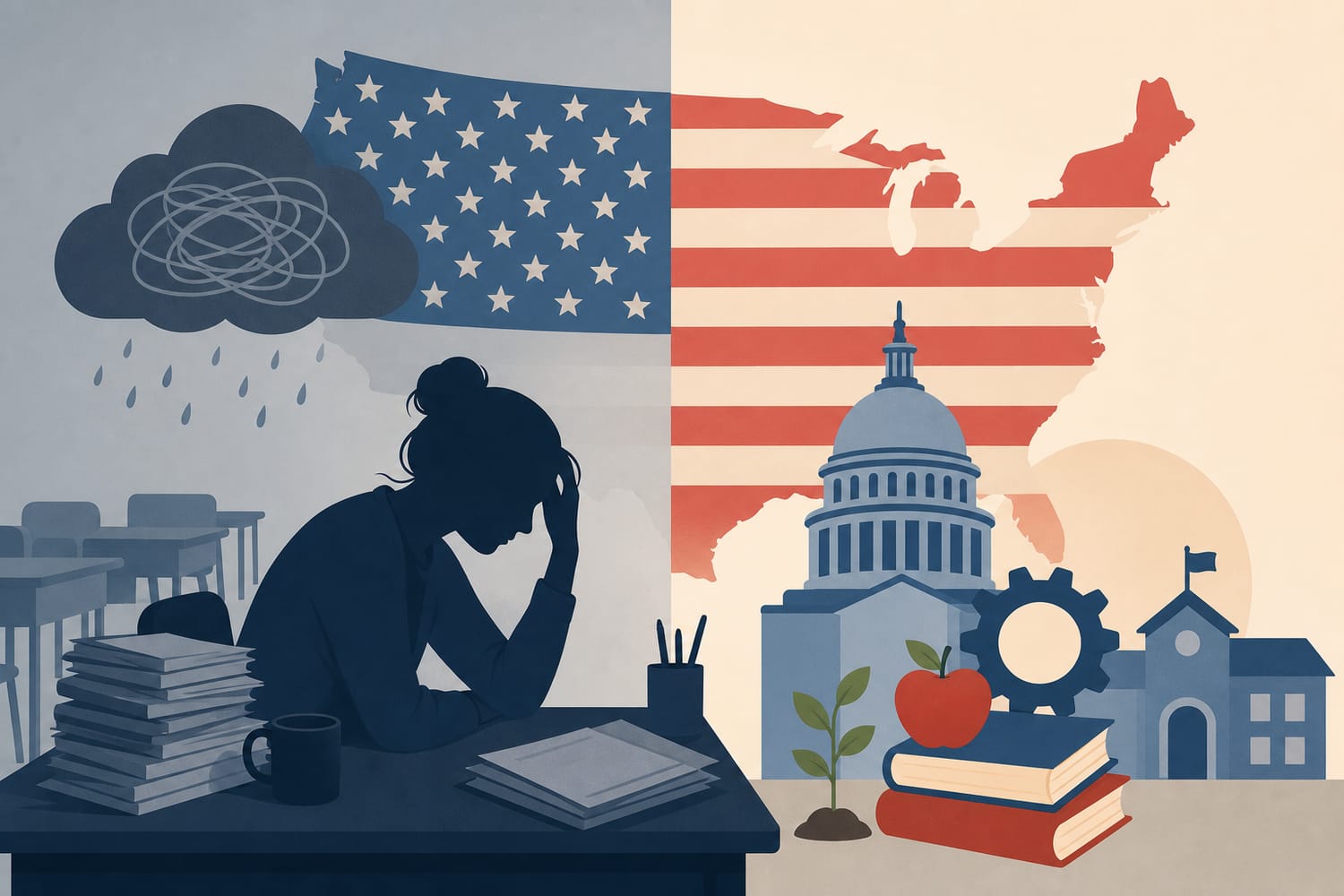
Teacher burnout in America is often described as a classroom crisis: educators exhausted by long hours, student needs, paperwork, political pressure, and relatively modest pay. But there is disagreement over what this burnout means and what should be done about it. Some see it as evidence of a broken system that places unreasonable demands on teachers. Others argue that burnout is real but not unique to teaching, and that solutions should focus on better management, clearer expectations, and individual resilience. Still others believe the issue is connected to broader debates over school funding, unions, accountability, discipline, and the purpose of public education itself.
At the center of the discussion is a shared concern: when teachers are overwhelmed, students can be affected. High turnover disrupts learning, weakens relationships, and forces schools to spend time and money recruiting replacements. Yet people disagree sharply about the causes. Is teacher burnout mainly the result of underfunded schools and unrealistic workloads? Is it driven by poor leadership and inefficient bureaucracy? Is it made worse by cultural and political conflict? Or is it partly a matter of whether teaching, as a profession, has adapted to changing expectations?
The debate is not simply between people who support teachers and people who do not. Many viewpoints overlap. Parents may sympathize with teachers while also wanting higher academic standards. Administrators may want to reduce stress but feel constrained by budgets and regulations. Policymakers may seek accountability but unintentionally create more paperwork. Teachers themselves may disagree about whether the biggest problem is pay, workload, student behavior, lack of autonomy, or public disrespect.
The View That Burnout Is a Systemic Problem
One common perspective is that teacher burnout is primarily a systemic issue. Supporters of this view argue that teachers are being asked to do too much with too little support. In many schools, teachers are responsible not only for academic instruction but also for social-emotional support, behavior management, data tracking, family communication, standardized test preparation, and administrative documentation. The job has expanded far beyond lesson planning and classroom teaching.
Those who see burnout as systemic often point to low salaries compared with other professions requiring similar education levels. While teacher pay varies widely by state and district, many educators report needing second jobs, especially early in their careers or in high-cost areas. From this perspective, burnout is not just emotional fatigue; it is tied to financial stress and the feeling that society values teachers in words but not in compensation.
Class size is another major concern. Teachers with large classes may have less time to give individual attention, grade assignments thoughtfully, or manage behavior effectively. In under-resourced schools, the problem may be compounded by shortages of counselors, aides, nurses, special education staff, and substitute teachers. When support positions are cut or left unfilled, classroom teachers often absorb the extra work.
Advocates of this position argue that burnout cannot be solved with wellness workshops or inspirational messages. They believe the root causes are structural: funding formulas, staffing shortages, accountability mandates, inadequate planning time, and a lack of professional respect. Their solutions tend to include higher pay, smaller classes, more mental health staff, reduced paperwork, stronger teacher voice in decision-making, and more stable school funding.
The View That Leadership and Management Matter Most
Another perspective agrees that burnout is serious but emphasizes school leadership and management rather than the entire education system. According to this view, two schools with similar funding can have very different teacher morale depending on the quality of leadership. A supportive principal, clear communication, consistent discipline policies, and a healthy staff culture can make a difficult job feel manageable. Poor leadership, by contrast, can make even a well-funded school feel chaotic.
People who hold this view often argue that teachers burn out when expectations are unclear or constantly changing. New initiatives may be introduced without removing old responsibilities. Teachers may be asked to attend meetings that feel unproductive, collect data that is rarely used, or implement programs without proper training. In this argument, burnout is not only caused by lack of resources but by inefficient systems inside schools and districts.
This side may also focus on professional autonomy. Teachers often report frustration when they are required to follow scripted curricula or pacing guides that leave little room for judgment. Others feel micromanaged by administrators who are responding to district or state mandates. Supporters of management-focused reform argue that teachers need both accountability and trust. They believe schools should reduce unnecessary tasks, protect planning time, improve principal training, and create more realistic schedules.
This viewpoint can appeal to people across the political spectrum because it does not necessarily require a complete overhaul of public education funding. Instead, it asks whether existing resources are being used wisely. Critics, however, may respond that leadership improvements are important but cannot fully compensate for low pay, overcrowded classrooms, or chronic understaffing.
The View That Accountability and Standards Are Necessary
A different side of the debate worries that discussions of burnout may sometimes be used to resist accountability. From this perspective, public schools serve students and taxpayers, so there must be standards for performance. Supporters argue that testing, evaluations, and data collection exist because families and communities deserve to know whether students are learning. They may acknowledge that these systems can be burdensome but believe the answer is to improve them, not eliminate them.
People in this camp often point out that education outcomes vary significantly across schools, districts, and demographic groups. Without accountability, they argue, struggling students may be overlooked, and ineffective practices may continue unchecked. In their view, teacher burnout should be addressed, but not by lowering expectations for student achievement or removing measures of school performance.
Some also argue that teaching, like other professions, involves stress and evaluation. Doctors, nurses, lawyers, and social workers face demanding workloads and accountability as well. From this angle, the conversation should avoid portraying all professional pressure as unfair. Instead, it should distinguish between reasonable expectations and excessive bureaucracy.
Critics of this position respond that accountability systems often measure only a narrow part of what teachers do. Standardized tests may not capture student growth, classroom climate, creativity, or the challenges of teaching students with trauma, disabilities, or language barriers. They argue that poorly designed accountability can increase burnout without improving learning.
The View That Student Behavior and Social Conditions Are Central
Many teachers and commentators argue that burnout cannot be understood without discussing student behavior and the social conditions students bring into school. Teachers may face classrooms where students are anxious, distracted, disruptive, or dealing with serious personal challenges. Since the pandemic, many educators have reported increases in absenteeism, emotional distress, academic gaps, and behavioral problems.
From this perspective, burnout is connected to broader issues such as poverty, family instability, community violence, social media, mental health needs, and declining trust in institutions. Teachers are often expected to respond to these problems, but they are not trained or resourced to solve them alone. A classroom can become overwhelming when one teacher is responsible for both instruction and crisis management.
Some who emphasize behavior argue for clearer discipline policies and stronger consequences for disruptive conduct. They believe schools have become too hesitant to remove students who repeatedly interrupt learning. In this view, protecting teachers from burnout also means protecting the learning environment for other students.
Others caution against discipline-heavy responses, arguing that exclusionary policies can disproportionately affect students with disabilities, students of color, or students experiencing trauma. They advocate for restorative practices, counseling, and family support instead. However, even among those who support restorative approaches, there is debate over whether schools have enough staff and training to implement them effectively.
The View That Unions and Policy Play a Major Role
Teacher unions are another point of disagreement. Supporters argue that unions protect teachers from unfair treatment, advocate for better pay and working conditions, and give educators a voice in policy decisions. From this view, unions are essential in addressing burnout because individual teachers often have little power to challenge unreasonable workloads or unsafe conditions.
Critics of unions argue that they can make it harder to remove ineffective teachers, resist necessary reforms, or prioritize adult employment concerns over student outcomes. They may say that rigid contracts limit flexibility in staffing, scheduling, and innovation. In this view, burnout may be worsened when systems reward seniority over performance or make it difficult for school leaders to build strong teams.
There are also disagreements about state and federal policy. Some blame lawmakers for underfunding schools or imposing mandates without resources. Others blame education bureaucracies for spending too much on administration rather than classroom needs. The debate often reflects broader political beliefs about government, labor, taxation, and local control.
The View That Personal Resilience Still Matters
While many discussions focus on systems, some argue that individual coping skills and professional boundaries should not be ignored. Teaching is emotionally demanding, and educators may benefit from mentorship, time management strategies, peer support, and mental health resources. New teachers in particular may need help adjusting to the realities of the classroom.
Supporters of this view are not necessarily blaming teachers for burnout. Rather, they argue that even in improved systems, teaching will remain challenging. Learning how to set limits, avoid perfectionism, manage conflict, and recover from stress can help teachers stay in the profession.
Critics worry that focusing on resilience can shift responsibility away from institutions. They argue that telling teachers to practice self-care while leaving workloads unchanged can feel dismissive. For them, resilience is useful only if paired with real changes in conditions.
The debate over teacher burnout in America is not a simple argument between crisis and exaggeration. Most sides recognize that many teachers are under strain, but they differ on why it is happening and which solutions matter most. Some emphasize systemic problems such as pay, staffing, class size, and funding. Others focus on leadership, discipline, accountability, unions, social conditions, or personal resilience.
The most balanced view may be that burnout is both a classroom crisis and a fixable systemic problem. It is a crisis because it affects teachers and students right now. It is systemic because many causes extend beyond any single classroom. But it may also be fixable if policymakers, administrators, families, and educators can separate competing assumptions from shared goals: stable schools, supported teachers, and students who can learn in safe and effective classrooms.