
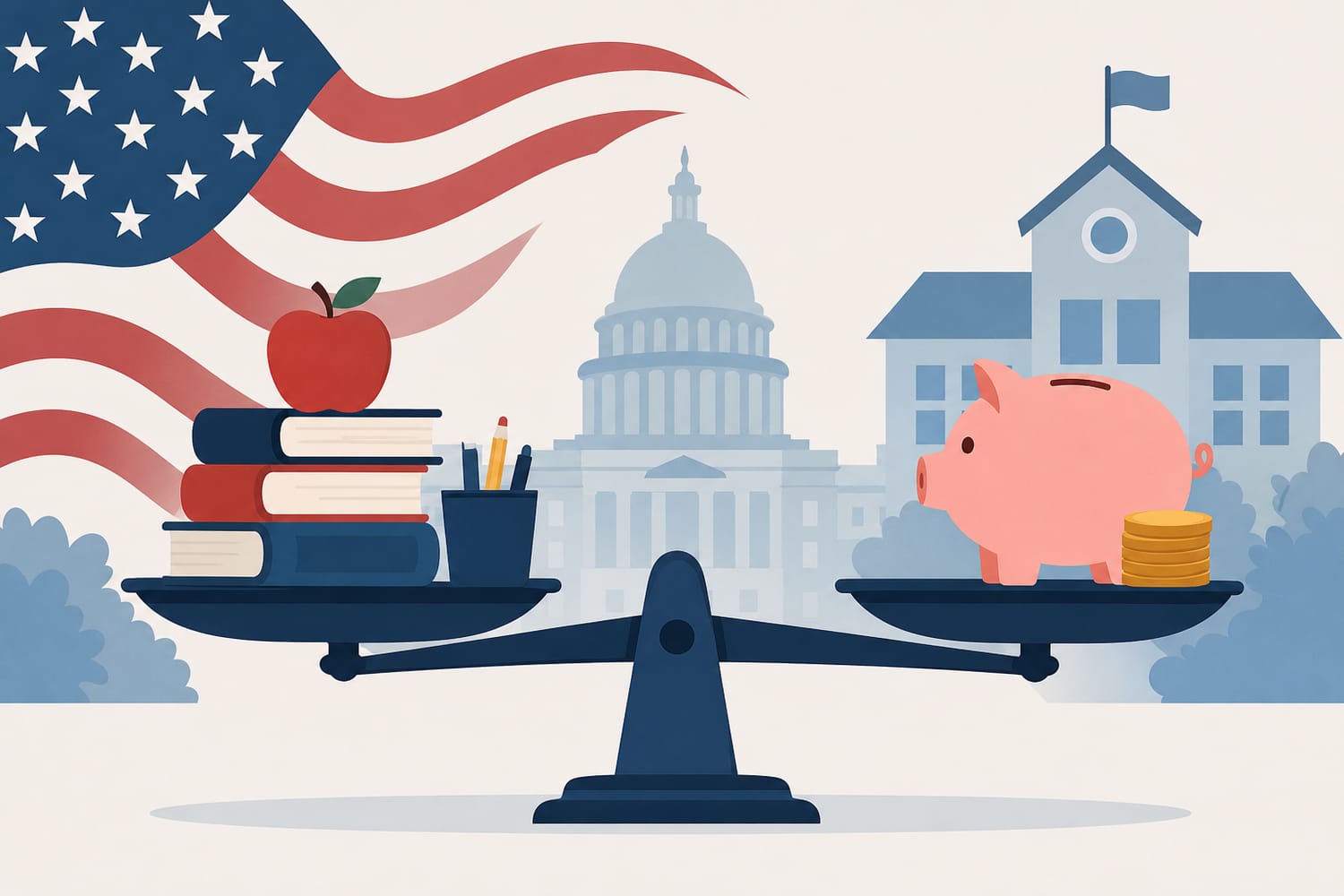
Why Teacher Pay Remains a National Debate
Teacher pay in America sits at the center of a difficult public policy debate: how to fairly compensate educators while also managing the financial realities of school systems. Nearly everyone agrees that teachers play a crucial role in children’s development, workforce readiness, and civic life. Yet there is far less agreement about how much teachers should be paid, how raises should be funded, and whether current compensation systems are effective or sustainable.
The debate is complicated because public education is funded through a mix of local, state, and federal dollars, with large differences across states and districts. A teacher’s salary may look reasonable in one community and inadequate in another, especially when cost of living is considered. In some areas, teachers struggle to afford housing near the schools where they work. In others, school districts argue that rising salary and benefit costs are already consuming most of their budgets.
As a result, the discussion is not simply about whether teachers “deserve” more pay. It is also about taxes, class sizes, pensions, staffing levels, school quality, and competing priorities within education budgets. Different sides emphasize different parts of the problem.
The Case for Raising Teacher Pay
Supporters of higher teacher salaries argue that teachers are underpaid relative to the importance and difficulty of their work. They point out that teachers are responsible not only for delivering academic instruction, but also for classroom management, lesson planning, student assessment, parent communication, and often emotional and social support for students.
Many teachers work beyond the official school day, grading assignments, preparing lessons, attending meetings, or supporting extracurricular activities. Advocates say the common idea that teachers have short workdays and long summers overlooks the unpaid or underpaid labor many educators perform throughout the year.
Another major argument is recruitment and retention. Districts in many parts of the country report shortages in areas such as special education, math, science, bilingual education, and rural schooling. Supporters of higher pay argue that if teaching salaries are not competitive with other professions requiring similar education and skill, fewer talented people will enter or remain in the field.
They also note that teacher turnover can be costly. When experienced educators leave, districts must spend money recruiting, hiring, and training replacements. Students may also lose the benefit of stable, experienced instruction. From this perspective, higher pay is not merely an expense, but an investment in educational quality.
The Argument That Budgets Are Already Stretched
On the other side, some school board members, administrators, taxpayers, and policy analysts argue that raising teacher pay is not as simple as it sounds. Public school budgets are finite, and salaries already make up a large share of district spending. When benefits, pensions, and payroll costs are included, employee compensation can consume the majority of many school budgets.
Those concerned about budget strain often ask where additional money would come from. Raising teacher salaries may require higher local property taxes, increased state funding, cuts to other programs, or larger class sizes. Some communities may support tax increases for education, while others may strongly oppose them, particularly in areas where residents already feel financially pressured.
Districts also face rising costs in areas beyond teacher salaries. Special education services, transportation, building maintenance, technology, school safety, health insurance, and mental health supports all compete for funding. Critics of broad salary increases may argue that every dollar spent on pay raises is a dollar not spent on textbooks, counselors, classroom aides, tutoring programs, or facility improvements.
This side does not necessarily oppose better teacher pay in principle. Rather, it emphasizes trade-offs and argues that salary decisions must be made within realistic financial limits.
Cost of Living and Regional Differences
One challenge in the teacher pay debate is that national averages can be misleading. Teacher salaries vary widely by state, district, and local cost of living. A salary that seems modest in a major metropolitan area may go further in a rural community with lower housing costs. Likewise, a relatively high salary in an expensive city may still leave teachers struggling to live near their schools.
Supporters of regional adjustments argue that teacher pay should be evaluated in relation to local living expenses. In high-cost areas, inadequate salaries can force teachers into long commutes, second jobs, or shared housing. This can make recruitment especially difficult in cities where housing prices have risen faster than public-sector wages.
Others caution that cost-of-living comparisons can complicate statewide salary policies. If high-cost districts receive more money for salaries, lower-cost districts may feel neglected or underfunded. Rural districts, for example, may face their own recruitment challenges even if the cost of living is lower. They may have smaller tax bases, fewer applicants, and difficulty attracting specialists.
Because of these differences, some argue for targeted pay strategies rather than across-the-board increases. Others believe that broad increases are necessary because underpayment is a national problem, not just a regional one.
Merit Pay and Performance-Based Compensation
Another major area of disagreement is whether all teachers should receive similar raises or whether pay should be linked to performance. Supporters of merit pay argue that effective teachers should be rewarded more than less effective ones. They say performance-based compensation could attract ambitious professionals, encourage excellence, and make teaching more similar to other fields where pay reflects results.
Some also argue that current salary schedules, which often reward years of service and advanced degrees, do not always reflect classroom effectiveness. From this perspective, a teacher’s impact on student learning should matter more than seniority alone.
However, opponents of merit pay raise several concerns. They argue that teaching quality is difficult to measure fairly, especially when student test scores are used as a major factor. Students come to school with different needs, resources, and challenges, and teachers may work in very different conditions. A teacher in a high-poverty school may be highly skilled but still face lower test score growth than a teacher in a more advantaged setting.
Critics also warn that merit pay can create competition rather than collaboration among teachers. Schools often depend on teamwork, shared planning, and mentorship. If pay is tied too narrowly to individual performance, some educators fear it could weaken the cooperative culture that helps students succeed.
Unions, Negotiations, and Public Perception
Teachers unions play a central role in the pay debate. Supporters of unions argue that collective bargaining helps educators secure fair wages, benefits, planning time, and working conditions. They say unions give teachers a voice in decisions that affect classrooms and prevent districts from balancing budgets by underpaying staff.
Union advocates also argue that better teacher working conditions are student learning conditions. If teachers have manageable class sizes, adequate preparation time, and stable compensation, students benefit from a stronger educational environment.
Critics of teachers unions sometimes argue that union contracts can make school systems less flexible. They may object to salary schedules based heavily on seniority, protections that make it difficult to remove ineffective teachers, or benefit commitments that create long-term financial obligations. Some believe unions prioritize adult employment interests over student outcomes or taxpayer concerns.
Public perception varies. During teacher strikes or protests, some community members see educators advocating for the respect and resources schools need. Others may see disruptions to families and question whether demands are affordable. The same event can be interpreted very differently depending on local conditions and political beliefs.
Benefits, Pensions, and Total Compensation
Salary is only one part of teacher compensation. Benefits such as health insurance, retirement plans, paid leave, and pensions are also important. Some analysts argue that discussions of teacher pay should include total compensation, not just wages. In some districts, benefits and pension contributions represent a significant financial commitment.
Those who emphasize total compensation argue that while teacher salaries may appear low compared with some private-sector jobs, public-sector benefits can be more generous or secure. They may point to defined-benefit pensions, job stability, or health coverage as forms of compensation that should be included in the comparison.
Others respond that benefits do not solve the problem of low take-home pay. Younger teachers, in particular, may struggle with rent, student loans, childcare, or transportation costs. A pension decades in the future may not help a teacher afford basic expenses today. In addition, some teachers leave the profession before becoming fully vested in retirement systems, meaning they may not receive the full value of promised benefits.
This creates a divide between short-term affordability and long-term compensation. Some reformers suggest shifting more money from back-loaded benefits into current salaries, while others warn that weakening pensions could make teaching less attractive over time.
Impact on Students and School Quality
Both sides of the debate often claim to be focused on students, but they emphasize different pathways to improving education. Supporters of higher pay argue that students benefit when schools can attract and retain strong teachers. They see teacher compensation as directly tied to classroom quality, especially in hard-to-staff schools.
They may also argue that low pay contributes to burnout. Teachers who work second jobs or feel financially stressed may have less energy for instruction and student support. In this view, investing in teachers is one of the most direct ways to invest in students.
Those more cautious about salary increases may argue that student outcomes depend on more than teacher pay. They may prioritize early literacy programs, tutoring, smaller classes, curriculum improvements, school leadership, or family support services. If large raises reduce funding for these initiatives, they argue, students may not benefit overall.
The central disagreement is not whether teachers matter, but how school dollars should be allocated to produce the greatest benefit for students.
Possible Middle-Ground Approaches
Some policy proposals attempt to bridge the divide. One approach is targeted salary increases for shortage areas, high-poverty schools, or early-career teachers. This could address urgent recruitment problems without requiring the same level of spending as universal raises.
Another option is increasing state funding to reduce reliance on local property taxes. Supporters say this could help poorer districts compete for teachers. Critics may worry about state budget pressures or the possibility that new education funding could crowd out other public services.
Some advocate career ladders, where experienced teachers can earn more by mentoring colleagues, leading curriculum work, or taking on specialized roles without leaving the classroom. Others support loan forgiveness, housing assistance, or tax credits as ways to improve teachers’ financial position without permanently increasing salary schedules.
There is also interest in rethinking school spending more broadly. Some argue districts should reduce administrative costs, consolidate services, or redirect money toward classrooms. Others caution that what appears to be “administration” may include essential functions such as compliance, student services, and operations.
A Debate About Values and Trade-Offs
Teacher pay in America is ultimately a debate about both values and trade-offs. Many people believe educators should be paid more because their work is essential, demanding, and socially valuable. Others agree with the sentiment but worry about how to pay for it without overburdening taxpayers or cutting other school services.
The strongest arguments on each side recognize part of the truth. Teachers need compensation that allows them to live with dignity and remain in the profession. School districts also need budgets that are sustainable and flexible enough to meet a wide range of student needs.
There is unlikely to be one national answer because communities differ in wealth, cost of living, staffing needs, and political priorities. Still, the debate continues because the stakes are high. How America pays teachers reflects how it values education, public service, fiscal responsibility, and the future opportunities of its children.