
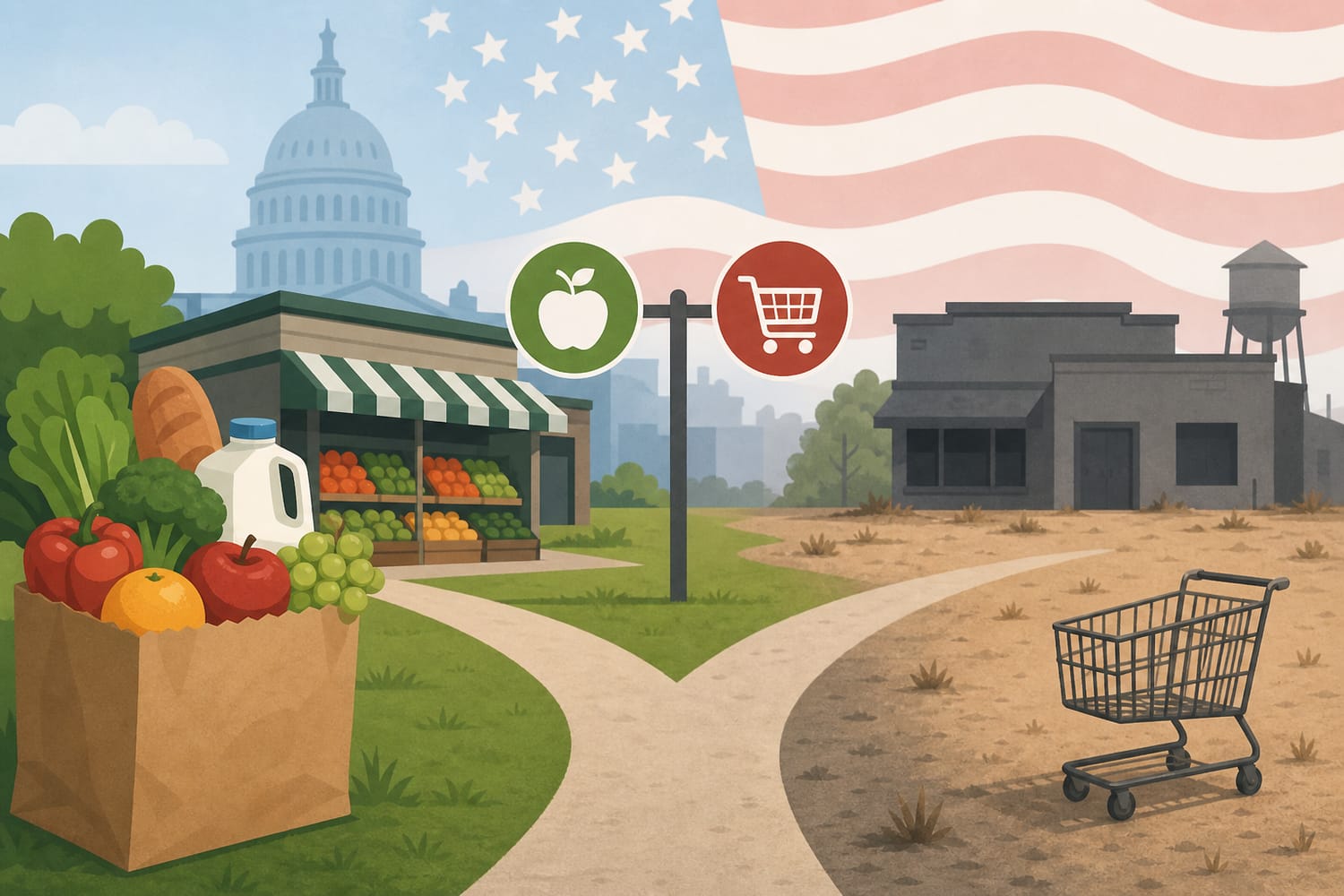
Across the United States, millions of people live in communities where fresh, affordable, and nutritious food is difficult to access. These areas are often called “food deserts,” though some advocates prefer terms like “food apartheid” or “low-access communities” because they believe the problem is shaped by policy, economics, and inequality rather than natural conditions. The debate over food deserts raises a larger question: Are unhealthy diets mainly the result of personal choice, or do they reflect a public health failure?
There is no single answer that satisfies everyone. Some people argue that individuals ultimately decide what to buy and eat, even in difficult circumstances. Others argue that choices are deeply shaped by income, transportation, neighborhood design, advertising, work schedules, and decades of disinvestment. Many researchers, policymakers, and community leaders take a middle position, suggesting that personal responsibility and structural barriers both matter.
Understanding the debate requires looking at the assumptions behind each side. Food access is not only about whether a supermarket exists nearby. It is also about price, time, culture, safety, transportation, quality, and trust. The question is not simply whether people can make healthy choices, but how easy or realistic those choices are in the environments where they live.
The Argument for Personal Choice
Those who emphasize personal choice often argue that individuals have more control over their diets than public health narratives suggest. From this perspective, people make daily decisions about what to eat, how to budget, and whether to prioritize health. Supporters of this view may point out that even in neighborhoods without large grocery stores, many residents can still access food through corner stores, discount stores, delivery services, public transportation, or shopping trips outside the neighborhood.
This side often argues that education and motivation are key. If people understand nutrition, learn how to cook affordable meals, and plan purchases carefully, they may be able to eat healthier even on limited incomes. Beans, rice, frozen vegetables, oats, eggs, and canned fish are frequently cited as examples of relatively inexpensive foods that can form a nutritious diet. From this view, the issue is less about physical access and more about knowledge, habits, and priorities.
Some also argue that framing food deserts as primarily structural can unintentionally reduce people’s sense of agency. They worry that if public discussion focuses too heavily on barriers, it may imply that low-income communities cannot make good decisions without outside intervention. For these critics, encouraging personal responsibility is not meant to blame individuals, but to affirm that people have the ability to improve their health within existing constraints.
There is also skepticism about whether simply adding supermarkets changes eating patterns. Some studies have found that when new grocery stores open in underserved neighborhoods, residents do not always dramatically change their diets. Critics use this evidence to argue that access alone is not enough, and that preferences, habits, cooking skills, and family traditions play major roles.
The Argument for Public Health Failure
On the other side, many public health experts argue that food deserts are not mainly the result of individual choices, but of systems that limit meaningful options. They point out that a “choice” is not equally free when one person has several nearby supermarkets, reliable transportation, a flexible schedule, and extra income, while another person has a corner store, two bus transfers, unpredictable work hours, and a tight budget.
This perspective emphasizes that food environments are shaped by policy and market forces. Supermarkets may avoid low-income neighborhoods because of lower profit margins, perceived crime risk, higher insurance costs, or limited real estate options. Meanwhile, fast-food restaurants and convenience stores may be more common because they are cheaper to operate and can profit from highly processed foods with long shelf lives.
Supporters of the public health view also connect food deserts to broader patterns of inequality. Historically, practices such as redlining, racial segregation, highway construction, suburbanization, and uneven investment helped determine which neighborhoods received quality stores, safe streets, and economic opportunities. In this view, current food access problems are not accidents; they are the result of decisions made over generations.
Health outcomes are central to this argument. Communities with limited access to nutritious food often experience higher rates of obesity, diabetes, hypertension, and heart disease. While diet is not the only cause, public health advocates argue that it is unfair to tell individuals to “make better choices” without addressing the conditions that make healthy eating more expensive, time-consuming, or inconvenient.
The Role of Poverty and Food Prices
A key issue in the debate is affordability. Even when healthy food is technically available, it may not be financially realistic. Fresh produce, lean meats, and whole-grain products can cost more upfront than calorie-dense processed foods. For families trying to stretch limited food budgets, the priority may be getting enough calories rather than meeting ideal nutrition guidelines.
Those who focus on personal choice may respond that healthy eating does not always require expensive ingredients. They argue that careful shopping, cooking at home, and avoiding prepared foods can reduce costs. However, critics point out that this assumes people have time, equipment, storage space, stable housing, and predictable schedules. A person working multiple jobs or living in a motel may not have the same ability to cook large batches of meals as someone with a full kitchen and weekends free.
Food prices also interact with risk. A low-income parent may hesitate to spend limited money on fresh vegetables that children might reject or that may spoil quickly. Processed foods are often cheap, familiar, filling, and shelf-stable. From one angle, buying them may look like an unhealthy choice. From another, it may be a rational decision under financial pressure.
Transportation, Time, and Geography
Physical distance matters, but so does the ability to travel. In many rural areas, the nearest full-service grocery store may be many miles away. In urban neighborhoods, a store may be closer in distance but still difficult to reach without a car, especially for elderly residents, disabled people, or parents with young children.
Public transportation can help, but it may not fully solve the problem. Carrying groceries on buses or trains can be difficult, particularly in bad weather or when transfers are required. Ride-share services and grocery delivery may be available in some places, but fees, digital access, and payment requirements can exclude many households.
Time is another important factor. People with long commutes, irregular shifts, caregiving responsibilities, or multiple jobs may rely on fast food or convenience stores because they are quick and predictable. Personal choice advocates may say that planning ahead can help. Structural critics may respond that time itself is unequally distributed, and public health advice often assumes resources that not everyone has.
Culture, Preference, and Trust
Food is not only fuel; it is tied to culture, memory, comfort, family, and identity. Some debates about food deserts become too narrow when they assume that the presence of fruits and vegetables automatically changes behavior. People buy foods that fit their tastes, cooking traditions, religious practices, and household routines.
There can also be distrust between communities and outside institutions. A new supermarket or public health campaign may fail if it does not reflect local preferences or if residents feel they are being judged. Some communities may prefer smaller local stores, farmers markets, cooperatives, or culturally specific food businesses over large chains.
Those who emphasize personal choice often see preference as a powerful factor that policy cannot easily override. Those who emphasize public health failure may agree that preferences matter, but argue that preferences are shaped by availability, marketing, stress, and long-term exposure. If children grow up surrounded by fast food and processed snacks, their tastes may develop within that environment.
Possible Policy Responses
Policy proposals vary depending on how the problem is understood. If the main issue is personal choice, solutions may focus on nutrition education, cooking classes, budgeting skills, and public awareness campaigns. Schools, clinics, and community organizations may teach people how to prepare affordable healthy meals or read nutrition labels.
If the issue is viewed as structural, proposed solutions may include subsidies for supermarkets, incentives for grocery stores to open in underserved areas, improved public transportation, support for farmers markets, urban agriculture, food cooperatives, and stronger nutrition assistance programs. Some advocates call for restrictions on junk food marketing, especially to children, or zoning rules that limit the concentration of fast-food outlets.
There are also hybrid approaches. For example, programs that double the value of SNAP benefits at farmers markets address affordability while still allowing individual choice. Mobile markets and produce prescription programs bring healthier foods closer to residents while encouraging voluntary behavior change. Community-led grocery cooperatives may combine access, local ownership, and cultural relevance.
Where the Debate Often Overlaps
Despite disagreements, many sides share some common ground. Few people argue that individuals have no responsibility at all, and few argue that environment has no influence whatsoever. The real debate is usually about emphasis: how much responsibility belongs to individuals, businesses, government, and society?
There is growing recognition that simply placing a grocery store in a neighborhood may not be enough. At the same time, telling people to make healthier choices without improving access may also be insufficient. Food behavior is complex, and solutions that ignore either agency or environment are likely to fall short.
The debate over food deserts reflects larger American tensions about health, freedom, inequality, and responsibility. Some see unhealthy eating as a matter of discipline and education. Others see it as evidence of policy neglect and economic injustice. A balanced view recognizes that people make choices, but not under equal conditions. Whether food deserts are seen as personal choice or public health failure may depend on which part of that reality one chooses to emphasize.