
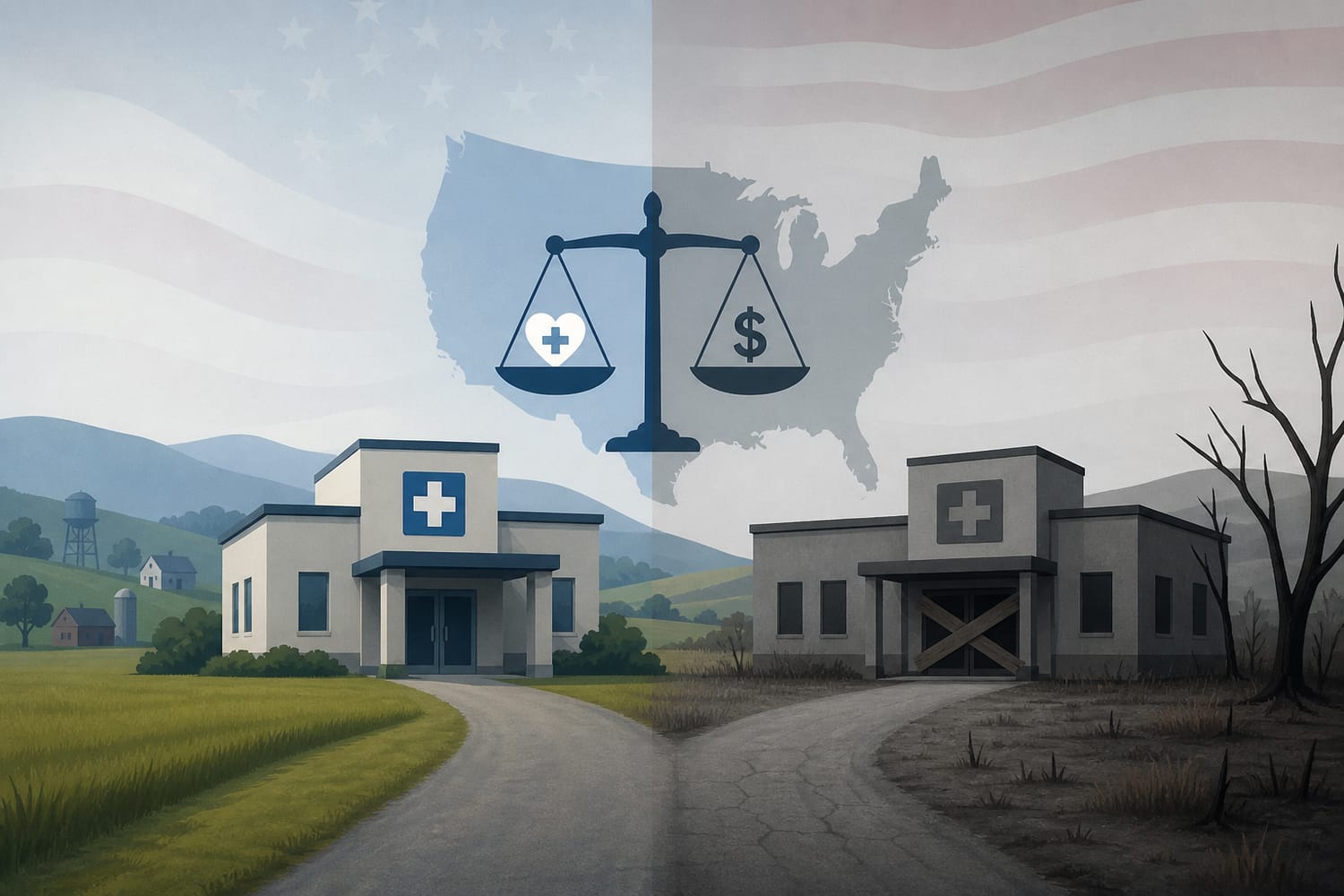
Across the United States, rural hospitals have been closing at a steady pace, leaving many communities farther from emergency rooms, maternity care, inpatient beds, and routine medical services. For some observers, these closures are a painful but predictable outcome of economic forces: declining populations, low patient volumes, staffing shortages, and unsustainable operating costs. For others, they represent a public health emergency that demands urgent government action, because access to care should not depend solely on whether a hospital can turn a profit.
The debate is complicated because both perspectives point to real pressures. Rural hospitals often operate on thin margins and serve areas with fewer patients, higher rates of poverty, older populations, and more chronic illness. At the same time, when a hospital closes, the consequences can be serious: longer travel times, delayed treatment, job losses, and reduced confidence that a community can attract families and businesses. The question is not simply whether rural hospitals are financially struggling, but how society should respond when essential medical infrastructure becomes economically fragile.
The Market Reality Argument
Those who view rural hospital closures as a market reality often argue that many facilities are caught in an unsustainable business model. Hospitals are expensive to operate. They require skilled staff, updated equipment, regulatory compliance, emergency readiness, and around-the-clock services. In areas where populations are shrinking or aging, there may not be enough patients to support a full-service hospital.
Supporters of this view note that health care, despite its public importance, still depends heavily on payment systems. If a hospital treats too few patients, receives low reimbursement rates, or has a high percentage of uninsured or underinsured patients, it may not generate enough revenue to remain open. Even with careful management, a facility may face unavoidable losses.
Some also argue that maintaining every rural hospital in its current form may not be practical or efficient. Instead of preserving all hospitals as full-service institutions, they suggest adapting to modern realities. This could mean converting some hospitals into urgent care centers, freestanding emergency departments, outpatient clinics, telehealth hubs, or limited-service facilities focused on stabilization and transfer. From this perspective, the goal is not to abandon rural health care, but to redesign it in ways that match population size, technology, and available resources.
The Public Health Emergency Argument
Those who see rural hospital closures as a public health emergency emphasize that hospitals are not ordinary businesses. When a retail store or restaurant closes, consumers may be inconvenienced, but when a hospital closes, people may die or suffer preventable harm. In emergencies such as heart attacks, strokes, traumatic injuries, childbirth complications, or severe infections, time matters. A longer drive to the nearest hospital can change outcomes.
This side argues that market logic is poorly suited to essential health infrastructure. Rural communities may never generate the patient volume needed to make a hospital profitable, but residents still need timely access to care. In this view, allowing hospitals to close because they are not financially viable is similar to closing fire stations or police departments in low-population areas because they are not profitable.
Advocates of this position also point out that rural communities often have higher health needs. Many rural areas have older residents, higher rates of chronic disease, limited public transportation, fewer primary care providers, and higher poverty rates. A hospital closure can worsen existing disparities by making preventive care, follow-up appointments, diagnostic testing, and emergency treatment harder to access.
The Role of Medicaid and Insurance Coverage
A major part of the debate centers on Medicaid expansion and insurance coverage. Many analysts argue that rural hospitals in states that expanded Medicaid under the Affordable Care Act have generally fared better than those in states that did not. Medicaid expansion can reduce uncompensated care by giving more low-income adults insurance coverage, which helps hospitals receive payment for services that might otherwise go unpaid.
Supporters of Medicaid expansion say this is one of the clearest policy tools available to stabilize rural hospitals. They argue that when more people are insured, hospitals have a better chance of surviving and patients are more likely to seek care before conditions become severe.
Critics or skeptics may respond that Medicaid expansion is not a complete solution. Medicaid reimbursement rates can be lower than private insurance rates, and hospitals may still struggle even with more insured patients. Some also object to expansion on fiscal or political grounds, arguing that it increases government spending or creates long-term budget obligations. From this perspective, insurance coverage matters, but it does not solve deeper issues such as workforce shortages, low volume, and high fixed costs.
Staffing Shortages and Workforce Pressures
Rural hospital closures are also closely tied to staffing challenges. Recruiting doctors, nurses, specialists, pharmacists, technicians, and administrators to rural areas can be difficult. Many clinicians prefer larger cities where salaries may be higher, professional opportunities broader, and lifestyle amenities more available. Rural hospitals may have to rely on temporary or traveling staff, which can be expensive.
Some argue that the workforce problem supports the market reality perspective: if a hospital cannot attract enough staff, it cannot safely operate, regardless of funding. A hospital without adequate nurses or physicians may not be able to provide reliable care.
Others see staffing shortages as another reason for public intervention. They argue for loan forgiveness, rural residency programs, visa pathways for international physicians, higher rural reimbursement rates, and investments in training local health workers. In this view, the shortage is not an unavoidable market outcome but a policy challenge that can be addressed with incentives and planning.
Community and Economic Impact
Rural hospitals are often among the largest employers in their communities. When one closes, the impact extends beyond health care. Jobs are lost, local spending declines, and nearby businesses may suffer. A hospital closure can also make it harder for a town to attract new employers, retirees, or young families. People may be reluctant to live in a place where emergency care is far away.
Those concerned about rural economic development argue that hospitals serve as community anchors. Losing one can accelerate population decline and deepen rural distress. From this perspective, supporting rural hospitals is not only a health policy issue but also an economic development strategy.
However, others caution that using hospitals as economic development tools can be expensive and inefficient if the facility itself is no longer medically or financially sustainable. They may argue that communities need health access, but not always through the traditional hospital model. Instead of subsidizing large buildings with low occupancy, resources might be better directed toward primary care, transportation, telemedicine, preventive services, and regional emergency networks.
Quality of Care and Service Volume
Another argument in the debate involves quality of care. Some health policy experts note that hospitals with very low patient volumes may struggle to maintain expertise in certain procedures. For example, a facility that delivers very few babies or performs very few surgeries may have difficulty sustaining high-quality teams for those services. Consolidating specialized care in larger regional centers can sometimes improve outcomes.
This point is often raised by those who believe not every rural hospital should remain full-service. They argue that patients may benefit from receiving complex care at higher-volume facilities with more specialists and better equipment.
On the other hand, opponents of closure argue that quality cannot be separated from access. A high-quality regional hospital is less helpful if a patient cannot reach it in time. They also point out that rural hospitals often provide essential stabilization, routine care, and local knowledge that larger systems cannot easily replace. The debate, then, is not simply local care versus better care, but how to balance proximity, safety, specialization, and realistic capacity.
Possible Middle Ground
Many policy proposals attempt to move beyond the question of whether rural hospitals should simply stay open or close. One middle-ground approach is to create flexible hospital models. For example, some facilities may focus on emergency stabilization, observation beds, outpatient care, and transfer agreements rather than full inpatient services. The federal Rural Emergency Hospital designation is one attempt to support this kind of model by offering payments to facilities that maintain emergency and outpatient services without traditional inpatient care.
Other proposals include increasing reimbursement rates for rural providers, expanding telehealth, improving ambulance and air transport systems, investing in broadband, supporting rural maternity care, and encouraging partnerships between small hospitals and larger health systems. Some communities are experimenting with mobile clinics, community paramedicine, and integrated primary care models.
These approaches recognize that rural health care may need to change, but they also reject the idea that closure without replacement is acceptable. The challenge is ensuring that new models provide meaningful access rather than simply managing decline.
A Debate About Values
At its core, the debate over rural hospital closures is about more than balance sheets. It raises questions about what level of health care access every community should expect, how much taxpayers should pay to preserve that access, and whether health care should be treated primarily as a market service or a public good.
The market reality perspective emphasizes sustainability, efficiency, and adaptation. It warns against spending large sums to preserve institutions that may no longer fit demographic or economic conditions. The public health emergency perspective emphasizes equity, safety, and the moral obligation to protect communities from losing essential care.
Both sides acknowledge that the current situation is difficult. Rural hospitals face real financial and operational problems, and closures can cause real harm. The most constructive debates focus less on slogans and more on practical questions: Which services must remain local? Which can be regionalized? How should essential care be funded? And how can rural residents be assured that geography will not determine whether they receive timely medical help?