
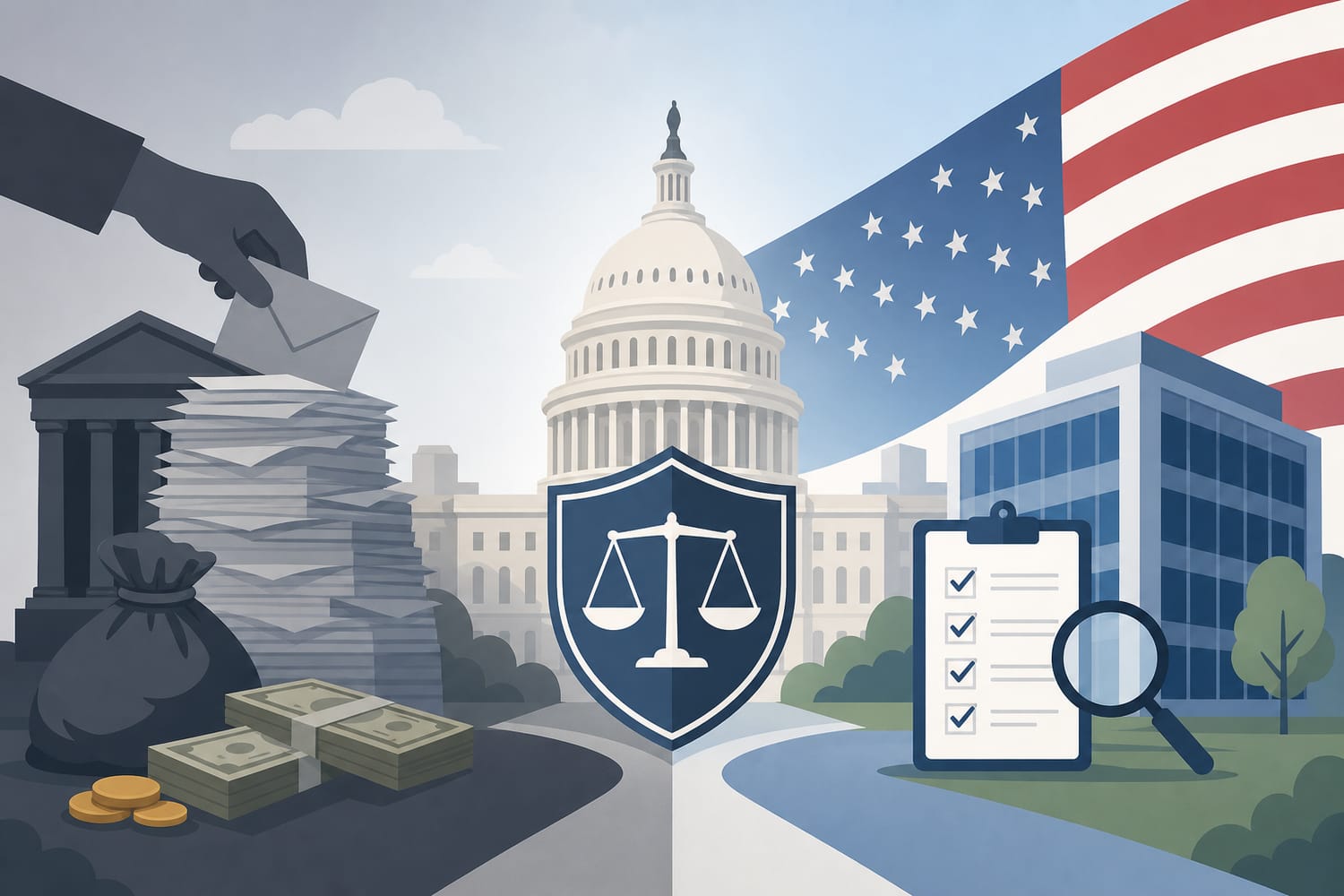
Public trust in government in the United States has been under pressure for decades. Polls regularly show that many Americans believe elected officials, lobbyists, regulators, and politically connected interests have too much influence over public policy. Concerns about campaign finance, conflicts of interest, revolving-door employment, insider access, procurement abuse, and selective enforcement have contributed to a broader debate over whether existing institutions are strong enough to prevent corruption.
One proposal that periodically emerges is the creation of an independent anti-corruption agency at the federal level. Supporters argue that such an agency could centralize enforcement, reduce political interference, and restore confidence in government. Critics warn that it could duplicate existing work, expand bureaucracy, and potentially become politicized itself. The debate is not simply about whether corruption exists, but about what kind of institutional response would be most effective, legitimate, and consistent with democratic accountability.
The Case for an Independent Anti-Corruption Agency
Supporters of a new agency argue that the current federal ethics and anti-corruption system is fragmented. Responsibility is spread across multiple bodies, including the Department of Justice, inspectors general, the Office of Government Ethics, congressional ethics committees, the Federal Election Commission, and various agency-level compliance offices. Each has a different mandate, different powers, and different limits.
From this perspective, fragmentation can make enforcement inconsistent and difficult for the public to understand. One office may identify misconduct but lack enforcement power. Another may have enforcement authority but be constrained by political leadership, limited resources, or narrow jurisdiction. Congressional ethics bodies are often criticized for being too slow, too lenient, or too dependent on lawmakers policing themselves.
An independent anti-corruption agency, supporters argue, could bring more coherence to this system. It might investigate conflicts of interest, bribery, illegal lobbying, misuse of public office, procurement fraud, and ethics violations across the federal government. Ideally, it would have clear authority, professional staff, public reporting obligations, and safeguards against partisan interference.
Advocates also point to international examples. Countries such as Hong Kong, Singapore, and Australia have experimented with independent anti-corruption commissions, though their structures and success levels vary. Supporters believe the United States could design its own model suited to its constitutional system, rather than copying another country’s approach directly.
Restoring Public Trust
One of the strongest arguments in favor of a new agency is symbolic as well as practical. A dedicated anti-corruption body could signal that the federal government takes integrity seriously. At a time when many citizens believe powerful people face fewer consequences than ordinary people, visible and independent enforcement could help rebuild confidence.
Supporters argue that trust is not restored only by passing ethics rules. It also requires credible enforcement. If the public sees ethics violations handled quietly, inconsistently, or along partisan lines, even strong laws may appear ineffective. A well-designed agency could publish regular reports, explain enforcement decisions, and make data about corruption risks more accessible.
For some reformers, the issue is not only criminal corruption, such as bribery, but also “legal corruption” or influence that may be permitted under current law but still undermines democratic legitimacy. This includes concerns about dark money, lobbying loopholes, stock trading by members of Congress, and former officials immediately taking high-paying jobs with industries they once regulated. While a new agency could not solve all of these problems without legislation, advocates say it could identify patterns and recommend reforms.
Concerns About Expanding Bureaucracy
Opponents of creating a new agency often argue that the United States already has extensive anti-corruption infrastructure. The Department of Justice prosecutes public corruption crimes. Inspectors general investigate waste, fraud, and abuse within agencies. The Government Accountability Office audits government programs. The Office of Government Ethics oversees executive branch ethics rules. Congressional committees, courts, and the press also play oversight roles.
From this point of view, the problem is not the absence of another agency but the inconsistent use of tools that already exist. Critics worry that adding a new institution could create overlapping authority, confusion, and interagency conflict. If several offices investigate the same conduct, cases could become slower and more complicated. If responsibility is spread even further, agencies may blame one another when enforcement fails.
There is also concern about cost. A serious federal anti-corruption agency would require investigators, lawyers, analysts, administrative staff, offices, technology, and long-term funding. Skeptics ask whether those resources would be better spent strengthening inspectors general, improving campaign finance enforcement, modernizing ethics disclosure systems, or increasing public corruption units within existing law enforcement agencies.
The Risk of Politicization
A major concern on both sides of the debate is politicization. Supporters of an independent agency want to reduce political influence, but critics argue that no agency is immune from politics. If an anti-corruption body has broad investigative powers, it could become a powerful weapon in partisan conflict.
Opponents worry that political actors might pressure the agency to investigate rivals, leak damaging information, or time enforcement actions around elections. Even if the agency behaves responsibly, accusations of bias could undermine its legitimacy. In a polarized environment, almost any investigation of a high-profile official could be interpreted through a partisan lens.
Design questions therefore matter greatly. Who would appoint the agency’s leaders? Would they be confirmed by the Senate? How long would their terms last? Could they be removed by the president, and under what conditions? Would the agency have criminal prosecution power, civil enforcement authority, or only investigative and referral powers? Each answer creates trade-offs between independence and accountability.
Some critics argue that too much independence can be dangerous. In a democracy, powerful enforcement agencies should be answerable to elected officials or the courts. Others respond that ordinary political control is exactly what can prevent serious investigations of powerful officials. The challenge is finding a balance between autonomy and oversight.
Constitutional and Legal Questions
Creating a federal anti-corruption agency would raise constitutional questions, especially if it were given significant enforcement powers. The U.S. system separates powers among the executive, legislative, and judicial branches. An agency that investigates members of Congress, executive officials, judges, contractors, and lobbyists could touch all three branches.
If placed inside the executive branch, the agency might be subject to presidential control, raising doubts about its independence when investigating the administration. If made more independent, it could face legal challenges over appointment and removal protections. Recent Supreme Court decisions have shown skepticism toward some forms of independent agency structure, especially where officials exercise significant executive power without clear presidential oversight.
There are also due process concerns. People accused of corruption or ethics violations have rights, including fair procedures and protection against reputational harm from unproven allegations. A new agency would need rules for confidentiality, public reporting, evidence standards, appeals, and coordination with prosecutors.
Possible Middle-Ground Approaches
Not everyone in the debate falls neatly into “create a new agency” or “do nothing.” Many observers support reform but disagree on the best mechanism. One middle-ground option is to strengthen existing institutions rather than build a new one. Congress could increase funding for inspectors general, give the Office of Government Ethics more enforcement authority, reform the Federal Election Commission, or expand Department of Justice public corruption units.
Another option is to create a coordinating body rather than a full enforcement agency. Such a body could collect data, identify corruption risks, recommend policy changes, and help agencies share information without replacing their authority. This might reduce duplication while still improving national strategy.
Some reformers favor targeted changes: stricter stock trading rules for lawmakers, stronger lobbying disclosure, limits on the revolving door, better whistleblower protections, real-time ethics disclosures, and more transparent government contracting. They argue that these reforms may have more direct impact than creating a large new institution.
The Role of Transparency and Whistleblowers
Many participants in the debate agree that transparency and whistleblower protection are essential, regardless of whether a new agency is created. Corruption is often difficult to detect from the outside. Employees, contractors, journalists, watchdog groups, and auditors frequently play important roles in exposing misconduct.
Supporters of a new agency argue it could provide a safe, centralized channel for whistleblowers and ensure tips are properly investigated. Critics respond that existing whistleblower systems should be improved first, especially because many whistleblowers already face retaliation, legal uncertainty, and professional risk.
Transparency is similarly complex. Public disclosure can deter misconduct and help citizens evaluate officials. But excessive or poorly handled disclosure can also damage privacy, discourage public service, or spread allegations before facts are established. Any reform would need to balance openness with fairness.
Public Confidence and Political Reality
The debate over an independent anti-corruption agency is also shaped by political reality. Passing such a reform would require lawmakers to create an institution that might later investigate lawmakers, executive officials, donors, or allies. That makes the politics difficult.
Public support might depend on how the proposal is framed. If voters see the agency as a nonpartisan watchdog with real independence, it could be popular. If they see it as another federal bureaucracy or a tool for partisan investigations, support could weaken quickly. Trust in the agency would likely depend not only on its legal design but also on its early leadership, transparency, and restraint.
The question of whether the United States should create an independent anti-corruption agency reflects a broader tension in American governance. Supporters believe a dedicated watchdog could address fragmentation, improve enforcement, and help restore public trust. Critics worry it could duplicate existing institutions, cost money, raise constitutional problems, and become politicized.
Both sides identify real concerns. Corruption and conflicts of interest can weaken democracy, distort policy, and deepen cynicism. At the same time, enforcement power must be carefully limited, accountable, and fair. Whether through a new agency or reforms to existing institutions, the core challenge is the same: creating a system that can investigate misconduct seriously without becoming a source of abuse itself.