
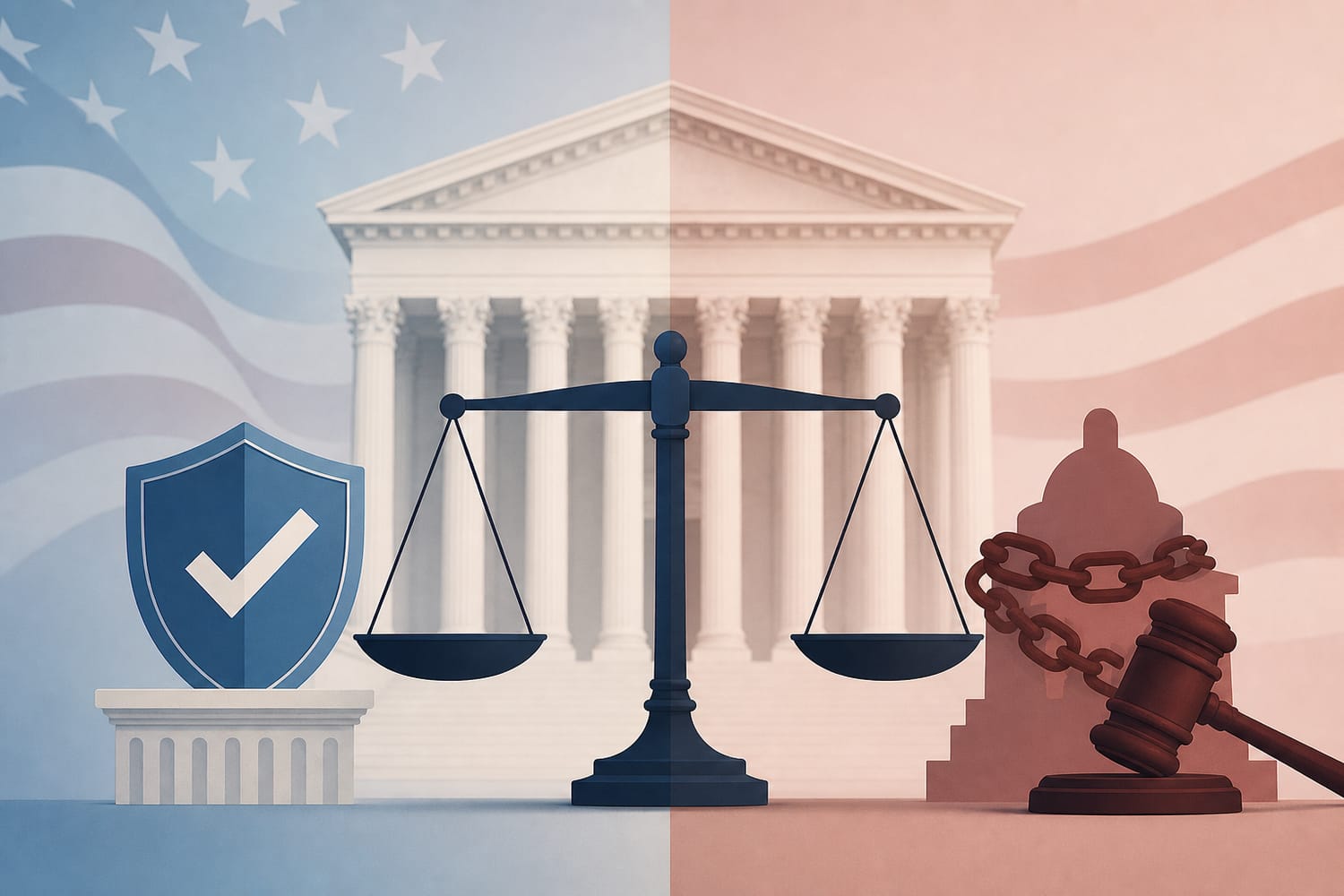
Debates over Supreme Court ethics reform have intensified in recent years, driven by controversies involving undisclosed gifts, luxury travel, book deals, speaking engagements, recusals, and personal relationships between justices and politically active individuals. For many Americans, these stories have raised a basic question: should the nation’s highest court be subject to stronger, enforceable ethics rules? For others, the push for reform looks less like a neutral effort to improve public confidence and more like a political campaign aimed at pressuring or weakening an independent judiciary.
The controversy is not simply about whether ethical behavior matters. Nearly everyone agrees that Supreme Court justices should act with integrity and avoid conflicts of interest. The dispute is over how ethics standards should be designed, who should enforce them, and whether reforms would strengthen the Court’s legitimacy or expose it to partisan interference.
The Case for Ethics Reform
Supporters of Supreme Court ethics reform argue that the Court occupies a unique position in American government. Its decisions can shape elections, civil rights, business regulation, criminal justice, environmental policy, and individual liberties for generations. Because the justices have life tenure and face no elections, proponents say strong transparency and accountability rules are essential to maintaining public trust.
One major concern is that the Supreme Court historically operated without a formal, binding code of conduct comparable to the one that applies to lower federal judges. Lower court judges follow rules addressing conflicts of interest, political activity, gifts, outside income, and public appearances. Reform advocates argue that it is difficult to justify holding lower judges to clearer standards than the nine justices at the top of the judiciary.
Supporters also point to the importance of perception. Even if a justice believes they can remain impartial, undisclosed financial benefits or close ties to political donors may create the appearance of bias. In the legal system, appearances matter because courts rely on public acceptance of their decisions. If people believe rulings are influenced by personal relationships or financial interests, confidence in the rule of law may erode.
For reform advocates, ethics rules are not about punishing particular justices or changing specific outcomes. They argue that clear standards would protect both the public and the Court itself. If the rules are known in advance, justices can avoid questionable situations, and the public can better understand why a justice did or did not recuse from a case.
Concerns About Judicial Independence
Opponents of aggressive ethics reform often begin from a different concern: preserving the independence of the Supreme Court. The judiciary is designed to be insulated from political pressure so that judges can decide cases based on law rather than popularity or partisan demands. Critics worry that some reform proposals could give Congress, outside panels, or executive branch officials too much influence over the Court.
From this perspective, ethics reform may sound neutral but could become a tool for political retaliation. If lawmakers dislike the Court’s decisions, they might use investigations, complaints, or enforcement proceedings to intimidate justices. Even the threat of ethics inquiries could create pressure around controversial cases involving abortion, guns, voting rights, presidential power, or campaign finance.
Skeptics also argue that the Constitution gives the Supreme Court a special status. While Congress has authority to regulate aspects of the federal judiciary, there are limits to how far it can go in controlling the internal operations of a coequal branch. Some conservatives and institutionalists contend that allowing Congress to impose detailed ethical rules on the Supreme Court could upset the separation of powers.
Another concern is that vague standards could be abused. Terms like “appearance of impropriety” may sound reasonable, but critics argue they can be interpreted subjectively. A justice who attends a university event, speaks at a legal conference, or has a friendship with a politically involved person could face accusations from ideological opponents. In a polarized environment, almost any association might be framed as suspicious.
The Middle Ground: Transparency Without Control
Between these positions is a more moderate view: the Supreme Court should adopt stronger ethics practices, but reforms should be carefully designed to avoid political manipulation. People in this camp often support clearer disclosure requirements, more detailed explanations for recusals, and an internal code of conduct, while remaining cautious about outside enforcement.
One common proposal is improved financial transparency. Justices could be required to disclose gifts, travel, reimbursements, real estate transactions, and outside income in a timely and detailed way. Supporters of this approach argue that sunlight is less intrusive than direct discipline. The public, press, and legal community can evaluate the information without giving Congress direct power over judicial decision-making.
Another moderate reform idea involves recusal practices. Currently, each justice generally decides for themselves whether to step aside from a case. Critics say this creates a problem because there is no appeal if a justice chooses not to recuse. Some suggest that justices should provide written explanations in significant recusal disputes, or that the full Court should have a role in reviewing recusal questions.
However, even this raises complications. If the full Court votes on whether a justice should recuse, the process could become awkward or strategic. Justices might be placed in the position of judging their colleagues. Additionally, in a Court of only nine members, recusal can affect outcomes dramatically. A justice stepping aside may leave the Court evenly divided, effectively changing the result.
How Partisanship Shapes the Debate
The ethics debate is deeply influenced by the current ideological makeup of the Court. Many calls for reform have come from Democrats and progressive groups, especially after controversial decisions by the Court’s conservative majority. This has led many Republicans and conservatives to suspect that ethics reform is partly motivated by dissatisfaction with rulings rather than neutral institutional concern.
Progressives often respond that ethical questions should not be dismissed simply because they arise in a political context. They argue that concerns about undisclosed gifts, donor access, and conflicts of interest would be serious regardless of which ideological bloc controlled the Court. In their view, the fact that reform proposals may be politically inconvenient for some justices does not make them illegitimate.
Conservatives, meanwhile, point out that public trust in the Court has often fluctuated depending on whether people agree with its decisions. They argue that accusations of illegitimacy can become a way to undermine rulings that one side dislikes. Some see ethics reform as part of a broader campaign that has included proposals for court expansion, term limits, and jurisdiction stripping.
This partisan backdrop makes consensus difficult. Even reforms that might seem reasonable in theory can be viewed with suspicion if one side believes they are designed to target specific justices. At the same time, refusing any reform can reinforce the perception that the Court is unwilling to police itself.
The Role of Public Trust
At the center of the debate is the question of trust. The Supreme Court does not command an army or control a budget in the same way the elected branches do. Its authority depends heavily on public belief that its decisions are legitimate, even when controversial. If that belief weakens, compliance with rulings and respect for judicial institutions may suffer.
Reform supporters argue that trust must be earned through accountability. In their view, public confidence cannot rest on tradition alone. Modern expectations of transparency are higher than they were in the past, and institutions that resist scrutiny may appear out of touch or self-protective.
Opponents counter that trust can also be damaged by constant attacks on the Court. If political leaders repeatedly suggest that justices are corrupt or illegitimate, the public may lose faith regardless of what ethics rules exist. From this standpoint, reforms may not restore trust if the underlying problem is political polarization and disagreement with outcomes.
Both sides may have a point. Ethical controversies can damage confidence, but so can partisan campaigns that portray every disliked decision as evidence of bad faith. Restoring trust may require not only better rules but also more restraint in how public officials and commentators discuss the Court.
Possible Reforms and Their Trade-Offs
Several reform ideas are commonly discussed. A binding code of conduct could clarify expectations for gifts, travel, speeches, political involvement, and conflicts of interest. Stronger disclosure laws could make financial relationships more visible. Recusal reforms could provide more consistency in cases involving personal or financial connections. Term limits, though often discussed separately, are sometimes included in broader conversations about Court accountability.
Each proposal involves trade-offs. A binding code may be useful, but only if enforcement is credible and constitutional. Disclosure rules may increase transparency, but they may not resolve disputes over whether conduct is actually improper. Recusal reform may prevent conflicts, but it could also encourage strategic efforts to force justices off cases. Term limits might reduce the stakes of each appointment, but they would require careful constitutional analysis and could alter the Court’s long-term role.
The challenge is designing reforms that address real ethical concerns without creating new risks. A system that is too weak may be dismissed as symbolic. A system that is too aggressive may threaten judicial independence or become another arena for partisan warfare.
The debate over Supreme Court ethics reform reflects two important values that can sometimes pull in different directions: accountability and independence. Supporters of reform believe stronger rules are necessary to restore public confidence, prevent conflicts of interest, and bring the Supreme Court closer to the standards applied across the judiciary. Opponents worry that reforms, especially if controlled by political actors, could become tools of intimidation and weaken the separation of powers.
The most constructive path may lie in recognizing the legitimacy of both concerns. The Supreme Court should not be above ethical scrutiny, but it also should not be made dependent on the approval of elected officials or partisan majorities. Reforms that emphasize transparency, clarity, and carefully limited enforcement may have the best chance of improving trust without compromising independence.
Ultimately, the question is not whether ethics matter. It is how to protect ethical standards in a way that preserves the Court’s ability to decide cases fairly, even when its decisions are unpopular. In a polarized era, achieving that balance is difficult, but the legitimacy of the judiciary may depend on it.