
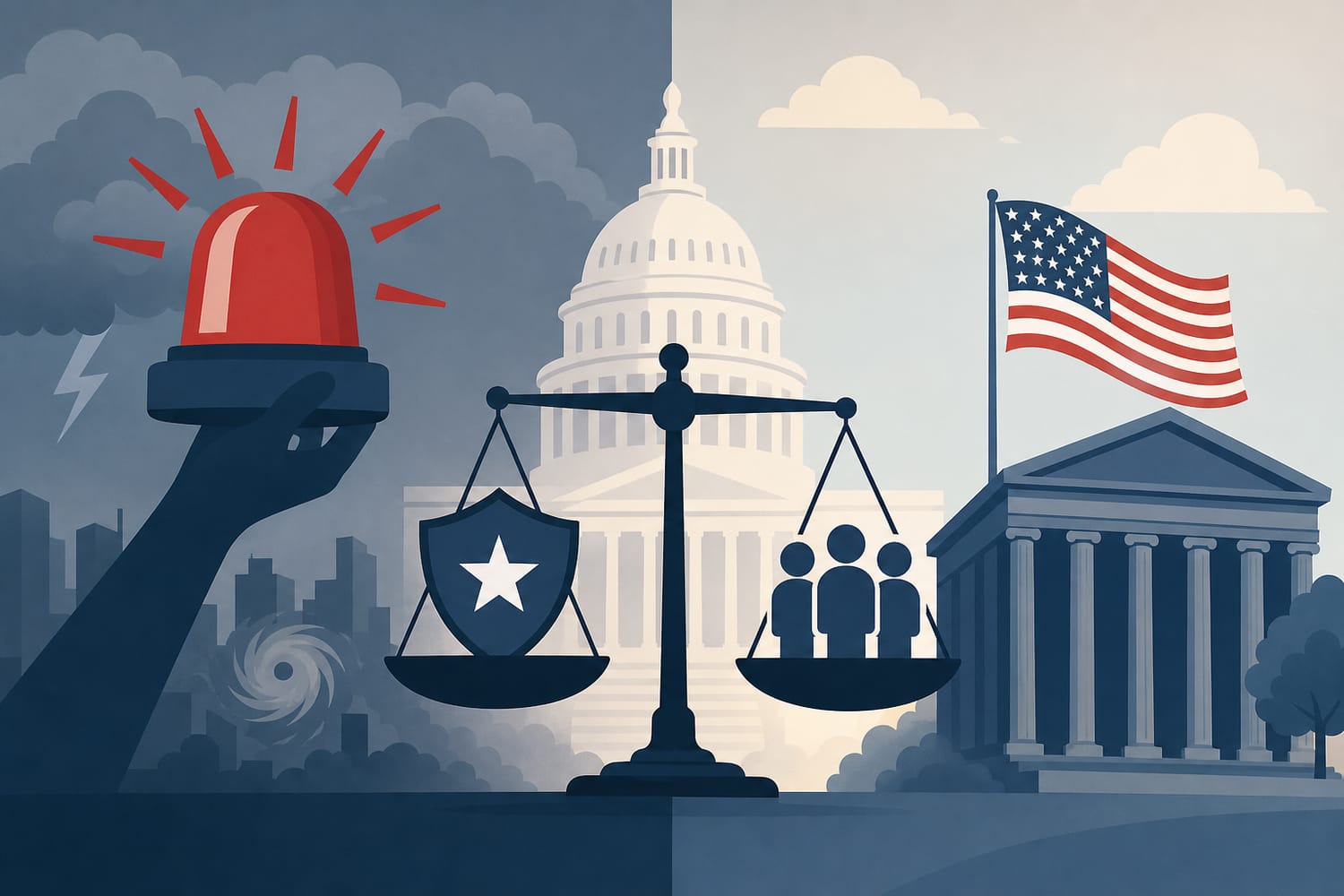
Emergency powers sit at the center of one of the most difficult questions in democratic governance: how can a state respond quickly and effectively to a crisis while still preserving the rule of law, civil liberties, and public accountability? Governments have long claimed special authority during wars, terrorist attacks, pandemics, natural disasters, economic collapses, and periods of severe unrest. Supporters argue that ordinary procedures are often too slow for extraordinary dangers. Critics warn that temporary powers can become permanent habits, weakening democratic institutions and concentrating authority in the hands of executives.
The debate is not simply between people who care about safety and people who care about liberty. Most participants on all sides recognize that emergencies are real and that democracies sometimes need flexibility. The disagreement is over how much flexibility is justified, who should control it, how long it should last, and what safeguards are necessary to prevent abuse.
The Case for Emergency Powers as a Necessary Crisis Tool
Those who defend emergency powers often begin with a practical point: crises rarely wait for normal political processes. In a public health emergency, a contagious disease can spread faster than a legislature can debate and pass new rules. During a terrorist attack or military invasion, officials may need to coordinate security responses immediately. After a natural disaster, authorities may need to evacuate areas, requisition supplies, impose curfews, or redirect public funds without going through routine administrative steps.
From this perspective, emergency powers are not inherently anti-democratic. Instead, they are tools that allow democratic governments to fulfill one of their most basic responsibilities: protecting the population. A government that cannot act decisively in a crisis may lose public trust, allow preventable harm, or create a vacuum that less accountable forces could fill.
Supporters also argue that emergency authority can be designed within a constitutional framework. Many democracies include emergency provisions in law precisely because crises are expected to occur. These provisions may define what counts as an emergency, who can declare one, what powers become available, and when those powers expire. In this view, the problem is not emergency powers themselves, but poorly written or poorly monitored emergency powers.
The Argument for Speed and Coordination
One major argument in favor of emergency powers is that they help overcome fragmentation. In normal times, democratic systems often divide authority across branches of government, levels of federal and local administration, courts, agencies, and independent bodies. This division is meant to prevent tyranny and encourage deliberation. But in a crisis, it can also produce delays, confusion, and conflicting instructions.
Emergency powers may allow a central authority to coordinate resources, issue uniform guidance, and act before a situation worsens. For example, during a pandemic, national or regional governments may need to close borders, regulate travel, distribute medical supplies, or restrict large gatherings. During a wildfire or flood, officials may need to order evacuations quickly, even if some residents object. During financial instability, governments may act rapidly to stabilize banks, guarantee deposits, or prevent broader collapse.
Advocates argue that without such powers, governments may be trapped by procedures designed for ordinary times. They believe that democratic accountability can happen after immediate danger is addressed, through legislative review, public inquiry, elections, and court challenges.
The Civil Liberties Concern
Critics of emergency powers focus on the risk that governments may use crises to limit rights in ways that are excessive, discriminatory, or unrelated to the emergency itself. Restrictions on movement, speech, assembly, privacy, property rights, and due process can have serious consequences even when they are temporary. In some cases, people may be detained without normal protections, protests may be restricted, media may be censored, or surveillance may expand.
Civil liberties advocates often accept that some restrictions may be justified in extreme circumstances. Their concern is proportionality. A policy that is reasonable during an immediate emergency may become unacceptable if it continues after the danger has declined. Similarly, a measure aimed at protecting public health or national security may be misused to target political opponents, minority groups, journalists, or activists.
This side of the debate emphasizes that rights are most vulnerable when fear is high. Citizens may accept extraordinary state power because they feel unsafe, only later realizing that the precedent has changed the relationship between the government and the public.
The Risk of Executive Overreach
Another central criticism is that emergency powers often strengthen the executive branch at the expense of legislatures, courts, and local authorities. Presidents, prime ministers, governors, and ministers are usually the officials empowered to declare emergencies and direct responses. Even when this is efficient, it can weaken checks and balances.
Skeptics argue that executives may have incentives to prolong emergencies because special powers allow them to govern with fewer obstacles. They may bypass legislatures, issue decrees, redirect funds, or limit public gatherings that could include political opposition. In fragile democracies, emergency rule can become a pathway toward authoritarianism. In stronger democracies, it may still normalize government by executive order rather than public debate.
Historical examples shape this concern. Around the world, leaders have invoked emergencies to suspend constitutions, postpone elections, silence opposition, or justify military involvement in civilian affairs. Critics point out that even when the original crisis is real, the expansion of power may go far beyond what is necessary to address it.
The Public Safety Perspective
Those more sympathetic to strong emergency measures often argue that discussions about overreach can underestimate the real harms of inaction. If a government fails to respond forcefully to a pandemic, thousands may die. If it hesitates during an armed attack, national security may be endangered. If it avoids imposing evacuation orders during a disaster, lives may be lost.
From this viewpoint, liberty is not only threatened by government action; it can also be threatened by chaos, violence, disease, or institutional paralysis. A society overwhelmed by crisis may become less free in practice, even if formal rights remain untouched. People cannot fully exercise their freedoms if they are unsafe, displaced, or living under conditions of severe instability.
Supporters of this position often argue that emergency powers should be judged by outcomes as well as principles. Did the measures save lives? Did they restore order? Were they based on evidence? Were they lifted when no longer needed? For them, the key issue is not whether emergency powers are used, but whether they are used responsibly.
The Democratic Accountability Argument
A middle position in the debate focuses on accountability rather than a simple yes-or-no view of emergency powers. Many legal scholars, civil society organizations, and policymakers argue that emergency authority can be legitimate if it is limited, transparent, and subject to oversight.
This approach often supports requirements such as legislative approval after a short period, automatic expiration dates, judicial review, public reporting, and clear definitions of permitted actions. It may also require that emergency measures be necessary, proportionate, and non-discriminatory. Some propose independent review bodies or post-crisis investigations to evaluate whether the government acted appropriately.
The idea is that emergencies should not create a legal blank check. Instead, they should activate a temporary framework with stronger monitoring, not weaker scrutiny. Supporters of this view believe democracies can prepare for crises in advance by building legal guardrails before fear and urgency dominate public debate.
The Question of Trust
Public opinion on emergency powers often depends heavily on trust. People who trust their government, public institutions, courts, media, and scientific experts may be more willing to accept temporary restrictions. People who distrust those institutions may see the same measures as suspicious or illegitimate.
Trust can vary based on political affiliation, historical experience, social identity, and past government behavior. Communities that have experienced discrimination or state abuse may be especially skeptical of emergency powers. They may worry that enforcement will fall hardest on already marginalized groups. Others may support strong measures if they believe authorities are acting in good faith and communicating clearly.
This makes transparency especially important. When governments explain why emergency measures are needed, what evidence supports them, how long they will last, and how they can be challenged, public acceptance may increase. When decisions appear secretive, inconsistent, or politically motivated, resistance tends to grow.
The Problem of “Temporary” Measures
One of the most persistent concerns is that emergency measures often outlive the emergency. Surveillance systems created after terrorist attacks, border controls introduced during security crises, or executive authorities expanded during wars may remain in place for years. Even if rarely used, they can become part of the normal powers of government.
Critics call this “emergency creep,” where exceptional measures gradually become ordinary. Supporters may respond that some threats also evolve and persist, requiring long-term adaptation. For example, terrorism, cyberattacks, climate-related disasters, and pandemics may not fit neatly into short timeframes. The challenge is distinguishing between a genuine continuing threat and a government’s preference for retaining convenient powers.
Sunset clauses, renewal votes, and independent audits are often proposed as ways to address this problem. Yet these safeguards only work if legislatures and courts are willing to enforce them.
The debate over emergency powers is ultimately a debate about balance. Democracies must be capable of acting decisively when lives, security, or social order are at risk. At the same time, the concentration of power during crises can endanger the very democratic values governments claim to protect.
One side emphasizes necessity, speed, and the duty of the state to protect its people. Another emphasizes rights, limits, and the danger that fear can be used to justify excessive authority. Between them lies a broad range of views focused on oversight, proportionality, transparency, and time limits.
Emergency powers are neither automatically legitimate nor automatically dangerous. Their democratic value depends on how they are designed, used, reviewed, and ended. The hardest task is ensuring that governments have enough authority to confront real crises, but not so much that crisis becomes a permanent excuse for weakened democracy.