
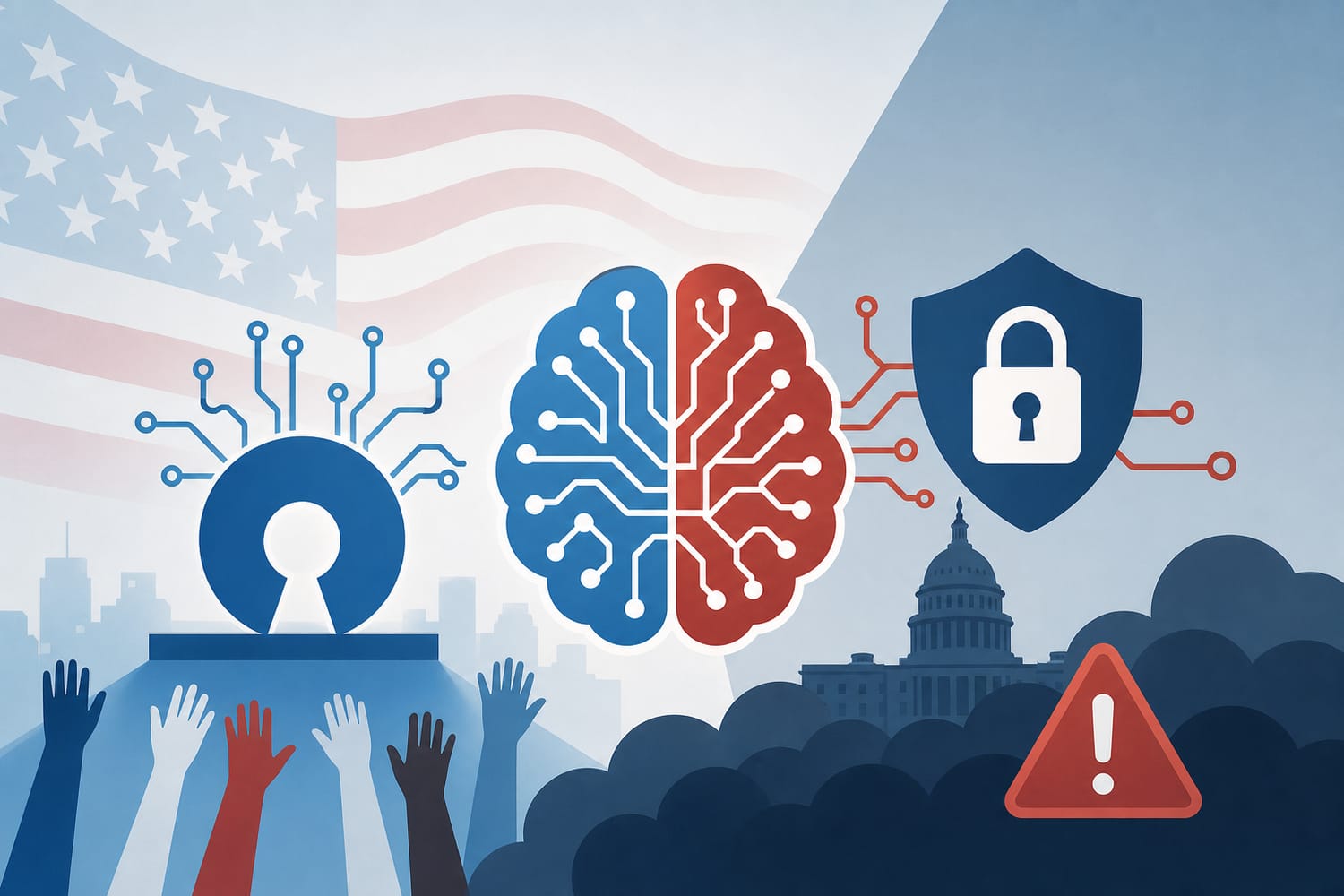
Open-source AI promises to spread access to powerful technology, allowing researchers, startups, governments, and individuals to build systems without depending entirely on a few large companies. Supporters view this openness as a path toward broader innovation and accountability. Critics warn that the same accessibility could make advanced capabilities easier to misuse. The debate is therefore not simply about whether openness is good or bad, but about which systems should be open, what information should be released, and which safeguards should accompany that release.
What Counts as Open-Source AI?
Before evaluating the arguments, it is important to define the term. Traditional open-source software generally gives users permission to inspect, modify, use, and redistribute source code. AI systems are more complicated because they may include source code, model weights, training methods, datasets, documentation, and safety controls.
The Open Source AI Definition developed by the Open Source Initiative says an open-source AI system should grant the freedom to use, study, modify, and share it. It also calls for access to relevant code, model parameters, and detailed information about training data.
Not every model marketed as “open” meets that standard. Some developers release model weights while withholding training data or imposing restrictions on commercial use. These systems may be more accurately described as “open-weight” models. This distinction matters because different levels of openness create different benefits and risks.
The Case for Democratizing AI Innovation
Supporters argue that open-source AI lowers barriers to participation. Developing a large model from the beginning can require extensive computing resources, specialized talent, and enormous amounts of data. Publicly available models allow smaller organizations to begin with an existing foundation and adapt it to their needs.
This accessibility can support innovation in areas that may not attract major commercial investment. Universities could develop specialized research tools, nonprofit organizations could create services for underserved communities, and local businesses could customize models for regional industries or languages. Developers may also run models on their own infrastructure, giving them more control over costs, data, and system behavior.
Open development can encourage collaboration. Researchers can test models, identify weaknesses, propose improvements, and compare results. In theory, this distributed process prevents AI research from being controlled solely by companies with the largest budgets.
Advocates also connect openness with competition. If a small number of corporations control the strongest models, they may determine prices, access conditions, and acceptable uses. Open alternatives can reduce vendor dependence and make it harder for any single provider to dominate the technology. These concerns reflect the broader debate over whether AI will ultimately help or harm society.
Transparency as a Safety Tool
Another argument for open-source AI is that transparency can improve accountability. Independent researchers can examine a model for bias, security vulnerabilities, privacy problems, and unreliable behavior rather than relying entirely on a developer’s internal evaluation.
This resembles the “many eyes” principle associated with open-source software: when more qualified people can inspect a system, problems may be discovered sooner. Public scrutiny can also make it more difficult for developers to conceal weaknesses or exaggerate safety claims.
The Linux Foundation’s discussion of open-source AI highlights both this potential and the difficulty of understanding AI systems. Access to code alone may not explain a model’s behavior because training data, weights, and development processes also shape its outputs.
Openness, therefore, does not automatically produce transparency. A model can technically be available while remaining too complex, expensive, or poorly documented for meaningful public examination.
The Argument That Openness Creates Security Risks
Critics focus on the dual-use nature of AI. The same model that helps a programmer find software vulnerabilities might help an attacker exploit them. A system designed for scientific research could potentially be adapted for harmful biological or chemical applications. Generative models may also support fraud, impersonation, phishing, propaganda, or automated harassment.
Open release can make safety restrictions easier to remove. With a closed, hosted service, the provider can block certain requests, monitor abuse, update safeguards, or suspend accounts. Once model weights can be downloaded and modified, those controls may no longer be enforceable.
This creates an asymmetry between release and recall. A company can patch a centralized service, but it cannot reliably retrieve every copy of a downloadable model. The Associated Press has reported on official concerns that releasing model weights may bring substantial innovation benefits while allowing safeguards to be removed.
These risks become more serious as models gain stronger capabilities. Critics may tolerate open access to smaller or narrowly focused systems while opposing unrestricted release of models that could significantly lower the expertise required to conduct cyberattacks or other harmful activities.
Can Open AI Strengthen Security?
Open-source advocates respond that secrecy does not guarantee safety. Closed models can still be abused through prompts, stolen credentials, data leaks, or unauthorized access. Companies may also overlook vulnerabilities when external experts cannot inspect their systems.
From this perspective, open models can strengthen defensive capabilities. Security teams can adapt them to detect malicious code, analyze threats, or operate privately inside protected networks. Communities can publish fixes and develop safety tools without waiting for the original provider.
The wider challenge of protecting data in an increasingly digital world illustrates why both offensive and defensive uses must be considered. Restricting models could slow malicious actors, but it could also limit access for researchers and smaller organizations working on protection.
Competing Interests Behind the Debate
The disagreement is not purely philosophical. Both open and closed approaches can serve commercial interests.
Companies releasing models may benefit when outside developers improve them, create compatible products, or establish their technology as an industry standard. Meanwhile, companies favoring closed systems may cite safety concerns while protecting revenue, intellectual property, and market leadership.
Governments face similar tensions. Restricting access could reduce certain security threats, but excessive controls might concentrate AI capabilities in a small group of approved institutions. Open access could support education and competition while making oversight more difficult.
There are also privacy and copyright concerns. Full disclosure of training data could reveal personal, sensitive, licensed, or proprietary material. Withholding that information, however, makes it harder to evaluate how a model was created. This reflects the broader need to balance data privacy with technological innovation.
A Spectrum Rather Than a Binary Choice
Many participants in the debate favor a middle path rather than treating every system as completely open or completely closed. Possible approaches include:
- Releasing lower-capability models while limiting access to more powerful systems
- Providing model weights but withholding particularly sensitive components
- Requiring safety evaluations before public release
- Using staged releases that begin with trusted researchers
- Publishing detailed documentation without releasing every asset
- Establishing security standards for repositories and distribution platforms
- Creating legal responsibilities for developers and deployers based on demonstrated risk
Each option involves trade-offs. Restrictions may reduce misuse but weaken reproducibility and public accountability. Full disclosure may support independent research while exposing capabilities that cannot be contained afterward.
Finding a Sustainable Balance
Open-source AI can democratize innovation, but it can also distribute risks. Closed AI can preserve safeguards, but it may concentrate power and prevent meaningful independent oversight. Neither model offers a complete solution.
The most practical question may be how openness should vary according to capability, context, and evidence of harm. A small educational model does not necessarily require the same controls as a highly capable general-purpose system. Policies that recognize these differences may preserve many benefits of open development without assuming every release carries equal risk.
Ultimately, the debate will depend on whether institutions can create standards that protect competition, research, privacy, and security at the same time. Openness and safety need not be opposites, but reconciling them will require more than simply choosing between public access and corporate control.