
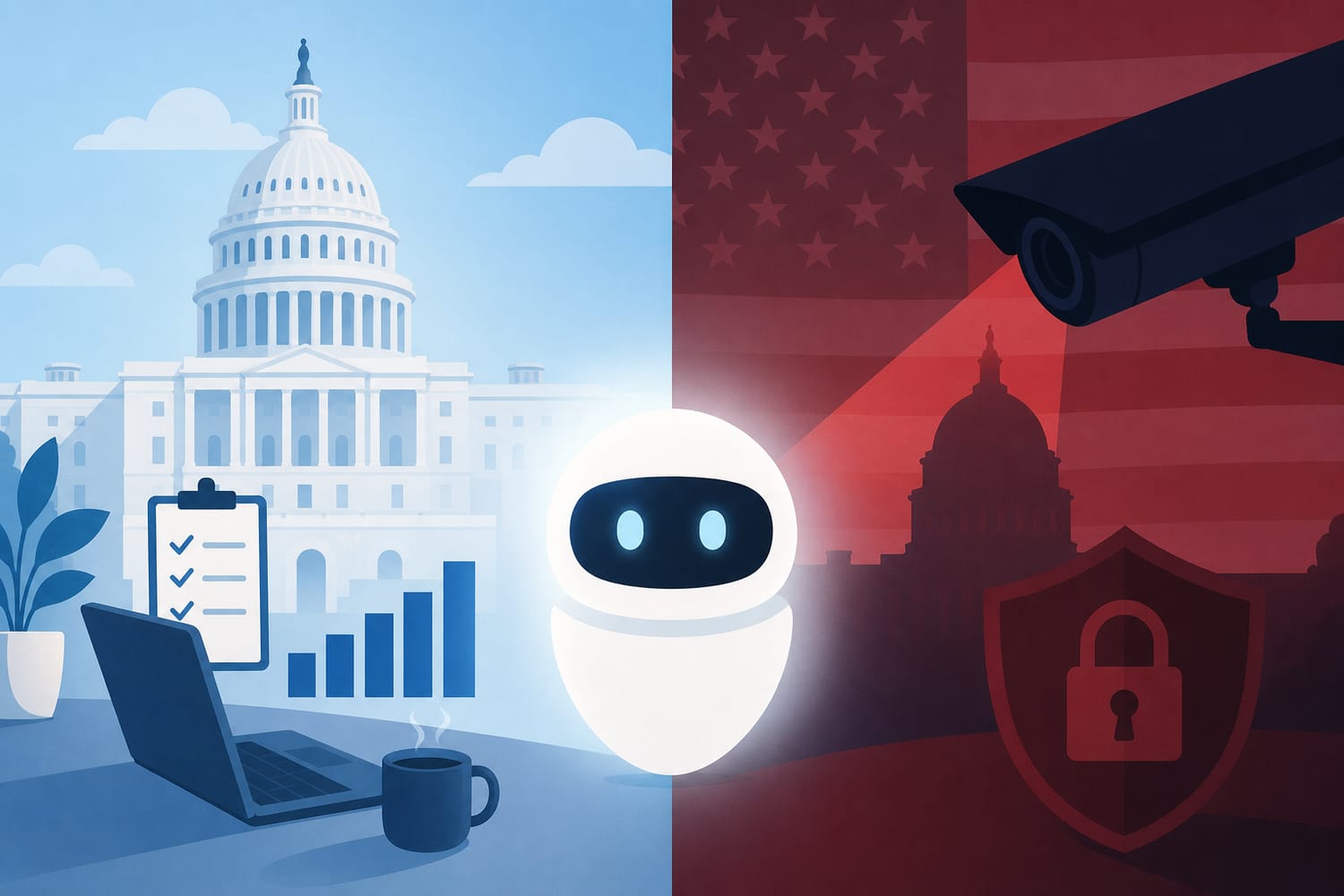
Personal AI assistants have moved quickly from novelty tools to everyday companions for writing emails, summarizing meetings, organizing schedules, answering questions, generating ideas, and automating routine tasks. For some, they represent one of the most important productivity shifts since the smartphone or the search engine. For others, they introduce a new layer of surveillance into work and private life, collecting sensitive information in ways that may be difficult to understand, control, or reverse.
The debate is not simply between people who like technology and people who fear it. Supporters, critics, employers, workers, privacy advocates, developers, educators, and regulators often agree on some points while strongly disagreeing on others. Many people see genuine benefits and genuine risks at the same time. The central question is whether personal AI assistants can deliver meaningful convenience and efficiency without creating unacceptable threats to privacy, autonomy, fairness, and trust.
The Productivity Case
Supporters of personal AI assistants argue that these tools reduce friction in daily life. They can draft messages, translate text, summarize long documents, create travel plans, organize notes, and help users think through decisions. In professional settings, they can prepare meeting agendas, extract action items, generate reports, and help employees navigate large amounts of information.
This can be especially valuable in knowledge work, where much of the day is spent reading, writing, searching, coordinating, and reformatting information. Advocates argue that AI assistants do not merely save minutes on individual tasks; they can change the rhythm of work by allowing people to focus more on judgment, creativity, strategy, and interpersonal communication.
Some also see personal AI assistants as a democratizing force. A small business owner without a marketing team can get help writing promotional material. A student can receive explanations tailored to their learning style. A non-native speaker can communicate more confidently in another language. A person with a disability may use voice-based AI tools to interact more easily with digital systems. From this perspective, personal AI assistants can expand access to skills and services that were previously expensive, specialized, or time-consuming.
The Efficiency Concerns
Even among people who support AI assistants, there are concerns about overstating productivity gains. Not every AI-generated answer is accurate, useful, or appropriate. Users may save time on drafting but spend additional time checking facts, correcting tone, or repairing mistakes. In some cases, a poorly designed assistant can create more work than it removes.
There is also the question of whether productivity gains benefit workers themselves or primarily their employers. If AI tools allow one employee to do more work in less time, companies may raise expectations, reduce staff, or accelerate deadlines. What appears to be a productivity revolution for organizations may feel like pressure and surveillance for individuals.
Some critics argue that efficiency should not be treated as an unquestioned good. If every free moment becomes available for optimization, people may lose space for reflection, informal conversation, or rest. An assistant that schedules, reminds, suggests, and nudges can be helpful, but it may also make daily life feel increasingly managed by software.
The Privacy Nightmare Argument
The strongest criticism of personal AI assistants centers on data. To be useful, an assistant often needs access to highly personal information: emails, calendars, contacts, messages, location, work documents, voice recordings, search history, health data, financial details, and personal preferences. The more context it has, the more helpful it can become. But that same context can make it deeply invasive.
Privacy advocates worry about how this data is stored, processed, shared, and monetized. Users may not know whether their conversations are being used to train models, reviewed by humans, retained indefinitely, or shared with third-party services. Even when companies provide privacy policies, they are often long, technical, and subject to change.
There are also risks from breaches and misuse. A hacked AI assistant could expose not just isolated pieces of information, but a detailed picture of someone’s life. It might reveal relationships, habits, anxieties, plans, workplace conflicts, medical issues, or political views. Unlike a stolen password, personal context cannot simply be reset.
The Trust and Transparency Problem
A major challenge in this debate is that AI assistants often operate as black boxes. Users may not understand why an assistant made a recommendation, where it found information, or whether it is prioritizing the user’s interests over those of the company providing the tool.
For example, if an assistant recommends a restaurant, product, route, doctor, insurance plan, or news source, users may wonder whether the recommendation is neutral, sponsored, personalized, or influenced by hidden commercial arrangements. The more people rely on assistants to filter choices, the more important transparency becomes.
Supporters argue that this problem is not unique to AI. Search engines, social media feeds, maps, and shopping platforms already shape decisions through algorithms. In their view, the solution is not to reject AI assistants but to require clear standards for disclosure, user control, and accountability. Critics respond that personal AI assistants may become more intimate and influential than previous technologies because they interact conversationally and may come to feel like trusted advisers.
The Workplace Divide
In workplaces, personal AI assistants create both enthusiasm and unease. Employers may see them as tools for improving efficiency, reducing administrative burden, and helping employees manage information. Workers may appreciate assistance with repetitive tasks, meeting summaries, and communication.
However, workplace AI assistants can also blur the line between support and monitoring. If an assistant tracks productivity, analyzes communication patterns, or reports performance indicators, employees may feel constantly observed. Even tools introduced for convenience can become sources of evaluation and control.
There are also concerns about confidentiality. Employees may accidentally input sensitive company information into external AI systems. Legal, medical, financial, and government workplaces face especially high stakes because client or citizen data may be protected by strict rules. Supporters of workplace AI argue that these risks can be managed with secure enterprise systems, clear policies, and training. Skeptics worry that adoption may move faster than safeguards.
The Human Dependency Question
Another side of the debate focuses on human skills. If people rely heavily on AI assistants to write, plan, remember, calculate, and decide, will certain abilities weaken over time? Some educators and professionals worry that constant assistance may reduce independent thinking, writing ability, research skills, or memory.
Others argue that this concern repeats older fears about calculators, spellcheck, GPS, and search engines. Technology often changes which skills matter rather than eliminating skill altogether. If AI handles routine drafting, people may place greater emphasis on editing, judgment, prompting, verification, and strategic thinking.
The question may not be whether AI assistance is inherently weakening or empowering, but how it is used. An assistant that explains reasoning, offers alternatives, and encourages reflection may support learning. One that simply provides final answers may encourage passivity. The design of the tool and the habits of the user both matter.
The Inequality Debate
Personal AI assistants may also widen or reduce inequality. On one hand, affordable AI tools could give individuals and small organizations capabilities once available only to those with money, staff, or specialized training. They could support education, accessibility, entrepreneurship, and public services.
On the other hand, the most powerful assistants may be expensive, proprietary, or available mainly to large companies and wealthy users. People with better tools may become even more productive, while those with limited access fall further behind. Language, region, infrastructure, and digital literacy may also affect who benefits.
There is a related concern about whose data and culture shape these systems. If AI assistants are trained primarily on information from dominant languages, countries, or social groups, they may serve some users better than others. Bias in responses, assumptions, or recommendations can affect trust and usefulness.
Possible Middle Ground
Many observers take a middle position: personal AI assistants can be valuable, but only if strong safeguards are built in. This view emphasizes privacy by design, data minimization, local processing where possible, clear consent, limited retention, strong encryption, independent audits, and meaningful user controls.
Regulation may also play a role. Some argue for rules requiring companies to disclose how data is used, whether humans review interactions, how long information is stored, and whether outputs are influenced by advertising or partnerships. Others warn that overly strict regulation could slow innovation or make it harder for smaller companies to compete.
Users also have responsibilities, though opinions differ on how much burden should fall on individuals. Practical steps include avoiding sensitive inputs, checking privacy settings, using reputable providers, separating work and personal accounts, and verifying important outputs. Still, critics argue that ordinary users cannot realistically evaluate complex AI systems on their own.
The debate over personal AI assistants is not easily reduced to optimism or alarm. These tools can save time, improve access to information, support creativity, and reduce administrative burdens. They may help people communicate, learn, organize, and work in more flexible ways.
At the same time, their usefulness often depends on access to intimate data, raising serious questions about privacy, security, manipulation, workplace monitoring, dependency, and inequality. The very features that make an assistant feel personal can also make it risky.
Whether personal AI assistants become a productivity revolution, a privacy nightmare, or something in between will depend on design choices, business models, regulation, workplace norms, and user behavior. The most balanced view may be that the technology is neither inherently liberating nor inherently harmful. Its impact will be shaped by who controls it, what incentives guide it, and how much power users have to understand and limit its role in their lives.