
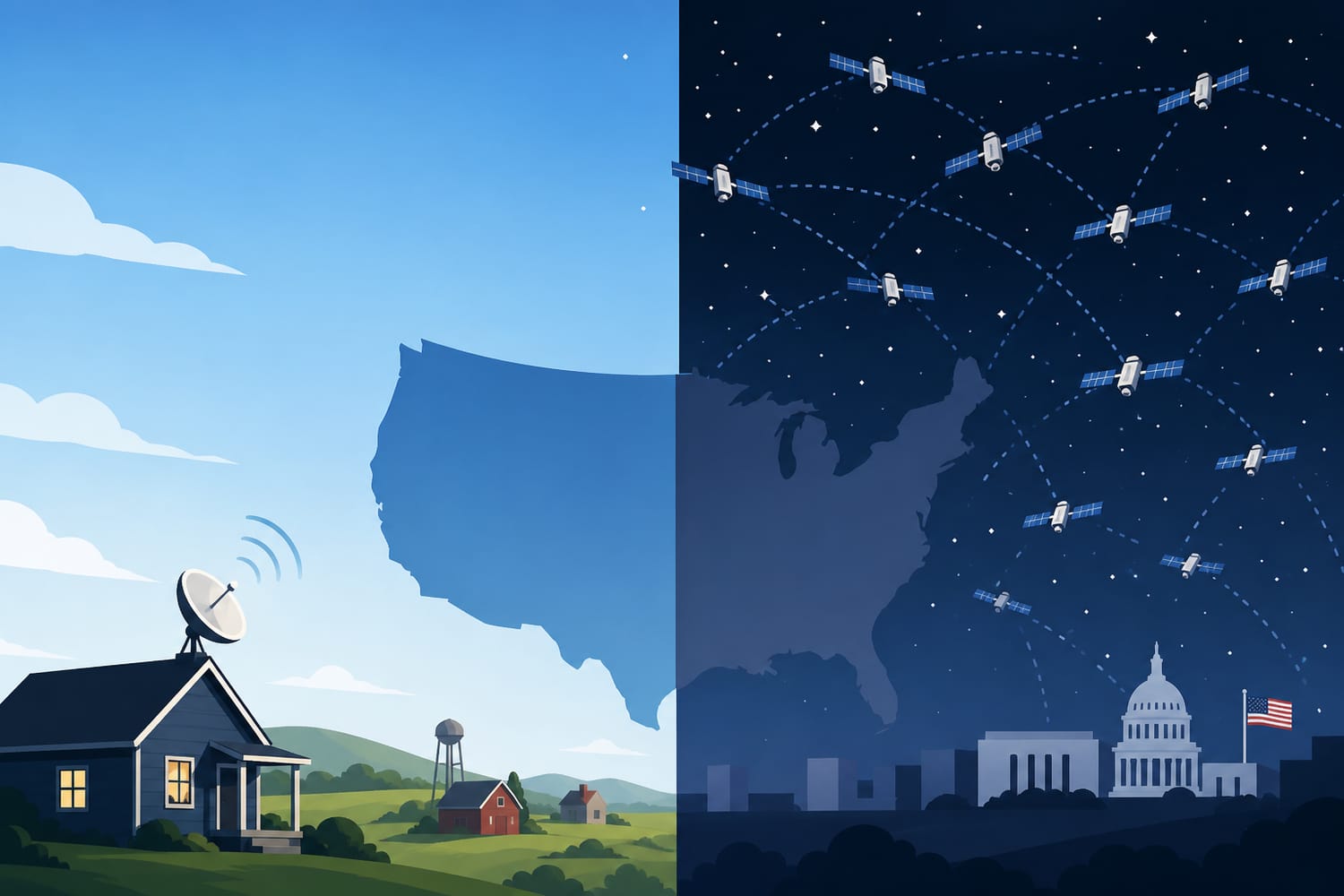
Satellite internet sits at the center of a difficult tradeoff. Supporters see it as a practical way to connect rural and isolated communities that terrestrial networks have struggled to reach. Critics warn that deploying thousands of satellites could endanger astronomy, increase orbital congestion, and transfer control of essential infrastructure to a small number of companies.
The Promise of Universal Connectivity
The strongest argument for satellite internet is geographic reach. Fiber-optic and cable networks are expensive to extend across mountains, deserts, islands, and sparsely populated regions. Providers may have little financial incentive to build infrastructure where relatively few customers live.
Satellite networks can serve these places without running a physical line to every property. A household typically needs electrical power, suitable equipment, and a relatively unobstructed view of the sky. This makes the technology attractive for remote homes, farms, Tribal communities, ships, aircraft, research stations, and temporary worksites.
Supporters argue that connectivity is now essential for education, employment, healthcare, commerce, and participation in public life. Students may need broadband to complete assignments, while small businesses increasingly depend on cloud platforms and digital payments. Telehealth can also be difficult to use without a dependable connection.
From this perspective, satellite service is one part of the broader effort to address the digital divide in internet access across America. It may not eliminate every affordability or digital-literacy barrier, but it can overcome the physical problem of distance.
A Faster Alternative to Traditional Satellites
Satellite internet is not entirely new. Traditional systems commonly rely on large satellites positioned far above Earth. Because signals must travel considerable distances, these services can experience noticeable delays.
Newer networks use constellations of satellites in low-Earth orbit. Their proximity can reduce delays and provide an experience more suitable for video calls, remote work, streaming, online learning, and some forms of gaming. Service can also be deployed more quickly than a major terrestrial construction project.
The FCC’s National Broadband Map allows Americans to examine reported service availability by address and compare technologies such as fiber, cable, fixed wireless, and satellite. Such comparisons are important because the best solution can differ dramatically between neighboring communities.
Affordability and Reliability Questions
Availability does not necessarily mean accessibility. Critics note that satellite customers may face equipment costs, monthly fees, data policies, or installation challenges. These expenses can be significant for households already struggling to afford internet service.
Performance may also vary. Heavy rain, snow, trees, buildings, network congestion, and limited satellite capacity can affect the connection. A remote community might technically have coverage but still receive inconsistent speeds during periods of high demand.
Supporters respond that no broadband technology is perfect. Cable networks can become congested, cellular coverage can be weak, and rural fiber projects may take years to complete. They argue that satellite internet should be compared with the alternatives actually available—not with ideal fiber service that may never reach a particular property.
Some advocates also see satellite systems as complementary infrastructure. Governments could continue funding fiber and wireless expansion while using satellites for the hardest-to-reach locations, emergency backup, and temporary coverage.
The Growing Pressure on Earth’s Orbit
The debate changes when individual satellite services become enormous constellations. Low-Earth orbit is useful but finite, and every spacecraft must share it with weather satellites, navigation systems, scientific missions, human spaceflight, and existing debris.
The European Space Agency’s 2025 Space Environment Report stated that around 40,000 objects were being tracked, including approximately 11,000 active payloads. It also estimated that more than 1.2 million debris objects larger than one centimeter could be in orbit. Objects of that size can cause severe damage because they travel at extremely high speeds.
Critics fear that adding more satellites creates additional opportunities for collisions. A major impact could produce fragments that threaten other spacecraft, potentially triggering further collisions. Operators can conduct avoidance maneuvers, but coordination becomes more complex as traffic grows.
Industry supporters emphasize that modern satellites can be maneuverable, trackable, and designed to leave orbit after their missions. Lower-altitude satellites may also reenter the atmosphere more quickly than objects placed in higher orbits. However, opponents argue that voluntary commitments may not provide sufficient protection when multiple companies and countries are launching competing systems.
Astronomy and the Changing Night Sky
Astronomers are among the most prominent critics of large satellite constellations. Satellites can reflect sunlight and leave bright trails across telescope images. Radio transmissions and unintended electromagnetic emissions may also interfere with sensitive radio astronomy.
The American Astronomical Society’s statement on satellite proliferation identifies concerns involving optical, infrared, and radio observations, along with debris and environmental effects. The organization supports collaboration with satellite operators and regulators to better understand and reduce these impacts.
Companies have experimented with darker surfaces, altered orientations, operational coordination, and the sharing of orbital data. Supporters point to these efforts as evidence that connectivity and astronomy do not have to be mutually exclusive.
Astronomers generally welcome mitigation but question whether technical adjustments can fully solve the problem. A satellite that is difficult to see with the unaided eye may still be bright enough to affect sensitive instruments. Software can remove some trails, but it cannot always recover information hidden or distorted by them.
The night sky also has cultural and personal value. Some Indigenous communities, environmental advocates, and stargazers view an unobstructed sky as a shared heritage rather than an unused commercial space.
Competition, Control, and Public Interest
Another concern is who controls satellite infrastructure. Building and maintaining a large constellation requires substantial capital, creating the possibility that a few corporations or governments will dominate the market.
Supporters of private investment argue that commercial competition encourages innovation, lowers launch costs, and delivers services faster than government programs alone. This reflects a wider debate over public and private roles in space exploration.
Critics worry about dependency. If a single provider becomes essential to schools, emergency services, military operations, or entire regions, decisions about pricing and access could have far-reaching consequences. International service also raises questions about national sovereignty, censorship, security, and whether a private company should decide when connectivity is available during political conflicts.
Finding a Balanced Policy
The dispute does not have to be reduced to unrestricted deployment versus banning satellite internet. A middle-ground approach could combine connectivity goals with stronger safeguards, including:
- Clear collision-avoidance and data-sharing requirements
- Enforceable deadlines for removing inactive satellites
- Financial responsibility for debris and failed spacecraft
- Independent assessments of astronomical effects
- Brightness and radio-interference standards
- International coordination of orbital capacity
- Public funding that compares satellite, fiber, and wireless options fairly
The challenge is deciding how strict these rules should be. Excessive requirements could slow investment and preserve the digital divide. Weak rules could allow companies to privatize the benefits while leaving scientific institutions and future space users to absorb the risks.
A Debate About Shared Resources
Satellite internet can provide meaningful connectivity where conventional networks are impractical, but that benefit does not erase concerns about cost, reliability, astronomy, debris, and corporate influence. Likewise, orbital risks do not eliminate the urgent needs of people who remain offline.
Ultimately, the debate is about managing two shared resources: access to information on Earth and sustainable access to the sky. Bridging the digital divide and protecting orbit are both legitimate public interests. Whether satellite internet becomes a balanced solution or an example of poorly managed expansion will depend on transparent regulation, technical responsibility, international cooperation, and continued scrutiny.