
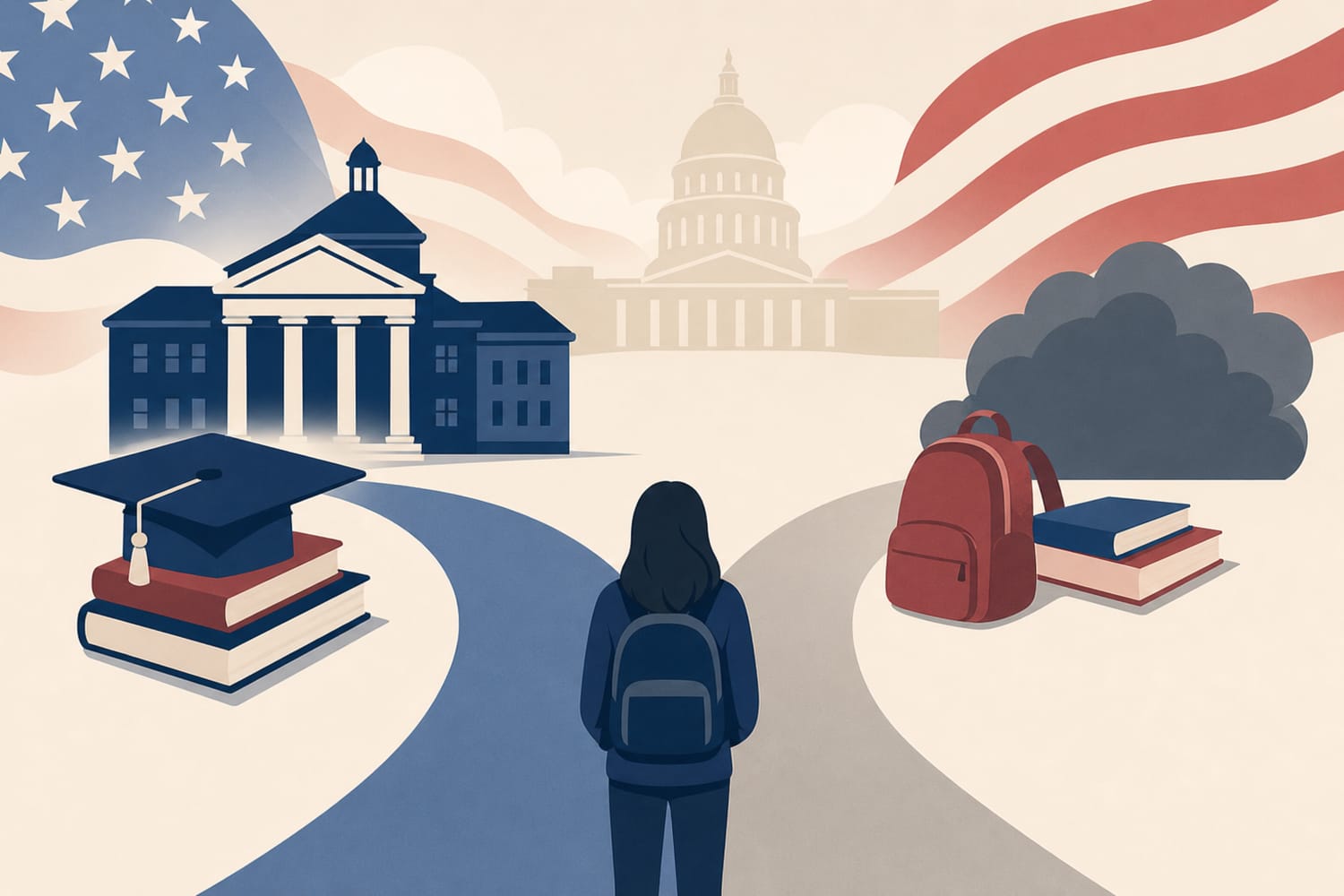
Dual enrollment allows high school students to take college-level courses and earn both secondary and postsecondary credit. Supporters see it as an affordable bridge to higher education, while critics worry that it introduces college pressure before students are academically or emotionally ready. The debate is not simply about whether dual enrollment works, but about whom it serves, how programs are designed, and what students sacrifice to participate.
The Case for an Academic Head Start
Supporters argue that dual enrollment gives motivated students access to greater academic challenge. A teenager who has exhausted a high school’s mathematics, science, language, or technical offerings may benefit from courses that would otherwise remain unavailable until graduation.
College classes can also introduce students to faster pacing, independent study, and more demanding assignments. Experiencing these expectations while still receiving support from high school counselors and family members may make the eventual transition to college less intimidating.
Research reviewed by the federal What Works Clearinghouse found positive effects in areas including college enrollment, credit accumulation, degree attainment, and high school completion. Supporters interpret such findings as evidence that early exposure can build both confidence and momentum.
The Financial Argument
The possibility of reducing college costs is among dual enrollment’s strongest attractions. When courses are free or heavily subsidized, students may complete general education requirements before paying full college tuition. Some graduate from high school with a semester or more of transferable credit.
For families concerned about higher education costs and student debt, that head start can appear highly practical. Fewer required college courses could mean lower tuition expenses, an earlier graduation date, or additional room to explore a second major.
Critics respond that the savings are not guaranteed. A college may accept a course as elective credit but refuse to apply it toward a student’s degree requirements. Private institutions and out-of-state universities may follow different transfer policies. Students can therefore accumulate credits without meaningfully shortening their degree programs.
Preparation or Premature Pressure?
Dual enrollment courses usually become part of a permanent college transcript. That distinction matters because a poor grade earned at 15 or 16 may have consequences beyond high school. Critics question whether teenagers fully understand those stakes when they register.
College-level work may require extensive reading, long research projects, strict deadlines, and less direct supervision. Students taking several advanced classes while participating in sports, clubs, employment, or family responsibilities can become overwhelmed. The opportunity to get ahead may gradually become an expectation to do more.
Supporters counter that challenge is not automatically harmful. Appropriate difficulty can teach time management, persistence, and self-advocacy. From this perspective, the problem is not dual enrollment itself but enrolling students without assessing their readiness or providing adequate support.
The Question of Student Choice
In theory, participation is voluntary. In practice, students may feel pressure from parents, counselors, classmates, or competitive admissions culture. When high-achieving peers accumulate college credits, declining the opportunity can feel like falling behind.
This concern connects dual enrollment to the wider debate over college admissions policies. Some families may treat college courses as another credential needed to create an impressive application, even when a student would prefer electives, creative activities, employment, or a less demanding schedule.
Advocates emphasize that dual enrollment can still expand choice. It may allow students to study subjects unavailable at their high school or explore possible careers before committing to a degree. The key disagreement is whether programs create genuine options or another competitive requirement.
Equity and Access
Dual enrollment is often promoted as a way to make college more accessible, particularly for students who might otherwise question whether they belong in higher education. Successfully completing a college course can make a degree feel attainable rather than distant.
However, access is uneven. Students may encounter tuition charges, textbook costs, transportation barriers, technology requirements, placement tests, or restrictive eligibility rules. Rural schools and underfunded districts may offer fewer courses than schools located near colleges. Students who work after school or care for relatives may also be unable to participate.
As New America’s discussion of dual enrollment notes, financial value depends partly on whether courses are affordable, transferable, and applicable to a degree. Critics argue that without thoughtful design, programs may primarily reward students who already possess academic advantages.
Concerns About Academic Quality
Another disagreement involves whether every dual enrollment course delivers an authentic college experience. Programs vary considerably. A course might be taught on a college campus by a professor, online through a community college, or inside a high school by an approved instructor.
Supporters say multiple formats make participation practical and allow qualified high school teachers to deliver rigorous material in a familiar environment. Critics worry that standards, grading, assignments, and classroom expectations may differ across locations.
This concern overlaps with the broader debate over grade inflation and academic standards. If a course is labeled “college level” without matching the rigor of its campus equivalent, students may receive credit without becoming better prepared. Conversely, excessively rigid standards could discourage capable teenagers who need time to adjust.
Social and Developmental Considerations
High school is not solely preparation for college. It is also a period of social development, identity formation, experimentation, and increasing independence. Critics worry that an intense focus on accumulating credits can turn adolescence into an extension of the college résumé.
Students attending courses on a college campus may also enter classrooms designed primarily for adults. While many adapt successfully, others may feel isolated or uncomfortable discussing mature material with older classmates.
Supporters argue that interacting with adults can encourage maturity and broaden a student’s perspective. They also note that dual enrollment does not have to replace the high school experience. A student taking one carefully selected course may gain exposure to college without abandoning friendships, activities, or age-appropriate opportunities.
Finding a Balanced Approach
The strongest middle-ground position treats dual enrollment as an option rather than a universal benchmark. Instead of asking whether every student should participate, families and schools can consider:
- Is the student genuinely interested in the course?
- Does the workload fit alongside existing responsibilities?
- Will the credit transfer and apply to likely degree pathways?
- What happens if the student struggles or withdraws?
- Are tutoring, advising, and mental health resources available?
- Is participation expanding the student’s education or merely strengthening a résumé?
Clear answers cannot eliminate every risk, but they can prevent students from enrolling based only on prestige or assumed savings.
A Program Defined by Its Design
Dual enrollment can provide meaningful academic preparation, financial savings, and confidence. It can also create stress, deepen inequities, and produce credits that offer less value than families expected. Both perspectives contain legitimate concerns because programs and students differ widely.
The debate ultimately depends on readiness, access, quality, advising, and choice. Dual enrollment is neither an automatic shortcut to success nor inherently too much pressure. Its value rests on whether it serves the student’s goals—and whether adults allow teenagers to decide that getting ahead is an opportunity, not an obligation.