
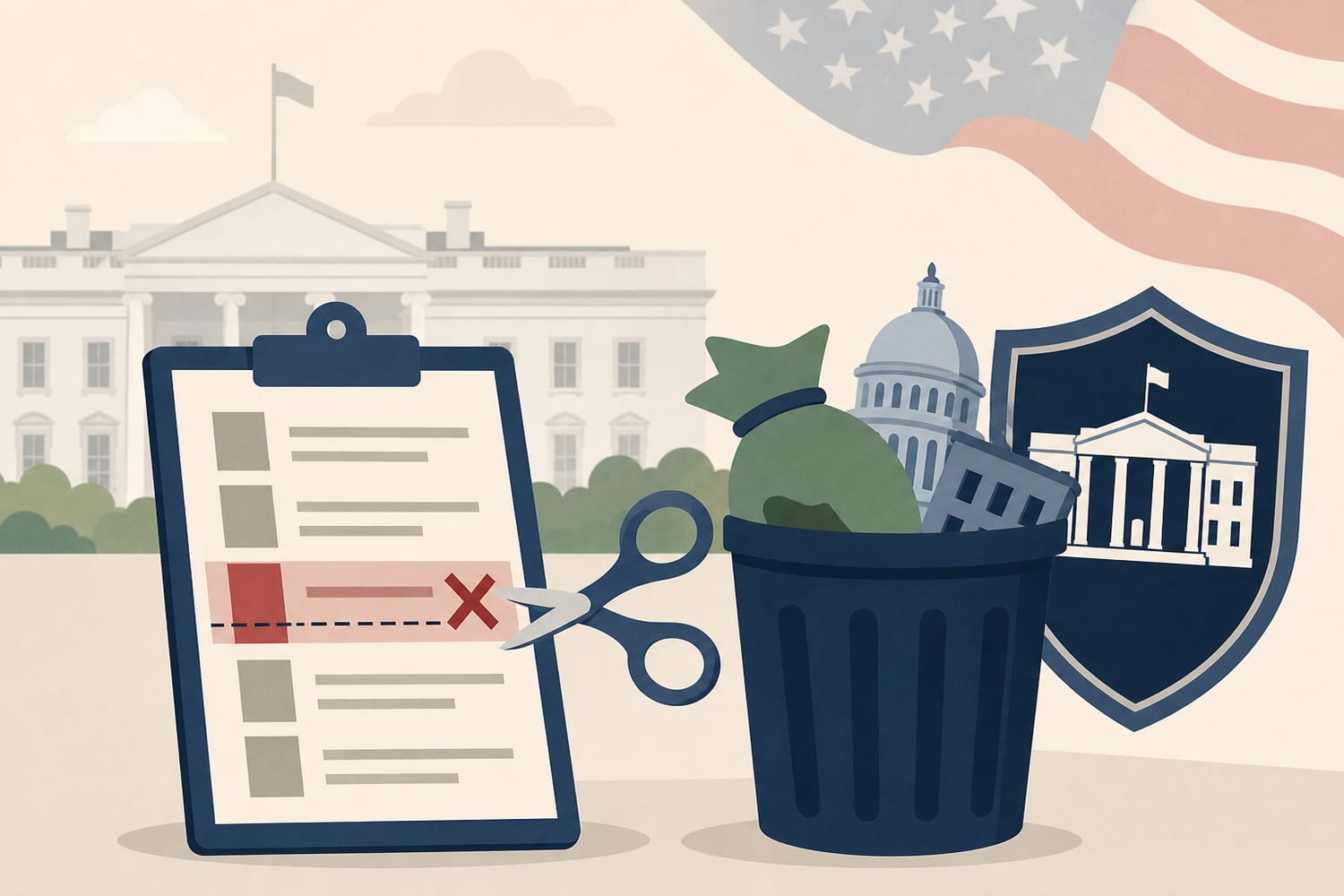
A presidential line-item veto would allow the president to reject particular spending provisions while approving the rest of a bill. Supporters see it as a practical weapon against wasteful spending and political favors. Opponents see it as a transfer of Congress’s constitutional power of the purse to an already powerful executive branch.
The disagreement is therefore about more than balancing the federal budget. It raises fundamental questions about accountability, bargaining, separation of powers, and who should decide whether a federal expenditure serves the public interest.
How a Line-Item Veto Would Work
Under the existing constitutional process, the president generally must sign or veto an entire bill. This can create an uncomfortable choice when legislation combines essential funding with provisions the president considers unnecessary or irresponsible.
A line-item veto would offer a third option: approve the broader legislation while eliminating selected appropriations, direct-spending provisions, or tax benefits. The exact scope would depend on how the authority was designed. Some proposals would cover only clearly defined appropriations, while others might extend to targeted tax breaks and mandatory spending.
Congress attempted to create such authority through the Line Item Veto Act of 1996. President Bill Clinton used it to cancel certain provisions, but the Supreme Court struck down the law in Clinton v. City of New York in 1998. The Court concluded that the cancellations effectively allowed the president to amend laws after they had passed Congress, violating the Constitution’s requirements for enacting legislation. The Constitution Annotated explanation of the line-item veto provides additional background.
Consequently, establishing a true federal line-item veto would most likely require a constitutional amendment rather than an ordinary act of Congress.
The Argument for Cutting Waste
Supporters argue that large spending bills make it difficult to challenge questionable projects individually. A president may oppose a narrow subsidy, local project, or tax benefit but accept it because rejecting the entire bill would shut down programs, delay salaries, or interrupt essential services.
Line-item authority could change that calculation. Advocates believe its primary benefits would include:
- Removing narrowly targeted expenditures without blocking necessary funding
- Discouraging lawmakers from adding unrelated projects to major bills
- Drawing public attention to individual spending decisions
- Giving the president greater leverage to demand fiscal discipline
- Making it harder to protect provisions that could not pass independently
From this perspective, the power would not replace Congress’s budgetary role. Congress would still write and pass spending legislation, while the president would exercise a more precise version of the veto power already available.
Fiscal conservatives often emphasize that even modest savings can establish better habits. They argue that the ability to challenge individual items could weaken the culture of trading votes for projects and benefits. Concerns about targeted subsidies also appear in the broader debate over whether government assistance to corporations represents sound investment or corporate welfare.
Would It Produce Meaningful Savings?
Skeptics question whether a line-item veto would significantly improve the federal government’s finances. Many expensive federal commitments are established through entitlement laws, tax policy, defense programs, and other long-term obligations. Eliminating a collection of smaller appropriations might attract attention without substantially changing deficits or debt.
A Government Accountability Office review of potential line-item veto savings examined the difficulty of estimating how much such authority could actually save. The impact would depend on which expenditures qualified, how aggressively presidents used the power, and whether Congress responded by changing the structure of legislation.
Critics also distinguish controversial spending from genuine waste. A program benefiting one region may look unnecessary to people elsewhere, but its supporters may view it as an important infrastructure, research, economic development, or public safety investment. A presidential cancellation would not automatically prove that an item lacked value.
The federal government can also pursue savings through audits, program evaluation, procurement reform, and the elimination of overlapping activities. GAO’s duplication and cost-savings work demonstrates that both Congress and executive agencies already have opportunities to improve efficiency without creating a new veto power.
The Risk of Expanding Executive Power
The strongest objection concerns the constitutional balance between Congress and the president. The Constitution gives Congress authority over federal taxation and spending. Opponents argue that allowing the president to rewrite spending bills after passage would weaken that legislative responsibility.
A line-item veto could also become a bargaining weapon. Presidents might threaten to cancel projects important to particular lawmakers unless those lawmakers supported unrelated administration priorities. Even if the authority were presented as a tool for neutral budget cutting, its use could be influenced by party, geography, ideology, or political loyalty.
For critics, the central danger is selective control. The president would not merely recommend reductions but could determine which communities, industries, and programs lose funding. This concern resembles other disputes over presidential authority, including the debate over executive and congressional war powers.
Opponents also warn that the power could reduce accountability in Congress. Legislators might vote for irresponsible packages while assuming the president would remove the most unpopular provisions. Instead of improving lawmaking, a line-item veto could encourage Congress to surrender difficult choices to the executive branch.
Could Safeguards Limit Abuse?
Some proposals seek a compromise between a true line-item veto and the current all-or-nothing system. One option is expedited rescission, under which the president identifies proposed cancellations but Congress must approve them through a prompt vote.
Other possible safeguards include:
- Limiting cancellations to specifically defined appropriations
- Excluding entitlement benefits and broad tax provisions
- Requiring written explanations and estimated savings
- Prohibiting cancellations based on political conditions
- Allowing Congress to reverse a cancellation through an expedited process
- Requiring all savings to reduce the deficit rather than finance other programs
- Creating judicial review for disputed uses of the authority
Supporters of these restrictions argue that they could preserve congressional control while forcing lawmakers to vote openly on proposed cuts. Critics respond that even a limited system could gradually expand or give presidents disproportionate influence over legislative negotiations.
The Question of Political Incentives
The effectiveness of any line-item veto would depend on the person exercising it. A fiscally cautious president might use the power to eliminate low-priority spending. Another might preserve favored programs while cutting those associated with political opponents.
Congress would adapt as well. Lawmakers could draft broader spending categories, combine provisions in ways that make individual cancellation difficult, or negotiate informally with the White House before passing bills. Political actors rarely respond passively when institutional rules change.
That means the debate cannot be resolved simply by asking whether waste exists. The more difficult question is whether presidents would identify waste more objectively than Congress—or merely bring a different set of political incentives to the decision.
Weighing Efficiency Against Constitutional Restraint
The case for a line-item veto rests on precision, accountability, and fiscal control. It promises to let presidents remove questionable provisions without endangering entire spending packages. For voters frustrated by enormous bills and opaque negotiations, that appeal is understandable.
The case against it rests on the separation of powers and the possibility of political coercion. Giving one person authority to cancel selected parts of enacted legislation could make government more efficient, but it could also weaken Congress and increase presidential influence over national and local priorities.
Ultimately, the debate turns on which risk appears greater: allowing wasteful provisions to survive because legislation must be accepted as a whole, or giving the executive branch a power that could be used far beyond the pursuit of budget savings.