
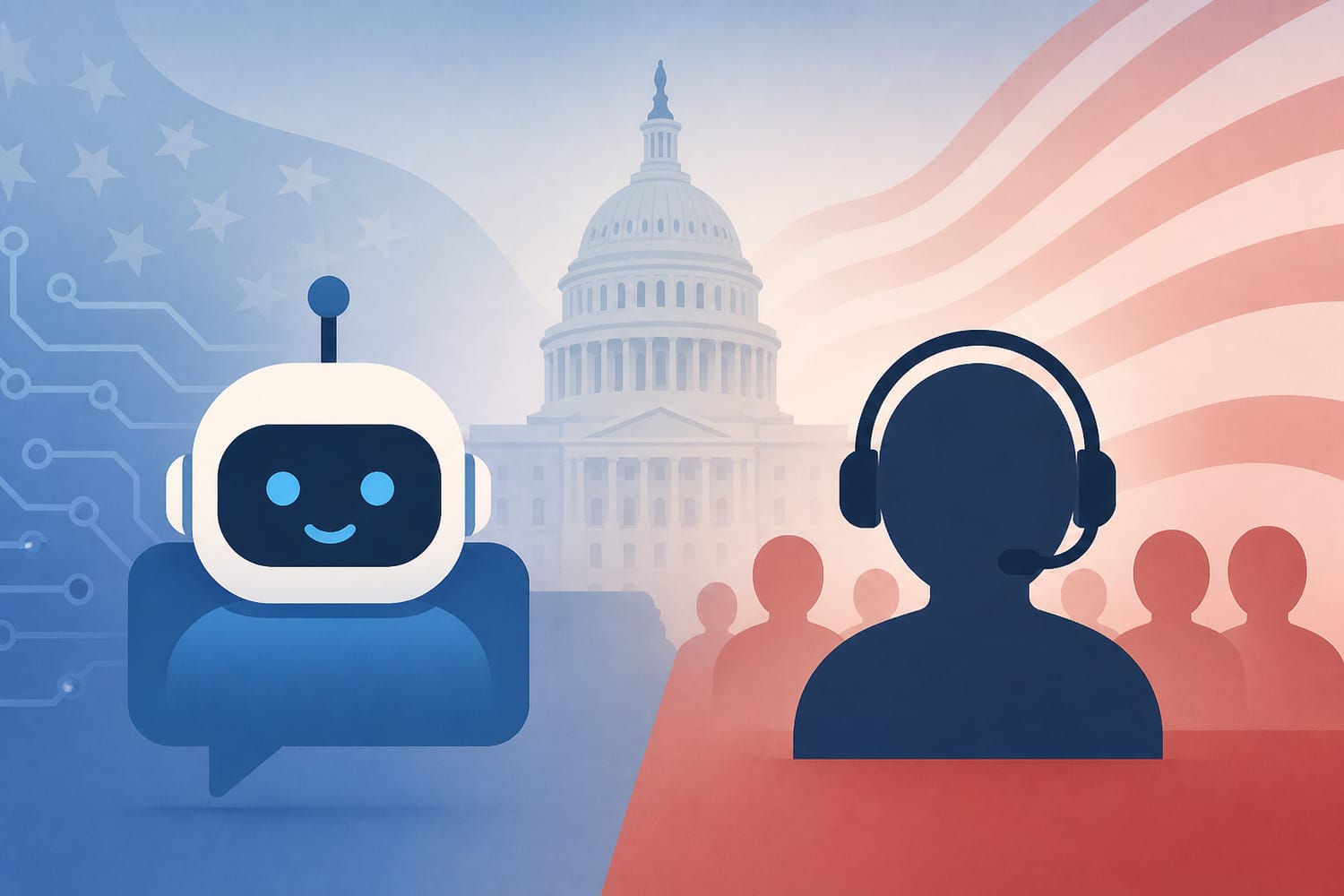
AI customer service promises an appealing exchange: less waiting, faster answers, and support available at any hour. For routine questions, that convenience can be valuable. Yet critics fear that businesses will use automation not to improve service, but to make human assistance harder to reach. The debate is ultimately about efficiency, trust, employment, and what customers deserve when something goes wrong.
Artificial intelligence already appears in chatbots, automated phone systems, email tools, and software that assists call-center employees. Newer systems can interpret conversational language, retrieve account details, summarize complaints, recommend solutions, and sometimes perform actions such as processing returns.
Supporters see this development as a long-overdue modernization of an often frustrating service model. Skeptics see the possible beginning of a world in which customers become trapped between confident software and understaffed human teams.
The Case for Instant Convenience
The strongest argument for AI customer service is speed. A person checking an order status, resetting a password, or asking about store hours may not need a lengthy conversation with an employee. An automated assistant can potentially provide the answer in seconds.
AI systems can also operate continuously. Customers working irregular schedules do not have to wait for business hours, while international companies can serve multiple time zones without maintaining equally large overnight teams. For people who prefer text communication or feel uncomfortable making phone calls, an effective chatbot may be more accessible than a traditional call center.
Proponents commonly highlight several potential benefits:
- Immediate responses to common questions
- Shorter queues for customers who need human agents
- More consistent explanations of standard policies
- Support across multiple languages
- Lower operating costs for businesses
- Faster analysis of previous conversations and account records
Automation may be particularly useful during sudden surges in demand. A delayed flight, service outage, product recall, or holiday shopping rush can generate more inquiries than a human team can answer promptly. AI can handle basic requests while employees concentrate on unusual or urgent cases.
Advocates also note that dissatisfaction with customer service existed long before generative AI. Long hold times, repeated transfers, inconsistent answers, and limited hours are human-centered problems too. From this perspective, preserving the old model simply because it involves people does not guarantee better support.
Why Some Customers Still Want a Person
Opponents argue that customer service is not merely an information-delivery system. It often involves interpretation, negotiation, reassurance, and empathy. A customer disputing a large charge or explaining a sensitive personal situation may need someone capable of understanding context beyond a company’s standard rules.
AI can produce language that sounds sympathetic, but critics distinguish simulated empathy from genuine human judgment. A chatbot may apologize politely while continuing to repeat an irrelevant response. This can make a customer feel that the company is performing concern without accepting responsibility.
Problems become more serious when automated systems misunderstand the request. The Consumer Financial Protection Bureau’s examination of financial chatbots warns that these tools may provide inaccurate information, fail to recognize when consumers are asserting legal rights, or limit access to individualized assistance. Although finance presents especially high stakes, similar concerns can arise in insurance, healthcare, utilities, travel, and telecommunications.
Critics therefore object less to AI’s presence than to its use as a gatekeeper. A chatbot that handles simple questions may be welcome. One that repeatedly refuses to transfer a complicated case can transform convenience into obstruction.
The Business Perspective
For businesses, AI customer service presents both financial opportunities and reputational risks. Automation can reduce the cost of handling repetitive requests, help organizations serve more customers, and give employees quicker access to relevant information.
AI may also support rather than replace workers. It can summarize a customer’s history, draft responses, translate messages, identify the likely subject of a complaint, or recommend the next step. This approach leaves the final decision with a person while reducing administrative work.
The broader discussion around AI agents and human control is especially relevant because customer-service systems are beginning to move beyond answering questions. An AI agent might eventually change a reservation, issue a refund, cancel a subscription, or negotiate a replacement without waiting for employee approval.
That expanded authority could make support dramatically faster. It also increases the consequences of errors. Businesses must decide which actions AI may take independently, which require human review, and who is accountable when an automated decision causes harm.
Organizations also risk confusing speed with success. A quick response is not valuable if it fails to resolve the problem. Metrics such as response time and percentage of automated conversations can look impressive while customers remain dissatisfied. Resolution, fairness, repeat contacts, complaints, and successful transfers may provide a more complete picture.
Jobs, Skills, and the Future of Support Work
Employment is another major dividing line. Customer service employs people with a wide range of educational backgrounds and often provides an entry point into larger organizations. Workers and labor advocates worry that companies will adopt AI primarily to reduce staffing rather than improve service.
The debate resembles the larger question of whether artificial intelligence will create or destroy jobs. Optimists expect roles to change rather than disappear completely. Employees may handle complex disputes, supervise automated systems, review questionable decisions, improve knowledge bases, and work with customers who need specialized help.
Pessimists argue that even if new positions appear, they may not replace lost jobs in equal numbers or locations. Remaining employees could also face heavier workloads because every routine case is removed, leaving them to manage a continuous stream of difficult and emotionally demanding interactions.
Recent industry research suggests that complete replacement may be less straightforward than some early predictions implied. Gartner reported in 2025 that most surveyed customer-service leaders planned to retain human agents and that many organizations were reconsidering aggressive workforce-reduction goals.
Privacy, Bias, and Accountability
AI support often becomes more useful when it can access personal data, including purchase histories, addresses, financial records, recorded calls, and previous complaints. That access creates tension between personalization and privacy.
Supporters argue that data can prevent customers from repeating information and help systems produce relevant answers. Critics question how conversations are stored, whether they are used to train models, which vendors can access them, and how securely sensitive details are protected.
These concerns connect with the wider debate over consumer data privacy and business needs. Customers may appreciate personalized service while still wanting meaningful control over how their information is collected and shared.
Bias presents another challenge. If an AI system is trained on flawed records or designed around incomplete assumptions, its errors may affect certain languages, accents, disabilities, or customer groups more than others. Clear appeal procedures and human review become especially important when automated support influences access to money, essential services, or contractual rights.
A Hybrid Model as the Middle Position
Between fully automated service and an exclusively human workforce lies a hybrid model. Under this approach, AI handles routine requests and assists employees, while people remain available for complex, sensitive, disputed, or high-risk cases.
A balanced system would normally include:
- Clear disclosure when a customer is interacting with AI
- An obvious route to human assistance
- Transfer of the full conversation so customers do not repeat themselves
- Human approval for consequential decisions
- Regular testing for accuracy, privacy, and unequal outcomes
- Performance measures focused on resolution rather than automation alone
This position does not satisfy everyone. Some advocates believe requiring frequent human involvement limits AI’s cost and speed advantages. Some critics believe businesses will gradually weaken human access even if they initially promise a hybrid approach.
What the Debate Ultimately Comes Down To
AI customer service is neither inherently convenient nor inherently dehumanizing. Its value depends on how it is deployed, what authority it receives, and whether customers retain meaningful alternatives.
For simple tasks, many people may gladly choose an instant automated answer. For consequential problems, the ability to reach a knowledgeable person can determine whether a customer feels supported or abandoned. The central question is therefore not whether AI belongs in customer service, but whether companies will use it to remove unnecessary friction—or to place another barrier between themselves and the people they serve.